
Quick answer: On almost every commercial water and sewer account, the fixed monthly charge is set by the size of your meter, not by how much water you use. If your meter is larger than your building actually needs, you pay that higher fixed charge every month whether the water runs or not, and the oversized meter also tends to under-register low flows. Right-sizing the meter can cut the fixed charge sharply. It will not, however, correct the separate over-registration that happens during demand surges, which is what a Flow Conditioning Device addresses.
Most commercial water managers watch the usage line on the bill. The fixed charge sits above it, looks like a flat administrative fee, and gets ignored. On an oversized account that is a mistake. The fixed charge is one of the few line items you can lower without changing a drop of consumption, and for a building carrying a meter two or three sizes larger than its real demand, the difference runs to thousands of dollars a year.
To compare meter sizes side by side, with and without the FCD, see Meter Size & Your Water Bill.
The fixed charge is priced by meter size
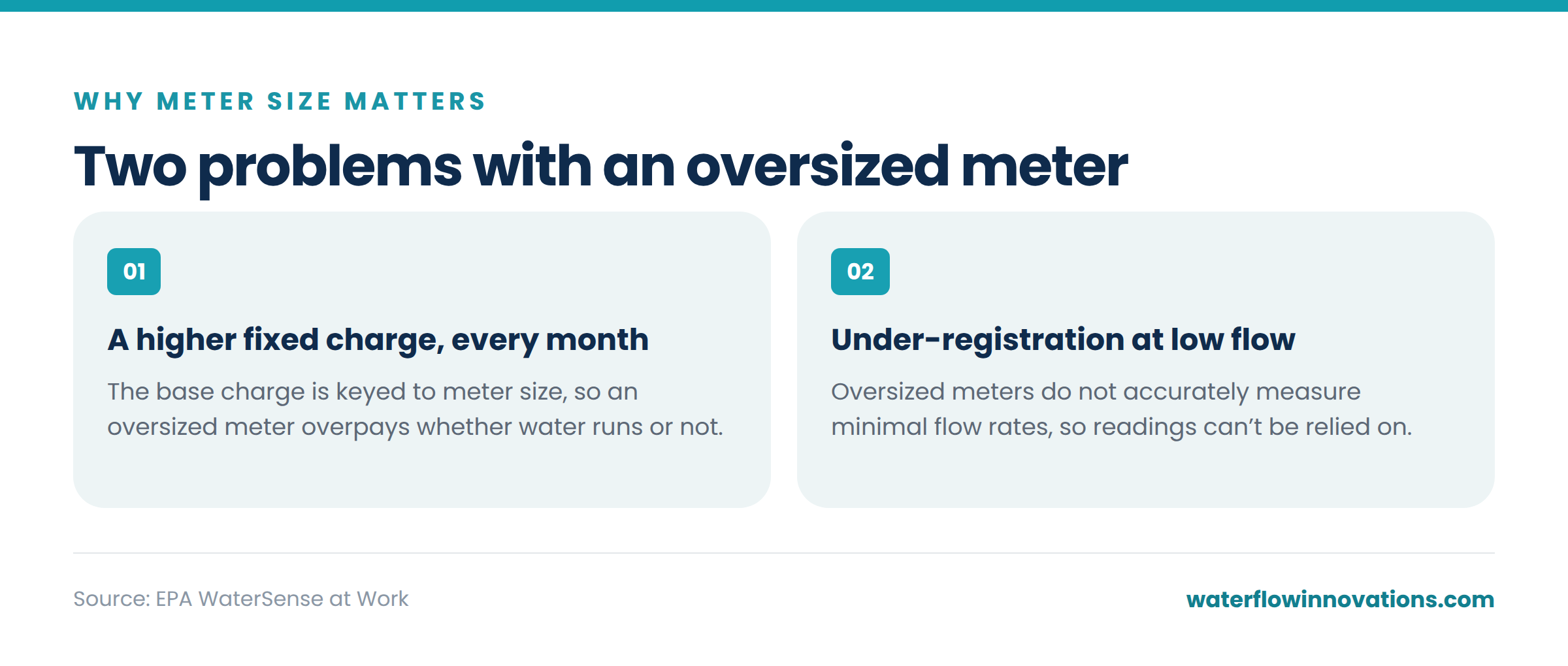
Utilities set the base, or fixed, charge on a schedule tied to meter diameter. The logic is capacity. A larger meter can pass more water, so the utility reserves more system capacity for that connection and charges more to hold it, every billing period, independent of use. The Metropolitan Sewer District of Greater Cincinnati states the rule plainly: its minimum base charge is “set by water meter size” and applies to all residential, commercial, and industrial customers alike (MSD Greater Cincinnati).
Because the charge is fixed, nothing you do operationally touches it. You can run an aggressive conservation program, cut consumption by a third, and the base charge does not move. The only lever is the meter size itself.
How big the gap gets
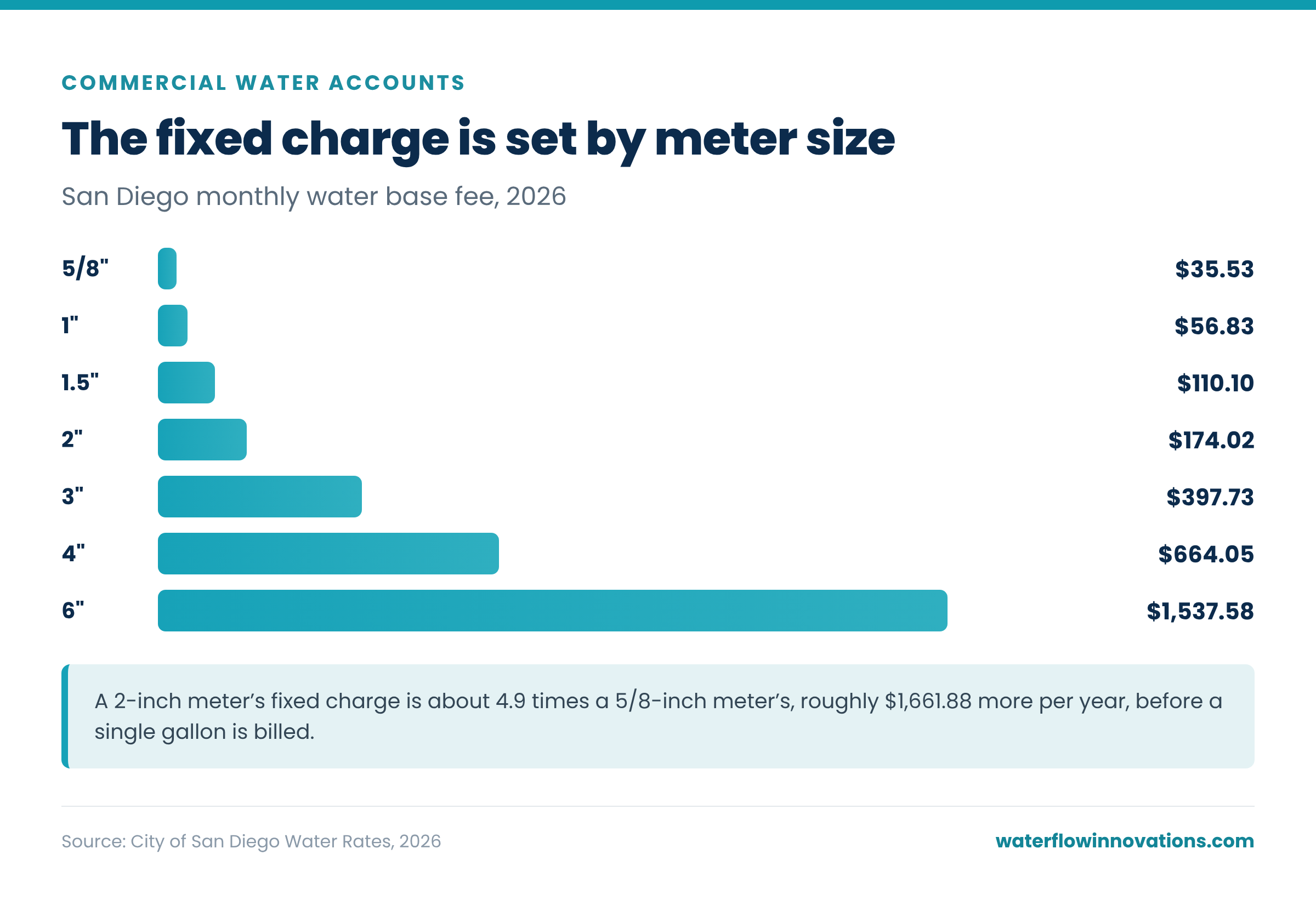
The gap between one meter size and the next is not small. San Diego’s water rates, effective January 2026, show the ladder clearly (City of San Diego):
- 5/8 inch: $35.53 per month
- 1 inch: $56.83 per month
- 1.5 inch: $110.10 per month
- 2 inch: $174.02 per month
- 3 inch: $397.73 per month
- 4 inch: $664.05 per month
- 6 inch: $1,537.58 per month
A 2 inch meter carries a fixed charge about 4.9 times that of a 5/8 inch meter. The difference is $138.49 every month, or $1,661.88 a year, before a single gallon is billed. Step from a 3 inch to a 2 inch and you save roughly $2,680 a year on the water base charge alone. Many utilities apply a parallel fixed charge on the sewer side, also keyed to meter size, so the real annual figure on a right-sized account is often higher than the water schedule shows on its own.
Why so many commercial meters are oversized
Oversizing is common, and it usually traces back to the day the service was designed. Engineers size the service line and meter for a theoretical peak that assumes many fixtures running at once. Real buildings rarely hit that peak, and when they do it lasts seconds. A conservative design, a later change of use that lowered demand, or a plumber who rounded up “to be safe” all leave the same result: a meter rated for far more flow than the building moves on an average day.
The EPA’s WaterSense at Work guidance is direct about the cost of that habit. It advises facilities that it is “important to ensure that a facility’s water meter is not oversized,” and warns that “oversized meters are not economical and do not accurately measure minimal flow rates” (EPA WaterSense at Work).
The second cost: an oversized meter misses low flow
The fixed charge is the obvious penalty. The quieter one is accuracy. A meter is built to register accurately across a defined flow range. Run water through it well below that range and it can spin too slowly to catch everything, so low flows get under-counted. For a utility that is lost revenue. For you it sounds like a gift, but it is a sign the meter is wrong for the building, and it makes your own submetering and internal tracking unreliable.
Meter type drives this. Positive displacement meters stay accurate at low flow and suit small commercial and institutional services. Velocity meters, such as turbine and propeller designs, lose accuracy at low flow and are usually not recommended for commercial buildings on their own. Compound meters pair a low-flow chamber with a high-flow chamber and fit large, variable facilities (EPA WaterSense at Work). An oversized velocity meter on a low-demand building is close to a worst case: you pay the top fixed charge and still do not get a clean reading.
How to tell if your meter is oversized, and right-size it
You do not need to guess. The approach WaterSense and AWWA recommend is to evaluate the building against its real flow, then match the meter to it.
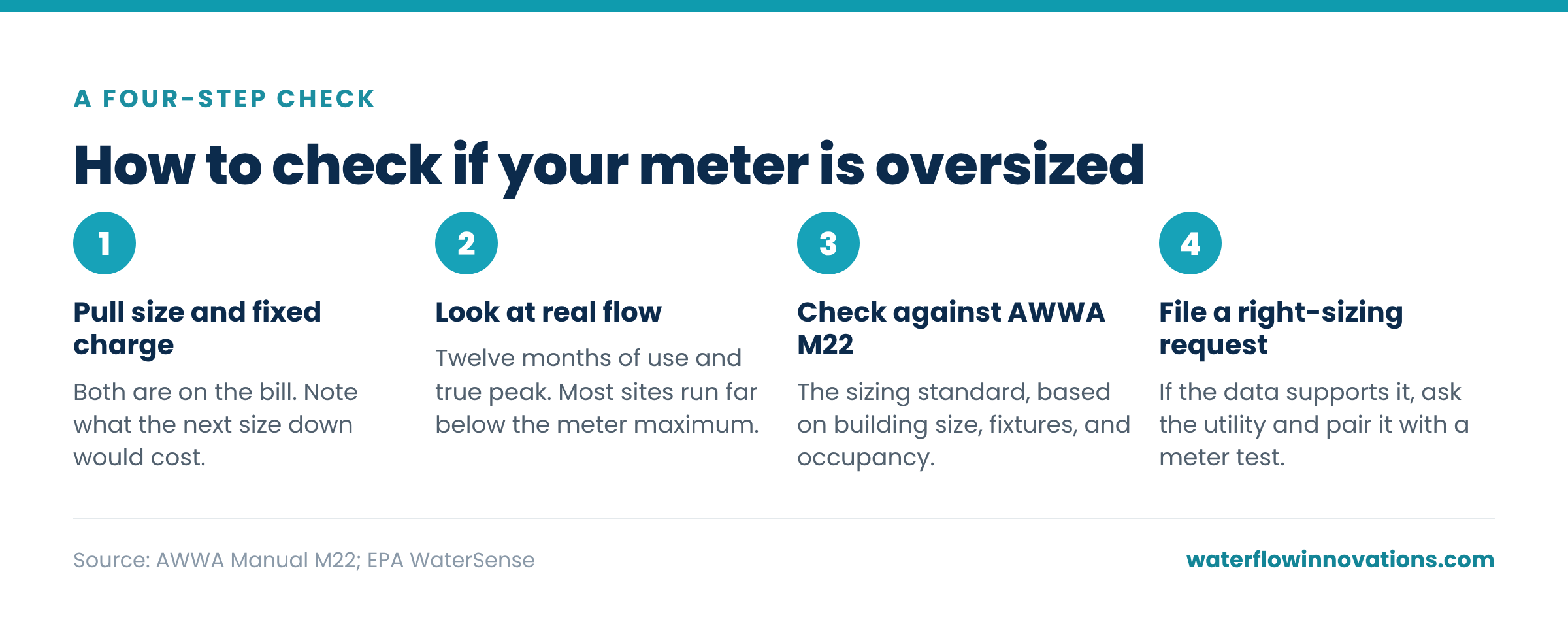
- Pull your meter size and fixed charge. Both are on the bill or the account record. Note what the next size down would cost on your utility’s schedule.
- Look at your actual flow profile. Review twelve months of consumption and the peak demand your building truly reaches. Most commercial sites run far below the meter’s rated maximum almost all the time.
- Check it against a sizing standard. AWWA Manual M22, Sizing Water Service Lines and Meters, is the reference utilities use. It sets meter size from building size and function, fixture types, typical occupancy, and peak population (AWWA M22, via EPA).
- Ask the utility for a meter evaluation or downsize. If the data supports a smaller meter, most utilities will review a right-sizing request. Pair it with a current meter test, since meters also drift with age. Many utilities follow AWWA guidance (Manual M6) that tests smaller meters less often and larger meters more often, with meters 4 inches and up commonly tested every year. If the meter also serves a fire sprinkler system, the smaller size must still meet fire flow requirements; utilities typically require a licensed professional to confirm it.
Right-sizing is a billing and engineering exercise, not a quick swap, and the utility owns the meter, so the request goes to them. The payoff is a permanently lower fixed charge and a meter that reads your building accurately.
Over-registration is a separate problem, and right-sizing does not fix it
Here is the distinction that matters, because it decides what actually lowers your bill. Right-sizing corrects two things: the fixed charge keyed to meter size, and the under-counting of low flow. It does not touch over-registration during demand surges.
Over-registration is a different mechanism. During demand surges water speeds up through the meter, pressure inside it drops, dissolved gas comes out of solution and vapor forms, and the meter counts that volume as water. Because the sewer charge is calculated from the same meter reading, the over-recorded volume is billed twice, once as water and once as sewer. This happens on a correctly sized, accurate, recently tested meter. The meter is not faulty. It is reporting what physically passed through it at that velocity.
A Flow Conditioning Device installs immediately after the meter and creates a small, controlled back-pressure that extends back through the meter, holding pressure up during demand surges so far less gas and vapor form and are counted as water. It corrects the reading. It does not reduce your actual water use, and the pressure loss across it is under 0.8 psi. See how the FCD works and water meter over-registration for the full mechanism.
So the two fixes stack. Right-size the meter to cut the fixed charge and clean up low-flow accuracy. Add the FCD to correct the over-registration that a right-sized meter still reports during surges. Neither one substitutes for the other.
There is one more reason to pair them. A smaller meter moves the same peak demand through a smaller opening, so water travels faster during surges and over-registration tends to rise. Right-sizing lowers the fixed charge; the FCD keeps the faster flow from being over-counted. Model both together on Meter Size & Your Water Bill.
What to do next
Start with the bill you already have. Find the meter size and the fixed charge, price the next size down on your utility’s schedule, and compare it against twelve months of real demand. If the meter looks oversized, open a right-sizing request with the utility. If you want the demand-surge over-registration checked at the same time, send us your bills and we will model it.
Get My Quote or call 1-(844)-934-8258. Water Flow Innovations LLC, 2651 Route 412, Coopersburg, PA 18036.
Frequently asked questions
Does a smaller meter lower both my water and sewer fixed charges?
Often, yes. Many utilities set a fixed or base charge on both the water and the sewer side, and both are commonly keyed to meter size. Check each line on your bill. Cincinnati’s sewer base charge, for example, is set by meter size and applied to commercial and industrial accounts.
Will right-sizing reduce my water usage or just the fixed charge?
It reduces the fixed charge and improves low-flow accuracy. It does not change how much water your building uses. Over-registration during demand surges is a separate issue that a Flow Conditioning Device corrects.
How do I know my meter is oversized without an engineer?
Compare your meter’s rated flow to twelve months of actual demand. If your building almost never approaches the meter’s maximum, it is a strong sign the meter is larger than it needs to be. AWWA Manual M22 is the standard a utility will use to confirm it.
Can the utility refuse to downsize my meter?
The utility owns the meter and makes the final call, usually after reviewing your flow history and fire or backflow requirements. A request backed by twelve months of consumption data and an M22 sizing is far more likely to be approved.
My oversized meter under-reads, so is it saving me money?
Not in a way you can rely on. Under-registration means your readings are inaccurate, which undermines internal tracking and submetering, and the utility can correct or replace the meter at any time. You are also still paying the higher fixed charge every month.
Sources
- City of San Diego, Water Billing Rates, effective January 2026: https://www.sandiego.gov/public-utilities/customer-support/water-billing-rates
- EPA, WaterSense at Work, Metering and Submetering: https://www.epa.gov/system/files/documents/2023-11/ws-commercial-bmp-watersenseatwork_section2.1_meteringandsubmetering.pdf
- Metropolitan Sewer District of Greater Cincinnati, Your Sewer Bill: https://msdgc.org/customers/residential-customers/your-sewer-bill/
0 Comments