

For commercial real estate owners, operating expenses aren’t just a cost line. They’re a valuation lever. Every dollar removed from annual operating expenses increases net operating income (NOI), and NOI is what an appraiser or buyer capitalizes into value. Water and sewer costs are an overlooked place to find those dollars. (For the full picture, see NOI & Property Value.)
The basic math
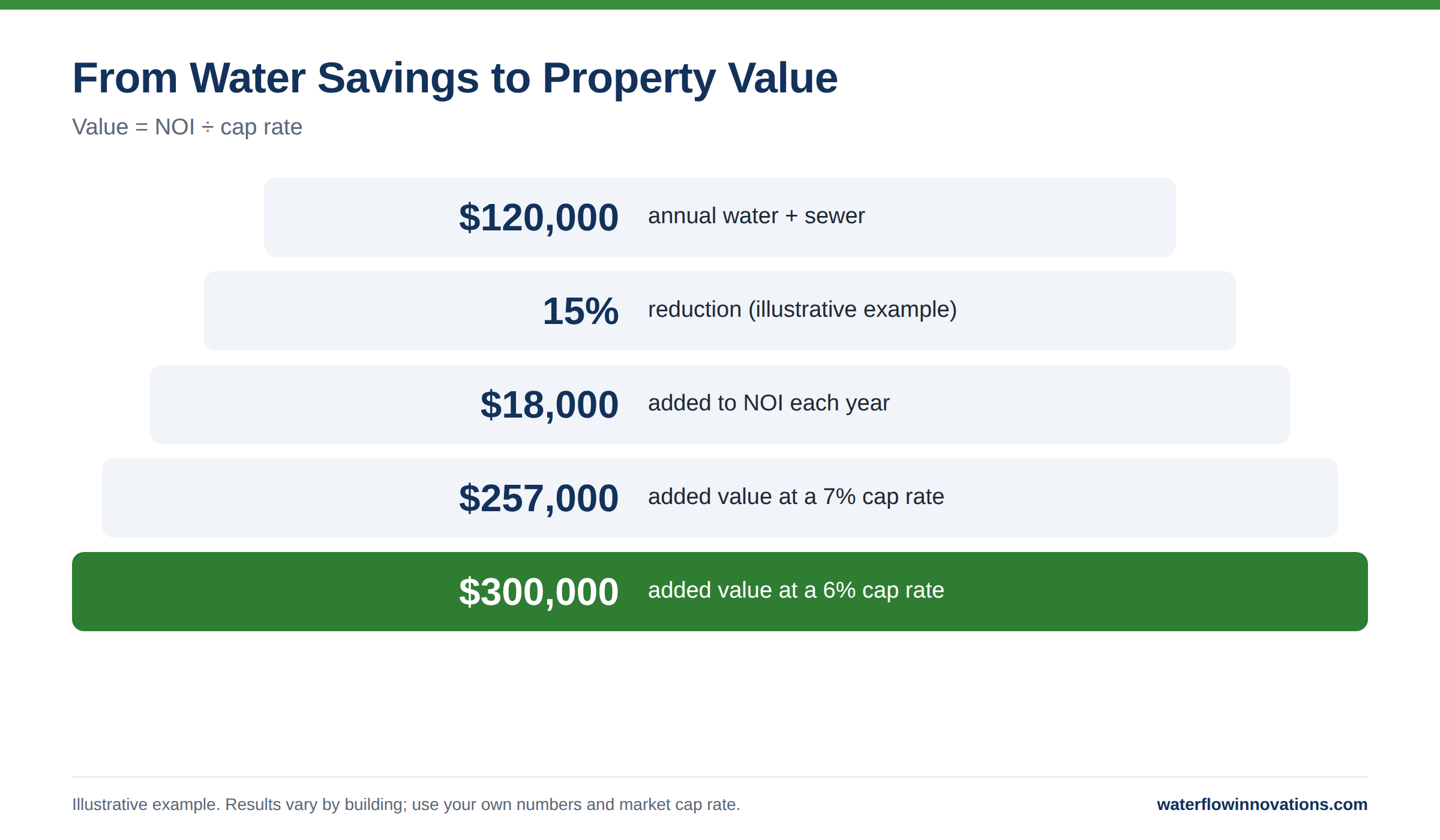
Income-producing property is commonly valued by dividing NOI by a capitalization (cap) rate:
Value = NOI ÷ Cap Rate
So a recurring reduction in operating expenses has a multiplied effect on value. Here’s a simple, hypothetical example.
A multifamily property spends $120,000 a year on water and sewer. Suppose an FCD reduces that by 15%, an illustrative figure; documented installations typically show up to a 30% reduction, and results vary by building. That saves $18,000 a year.
- At a 6% cap rate: $18,000 ÷ 0.06 = $300,000 in added value.
- At a 7% cap rate: $18,000 ÷ 0.07 = about $257,000 in added value.
Your numbers will differ, and actual savings depend on the property. But the principle holds: a modest, recurring expense reduction can translate into a meaningful change in value.
Why water is often the easiest expense to move
Most operating expenses are hard to cut without affecting tenants or service: staffing, insurance, taxes, maintenance. Water and sewer can be different, because part of the cost often isn’t usage at all.
During demand surges, such as morning shower peaks, booster pump cycling, laundry, and irrigation, water moves through the master meter at high velocity and pressure inside the meter drops. Dissolved gas comes out of solution and vapor forms, and the meter counts that volume as water. Since sewer is usually calculated from metered water, the over-read is billed twice. (See Water Meter Over-Registration.)
A Flow Conditioning Device (FCD) installs immediately after the meter and creates a small, controlled back-pressure that extends back through it, holding pressure up during surges so far less gas and vapor form and are counted as water. Tenants notice nothing: pressure loss is under 0.8 psi across all flow conditions, and installation takes about an hour.
Documenting it for a buyer or lender
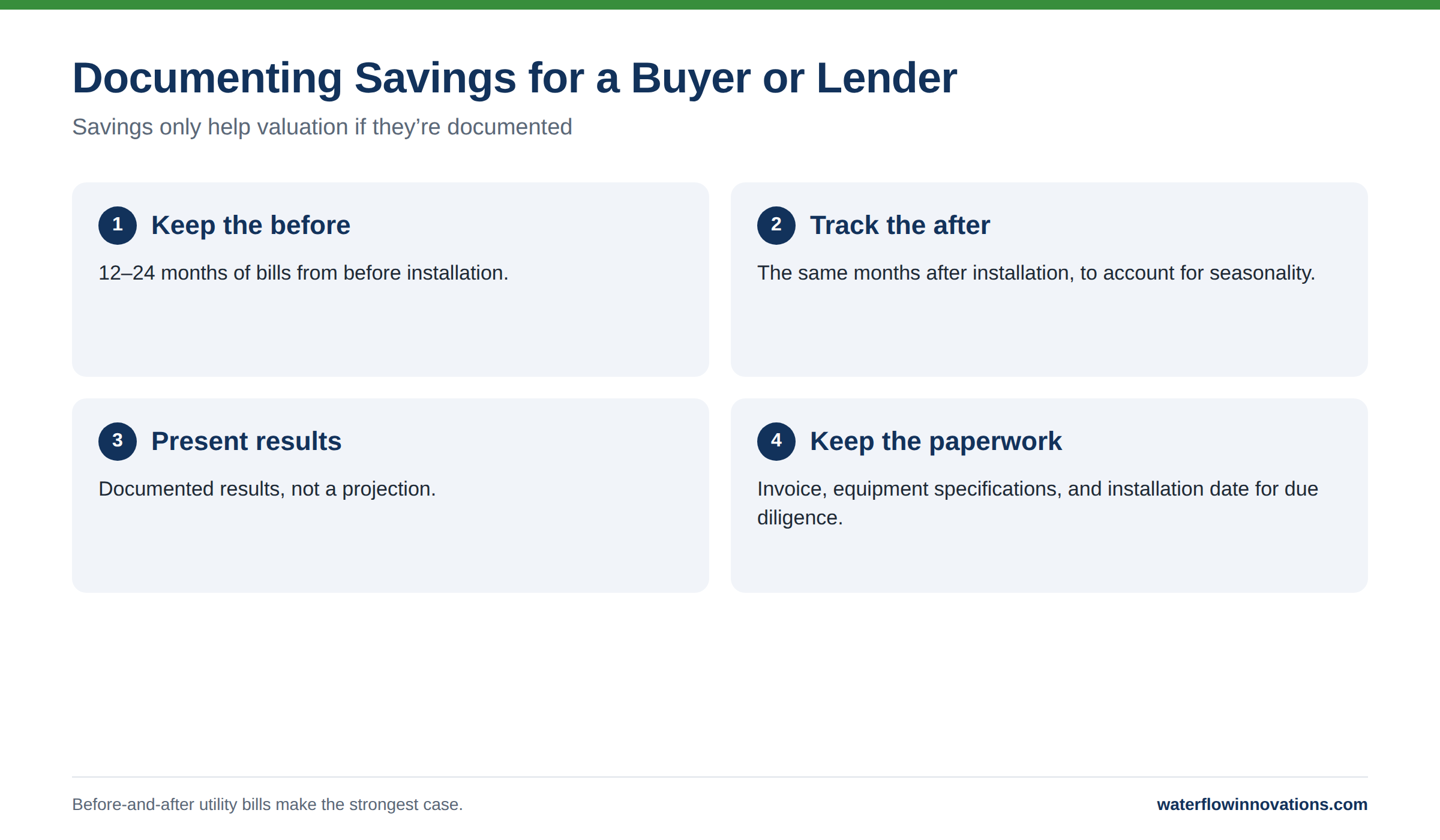
Savings only help valuation if they’re documented. Before-and-after utility bills give you a clean record of the change, and that record can be presented in due diligence or to a lender. (If a sale is ahead, see Selling Your Property? Consider an FCD First; for financing, the Refinance & DSCR Impact Calculator.)
A few practical tips:
- Keep 12–24 months of bills from before installation.
- Track the same months after installation to account for seasonality.
- Present the savings as documented results, not a projection.
- Keep the invoice, equipment specifications, and installation date with the bills.
Frequently Asked Questions
Q: Will a buyer give full credit for the savings?
A: That depends on the buyer, the market, and how well the savings are documented. Clean before-and-after bills make the case much stronger.
Q: Does this work for portfolios?
A: Yes. Each building with its own meter is a separate installation, and savings can be totaled across the portfolio with the Portfolio Savings Calculator.
Q: Is the cap rate in the example a recommendation?
A: No. It’s illustrative. Use the cap rate that applies to your property and market.
To model this for your own property, try the free NOI & Property Value Calculator, or start with the Water & Sewer Savings Calculator.
0 Comments