
Quick answer: When a utility cannot get an actual reading from your meter, it estimates the bill, usually from prior usage. On a commercial account those estimates can run high, and you keep paying them until an actual read trues up the account. You are entitled to a correction, and if the estimate was too high you are owed the difference back. Getting onto actual reads is the fix for estimation. It does not, however, address over-registration, which inflates the actual read itself during demand surges.
An estimated bill looks exactly like a normal one. Same layout, same due date, a number that is close enough to last month that nothing jumps out. That is the problem. Estimation is not an error the utility hides, it is a routine billing practice, and on a commercial account it can quietly carry an overcharge for months before anyone reconciles it.
What an estimated read is, and why utilities use them
A utility bills most accurately when a person or an automated transmitter captures the real number on your meter. When that fails, the utility bills an estimate instead so your statement still goes out on schedule. WSSC Water frames the trade-off directly: its “aim is to bill customers in the most accurate way possible using actual meter reads,” but “as a result of not being able to obtain actual reads, many customers will receive an estimated bill” (WSSC Water).
The reasons are ordinary. Virginia Beach cites its reading schedule, noting that “inclement weather or staffing impacts can cause disruptions to our contractor’s meter reading schedule,” and estimates “to provide timely monthly billing statements and avoid longer billing periods” (Virginia Beach Public Utilities). Newton points to meter transmitters that stop sending data automatically, while the meter itself keeps recording: the city confirms “the water meters have been accurately reading water usage throughout your estimated read period,” even when the transponder went quiet (City of Newton).
The meter knows the truth the whole time. The bill just is not based on it yet.
How to spot an estimated bill
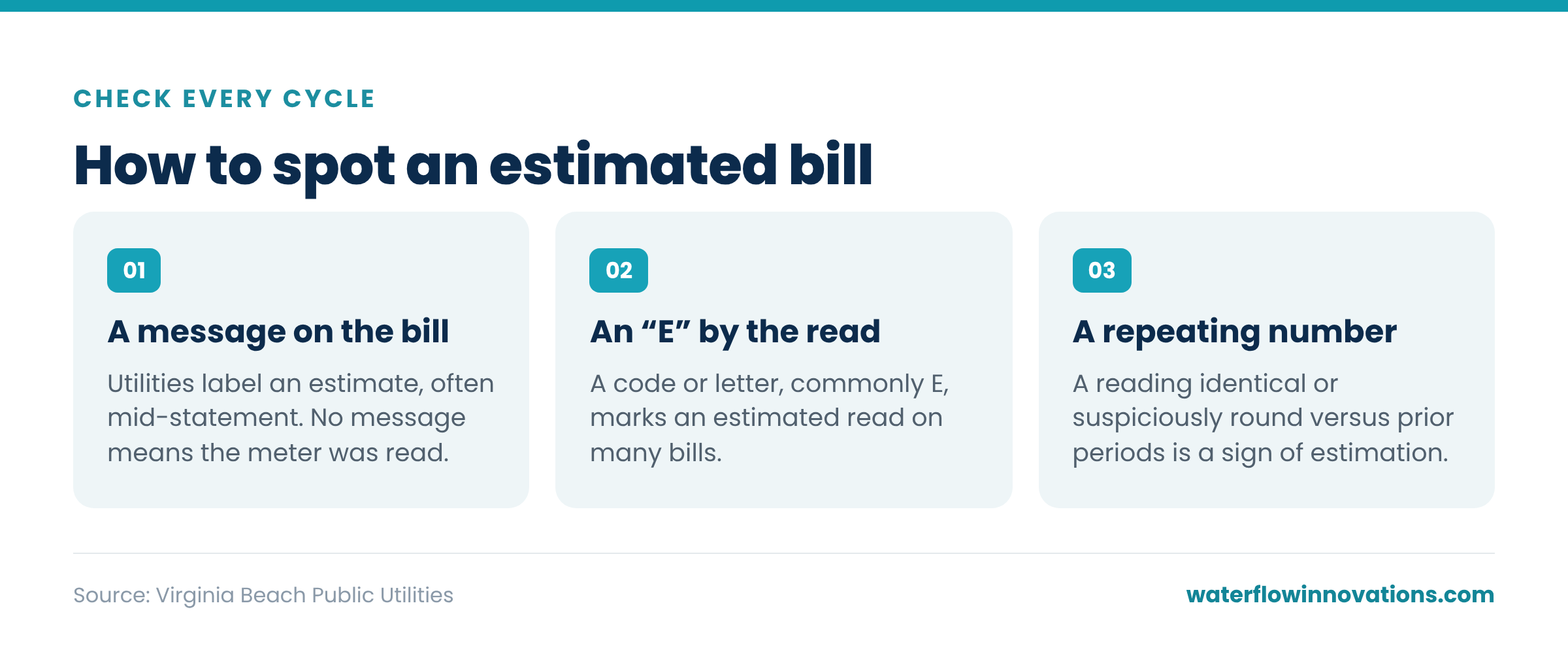
Most utilities label it, if you know where to look. Virginia Beach notes that only the water portion is estimated, and that “you can tell a bill is estimated from a message in the middle of the bill.” No message means the meter was read. Other common signals are a code or letter next to the read, often an E, and a reading that is identical or suspiciously round compared to prior periods.
For a commercial account, build the check into your bill review. Scan for the estimate flag every cycle, and treat two estimated bills in a row as a trigger to act. Newton tells customers to call once they get “more than two estimated bills in a row.” For a full walkthrough of the statement, see How to Read Your Commercial Water & Sewer Bill.
Why estimates tend to run high on commercial accounts
Estimation usually leans on history. The utility projects what it thinks you used from prior periods, and that is where commercial accounts get exposed. A business that cut consumption, idled a line, closed a wing, or idled a water-heavy operation will keep being billed near its old, higher baseline until an actual read catches up. The estimate does not know anything changed.
The exposure compounds on the sewer side. Because sewer is usually billed off the same metered water figure, an inflated water estimate carries an inflated sewer charge with it. One high estimate becomes two high line items. Over several cycles on a large account, that is real money sitting in the wrong column. If your sewer charge looks high for other reasons too, see Why Is My Sewer Bill So High?.
How to get an actual read, and your correction
The remedy is straightforward, and the utility’s own policy is on your side.
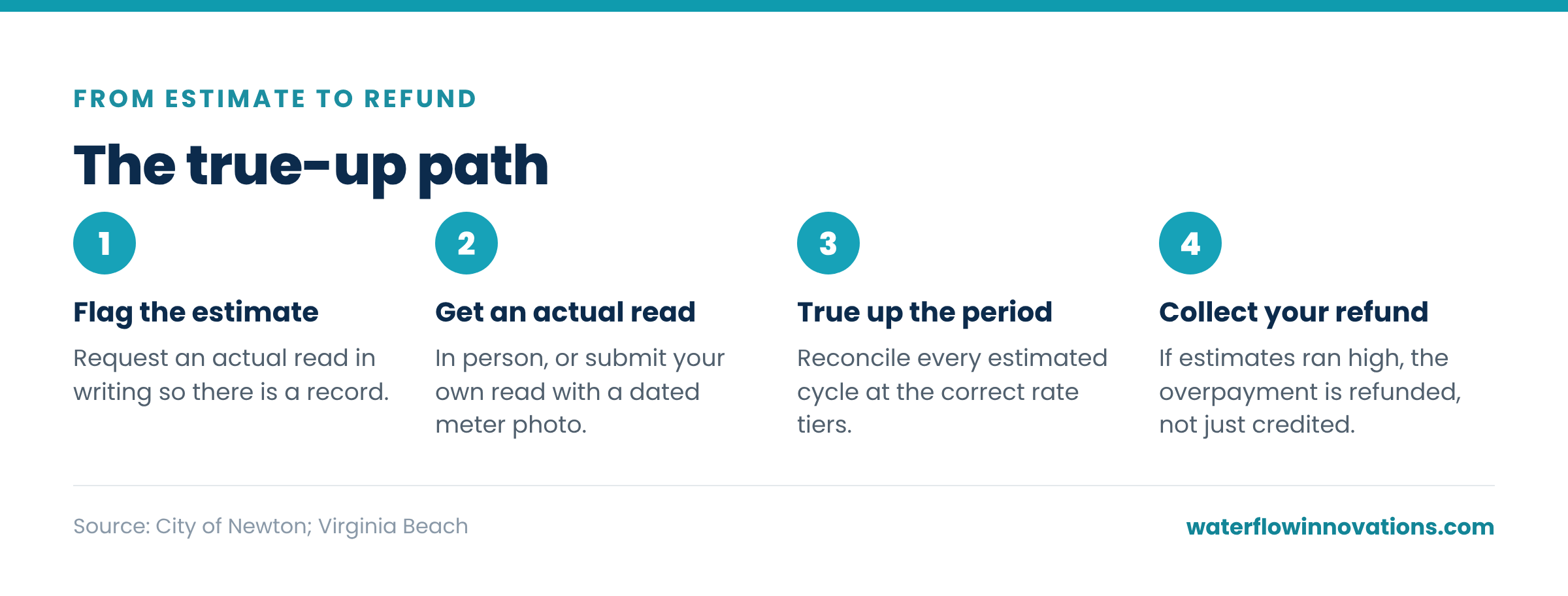
- Flag the estimate and request an actual read. Virginia Beach says it will “make every effort to read your meter in person the following month,” after which “the water portion of your bill will be adjusted so you only pay for the water you have used.” Make the request in writing so there is a record.
- Submit your own reading if you can reach the meter safely. Newton lets customers read the meter and email the reading with a photo of the serial number, and says “they will adjust your water bill accordingly.” A self-read with a timestamped photo is strong evidence.
- Insist on a true-up, not just a fresh start. When the actual read lands, the account should be reconciled across the whole estimated period, not merely corrected going forward. Newton runs “a daily analysis of consumption over the estimated period so that any catch-up bill reflects the correct rate tiers.”
- Collect your refund if the estimates were high. This is the part accounts miss. Newton states that “if your actual read is lower than the estimates, the city immediately process a refund.” An overpayment from estimation is money owed back to you, not a credit you have to argue for.
An actual read can still be inflated, and that is a different fix
Getting onto actual reads solves estimation. It does not mean the number is now the full truth of what your building should pay, because the actual read can itself be inflated by over-registration.
During demand surges water speeds up through the meter, pressure inside it drops, dissolved gas comes out of solution and vapor forms, and the meter counts that volume as water. The meter is not faulty and the utility is not doing anything wrong. The meter reports what physically passed through it at that velocity. Because the sewer charge is calculated from the same reading, the over-recorded volume is billed twice, once as water and once as sewer. An actual read captures that over-registration perfectly, which is exactly why an accurate read is not the end of the story.
A Flow Conditioning Device installs immediately after the meter and creates a small, controlled back-pressure that extends back through the meter, holding pressure up during demand surges so far less gas and vapor form and are counted as water. It corrects the reading, not your actual usage, and its pressure loss is under 0.8 psi. See how the FCD works and water meter over-registration.
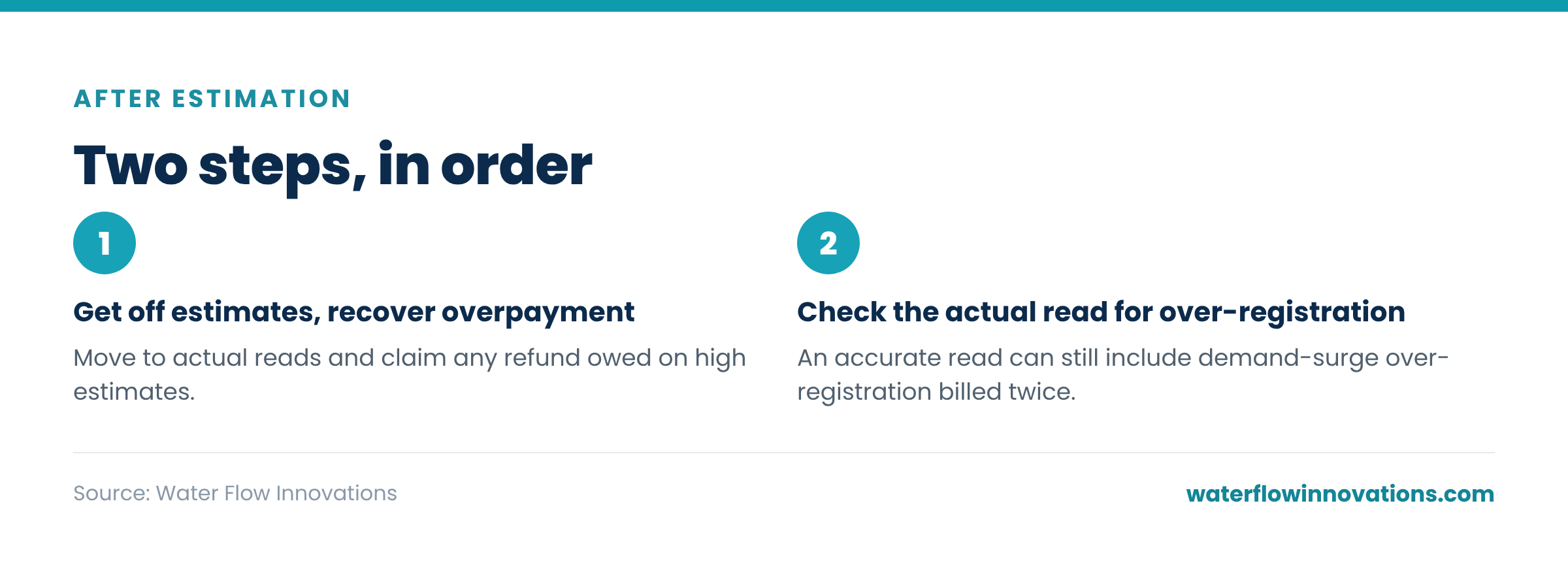
So the sequence is clear. First, get off estimated bills and recover any overpayment. Then, once you are being billed on real reads, check whether those reads are being inflated by demand-surge over-registration.
What to do next
Review your last six to twelve statements and mark every estimated one. If you find a run of them, request an actual read in writing, submit your own read if you can, and ask for the account to be trued up across the full period, with a refund if the estimates were high. Once you are on actual reads, send us the bills and we will check whether over-registration is inflating them.
Get My Quote or call 1-(844)-934-8258. Water Flow Innovations LLC, 2651 Route 412, Coopersburg, PA 18036.
Frequently asked questions
How do I know if my water bill is estimated?
Look for an estimate message on the statement, often in the middle of the bill, or a code such as an E next to the read. A reading identical to recent periods is another sign. Virginia Beach notes that only the water portion is estimated and is labeled as such.
Can I get money back if estimates were too high?
Yes. When an actual read comes in lower than the estimates, utilities reconcile the account and refund the overpayment. Newton states it processes a refund immediately when the actual read is lower than what was estimated.
Does the utility have to read my meter if I ask?
Utilities will make an effort to obtain an actual read on request, and many accept a customer-submitted reading with a photo of the meter. Put the request in writing and keep the record.
Are my sewer charges affected by an estimated water read?
Usually, yes. Sewer is commonly billed from the metered water figure, so an inflated water estimate carries an inflated sewer charge. Both should be corrected when the account is trued up.
If my reads are now actual, am I being billed correctly?
You are being billed on what the meter recorded, which is correct for estimation but not necessarily the full picture. During demand surges a meter can over-register, and an actual read captures that too. That is the problem a Flow Conditioning Device addresses.
Sources
- WSSC Water, Estimated Bills and Other Billing FAQs: https://www.wsscwater.com/customer-service/financial-assistance/customer-engagement-and-advocacy/estimated-bills-other
- City of Virginia Beach Public Utilities, Estimated Meter Readings: https://pu.virginiabeach.gov/customer-service/about-your-bill/estimated-meter-readings
- City of Newton, Estimated Water Bills: https://www.newtonma.gov/government/public-works/utilities-division/estimated-water-bills
0 Comments