
Quick answer: Water that evaporates from a cooling tower, boils off as steam, or leaves in a product never reaches the sewer, but a standard commercial account is billed sewer on it anyway, because sewer is estimated from the water meter. Many utilities offer a consumptive-use or evaporative-loss sewer credit that bills you only on what you actually discharge. For a facility with a cooling tower or an evaporative process, that credit is an ongoing reduction. It pairs with, rather than replaces, correcting over-registration on the water you do discharge.
A cooling tower is the clearest example of paying for something that cannot possibly be sewage. Its whole job is to reject heat by evaporating water into the air. That evaporated water is gone, into the atmosphere, not down the drain. Yet unless you have a credit in place, every gallon of make-up water is billed as both water and sewer.
Why you pay sewer on water that evaporates
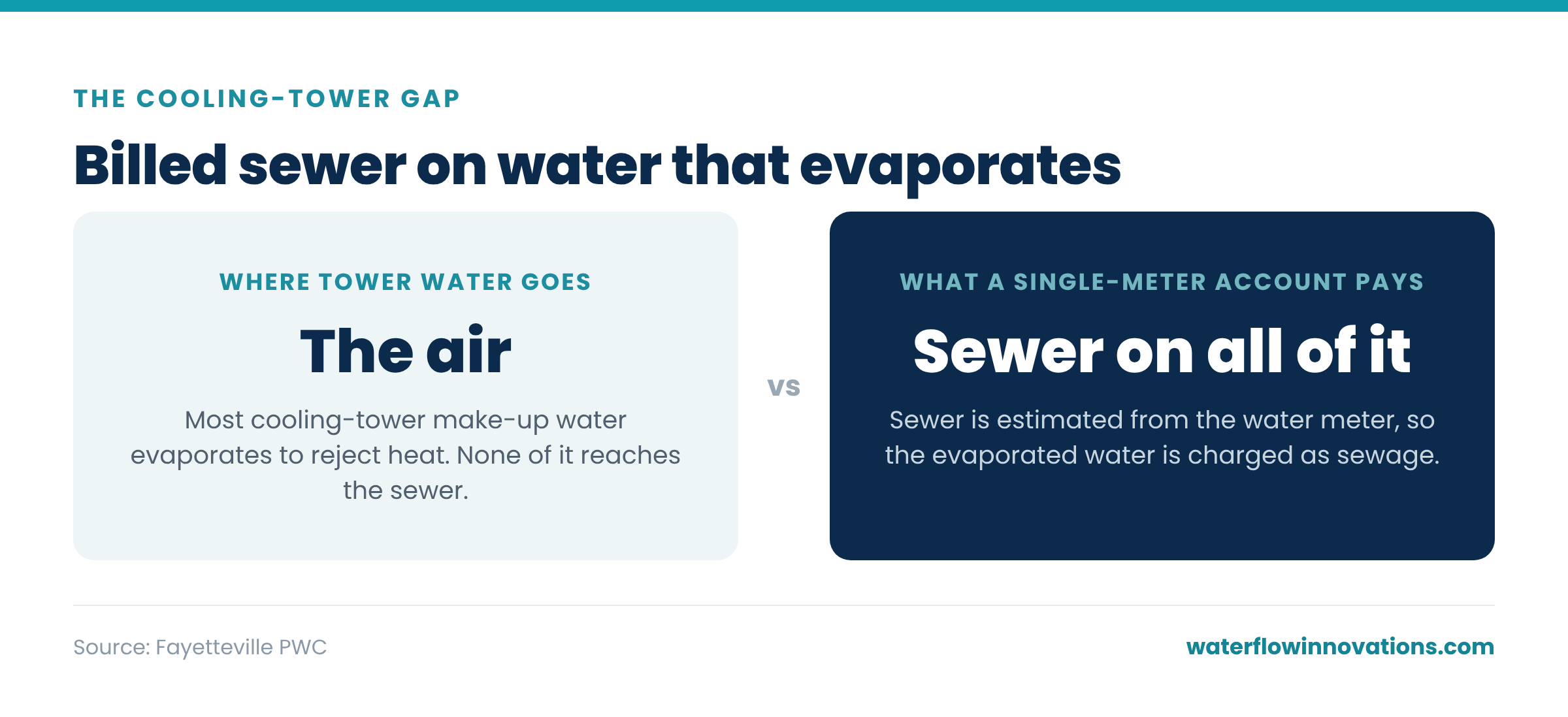
Utilities rarely measure sewage directly. They estimate it from the water meter, because metering actual discharge at every connection is impractical, so the sewer charge is applied to the full volume your water meter records. For most buildings that is a fair approximation, since most water used indoors goes down the drain. For a facility with an evaporative load it is not, because a large share of the metered water leaves as vapor and never enters the sewer. For the basics of how that charge is built, see what a sewer charge is.
Cooling towers are the biggest single case, but the same logic covers boiler steam, evaporative process losses, and water that leaves in a finished product. All of it is metered on the way in and billed as sewage on the way out, even though it never gets there.
What a consumptive-use or evaporation credit is
A consumptive-use credit, sometimes called an evaporative-loss credit, changes the basis of your sewer charge from water delivered to water actually discharged. Fayetteville’s public utility describes the purpose plainly: the procedure lets a customer be billed on the water discharged to the sewer rather than on water delivered, covering losses from “boiler steam, cooling tower evaporation, or industrial process” (Fayetteville PWC).
The result is that the evaporated portion is subtracted from the volume your sewer charge is based on. You still pay for the water you used, since you used it. You stop paying the sewer charge stacked on the part that evaporated.
How utilities measure it
Because the credit removes real revenue, utilities require measurement, not a guess. The common approaches use sub-meters.
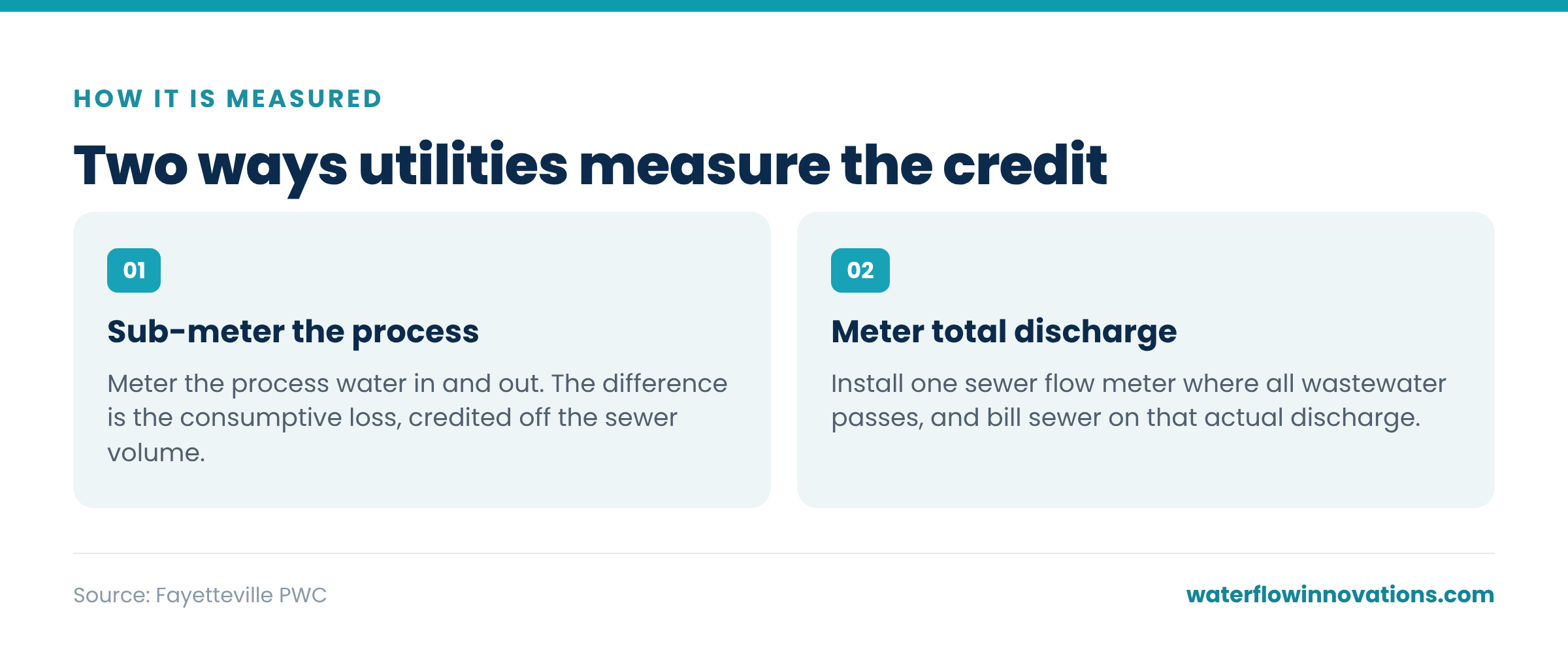
Fayetteville offers two options. In the first, the utility installs incoming and outgoing flow meters on the process that loses water, and the consumptive loss is the difference between them, credited against the sewer volume for that billing cycle. In the second, the customer installs a single sewer flow meter where all wastewater passes, and sewer is billed on that metered discharge instead of on incoming water (Fayetteville PWC).
The requirements are what you would expect for something that lowers a bill. Meters must sit in an approved, accessible location, be calibrated by an independent contractor at least once a year with documentation submitted, and any malfunction reported quickly. The utility can require recalibration if flows shift beyond set limits, and can revert you to estimated billing if a meter fails or is not maintained. Programs differ by city in their thresholds and paperwork, so the specifics come from your own utility, but the shape is consistent: measure the water that leaves, credit the water that evaporates.
Is it worth it for your facility?
The credit has setup and metering costs, so the question is payback. You can estimate it before committing.
A cooling tower’s evaporation is substantial. A rough rule is that roughly 1 percent of the circulating flow evaporates for every 10 degrees Fahrenheit of cooling range, and on an annual basis evaporation is often the large majority of a tower’s make-up water. Multiply the share of make-up water that evaporates by your sewer rate, across a full cooling season, and compare it to the cost of the sub-meter and the annual calibration. Facilities that run a tower hard through a long cooling season, or that have a steady evaporative process, tend to pay it back quickly. A facility with only minor evaporative loss may not.
Where it fits with deduct meters and irrigation
A consumptive-use credit is one case of a broader idea, which is separating any water that leaves your site without entering the sewer. If your site also irrigates landscaping, that water is handled the same way through an irrigation meter, covered in A Dedicated Irrigation Meter Stops Sewer Charges on Landscape Water. For the full picture across cooling, process, and product losses, start with deduct meters, and treat this article as the evaporation chapter of it. The distinction worth keeping straight: an irrigation or deduct meter measures water that bypasses the building entirely, while an evaporation credit handles water that enters the building and leaves as vapor.
The water you do discharge can still be over-registered
A credit removes sewer on the water that evaporates. It does nothing about the water that genuinely runs through your main meter and is billed on both the water and sewer lines. That water is still exposed to over-registration.
During demand surges water speeds up through the meter, pressure inside it drops, dissolved gas comes out of solution and vapor forms, and the meter counts that volume as water. The meter is not faulty. It reports what physically passed through it, and because sewer is billed from the same reading, the over-recorded volume is billed twice. See water meter over-registration.
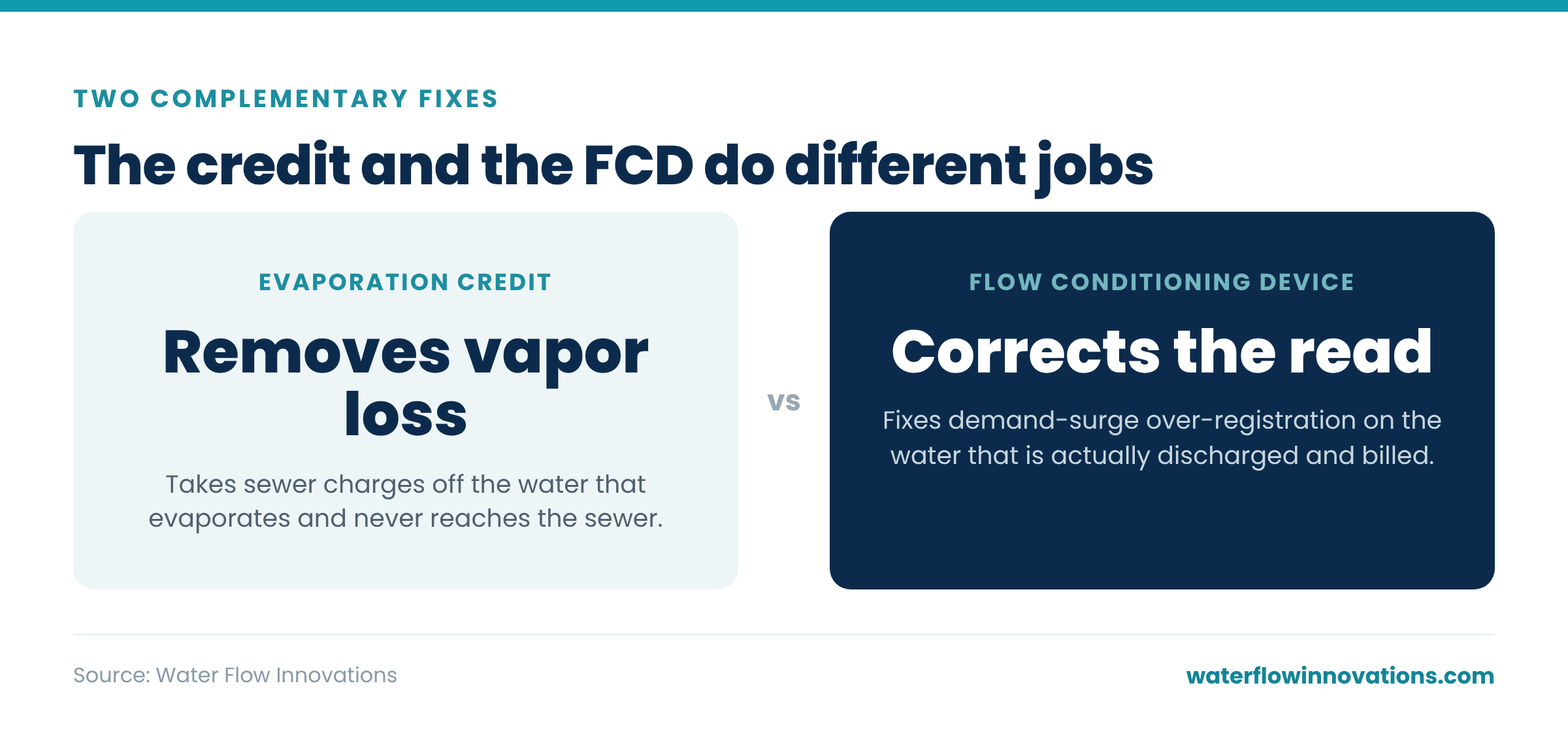
A Flow Conditioning Device installs immediately after the main meter and creates a small, controlled back-pressure that extends back through the meter, holding pressure up during demand surges so far less gas and vapor form and are counted as water. It corrects the reading, not your actual use, with pressure loss under 0.8 psi. See how the FCD works. The two measures are complementary: the credit removes sewer on water that evaporates, and the FCD corrects over-registration on the water that is discharged and billed.
What to do next
Identify your evaporative loads, the cooling towers, boilers, and processes that lose water to the air or to product. Ask your utility whether it offers a consumptive-use or evaporative-loss sewer credit and what metering it requires, then run the payback against your sewer rate and cooling season. While you are at it, have the over-registration on your main meter checked, since it inflates every gallon you are billed on. Send us your bills and we will model it.
Get My Quote or call 1-(844)-934-8258. Water Flow Innovations LLC, 2651 Route 412, Coopersburg, PA 18036.
Frequently asked questions
What is an evaporation or consumptive-use sewer credit?
It is a utility program that bills your sewer charge on the water you actually discharge rather than on all the water you buy, crediting water that evaporates from cooling towers, boils off as steam, or leaves in a product and never reaches the sewer.
How is the credit measured?
Through sub-meters. A utility may meter a process in and out and credit the difference as consumptive loss, or meter your total sewer discharge and bill on that. Both usually require an approved location, annual calibration, and documentation.
How much can a cooling tower save?
It depends on how much make-up water evaporates and your sewer rate. Evaporation is often the large majority of a tower’s make-up water over a season, so on a facility that runs its tower hard the credit can be significant. Estimate it before installing the meter.
Is this the same as a deduct meter?
It is the evaporative case of the same idea. A deduct or irrigation meter measures water that bypasses the building and never enters the sewer. An evaporation credit handles water that enters the building and leaves as vapor. Both remove sewer charges on water that does not reach the sewer.
Does the credit fix over-registration?
No. It removes sewer on evaporated water. Over-registration affects the water that runs through your main meter during demand surges and is a separate issue that a Flow Conditioning Device corrects.
Sources
- Fayetteville Public Works Commission, Consumptive Water Use and Evaporative Loss Sewer Credit: https://www.faypwc.com/consumptive-water-use-and-evaporative-loss-sewer-credit/
0 Comments