
Home » Essential Guides »
Essential guides · Flow conditioning
Flow Conditioning Across Industries: Straighteners, Back Pressure and Anti-Cavitation
4
After
<0.8 psi
Up to 30%
Direct answer: “Flow conditioning” means different things in different industries. In instrument metering, flow straighteners and flow conditioners sit upstream of a meter and fix the shape of the flow: they remove swirl and even out the velocity profile. A separate, long-established practice holds pressure up on the outlet side of a liquid meter, so the liquid doesn’t partly flash to vapor inside the meter and read high. Industrial standards call for this back pressure on liquid turbine and vortex meters. The Flow Conditioning Device (FCD) applies that same principle to commercial water service: it installs immediately after the meter and holds pressure up through it during demand surges.
Five Guides, One Principle
Each guide goes deeper on one family of devices.
Back Pressure on Meters
Why industrial metering standards require back pressure after liquid meters, and the physics behind it.
Anti-Cavitation Devices
How oil, gas, power and naval systems control pressure drops, and what that means for water meters.
Water Meter Strainers
The flow conditioner your meter already has, and why it doesn’t stop surge-driven over-registration.
Not to Be Confused With
Water conditioners, PRVs, backflow preventers & air release valves: what each does, and why none is an FCD.
After-Meter Valves Explained
The many names for after-meter valves, the claims you’ll hear, and eight questions to ask before you buy.
New to these terms? Keep reading this page first. Below, a diagram shows where each device sits, a table compares all of them side by side, and a short section explains the physics they share. It takes a few minutes and makes every guide easier to follow. ↓ Keep reading
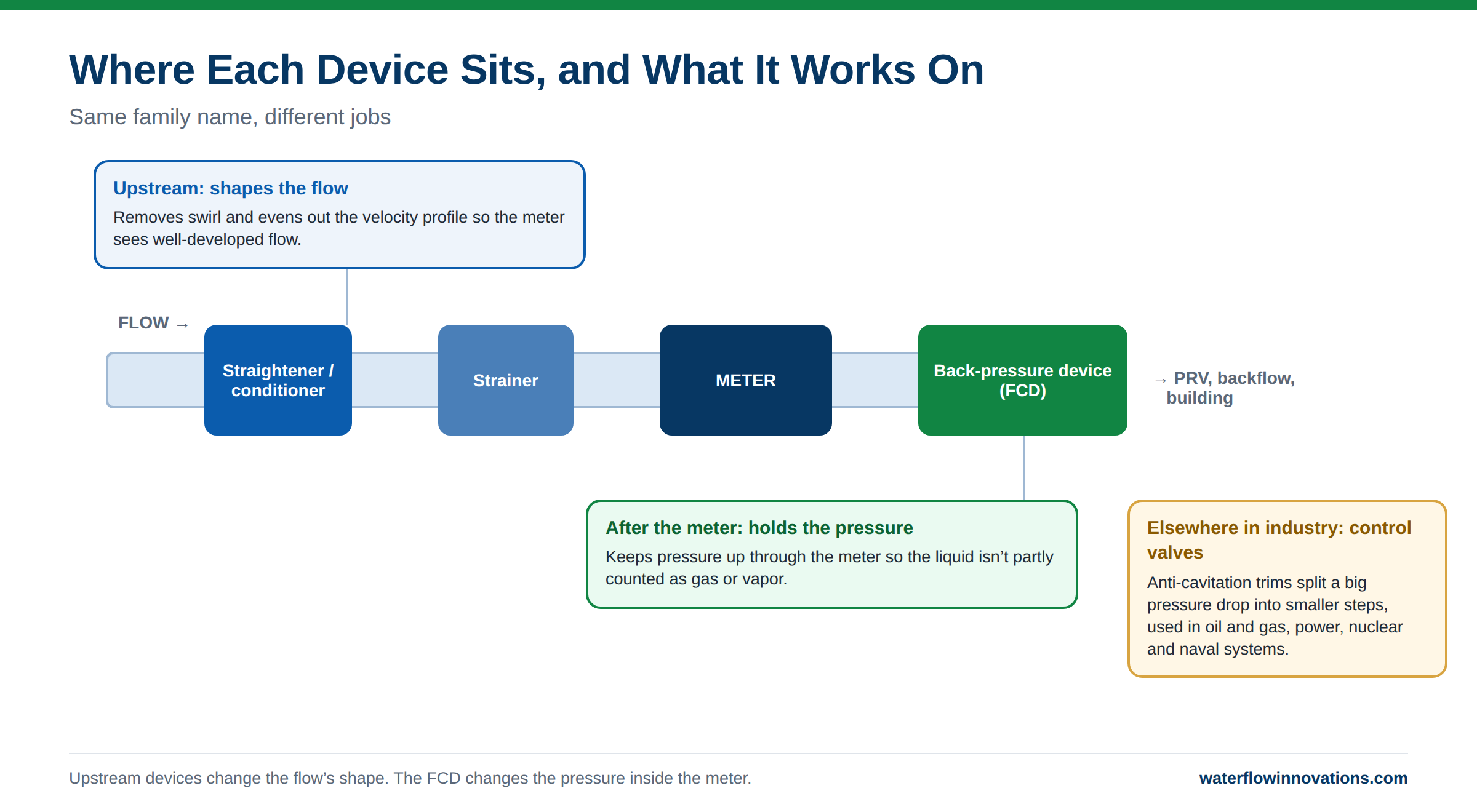
Upstream devices change the flow’s shape. The FCD changes the pressure inside the meter.
One Name, Different Jobs
The same words get used for very different devices. This table sorts them by what they actually do and where they sit.
| Term | Where it’s used | What it does | Where it sits | How it relates to the FCD |
|---|---|---|---|---|
| Flow straightener (tube bundle, vanes, honeycomb) | Oil and gas metering, HVAC duct airflow, wind tunnels, fan testing | Removes swirl so flow arrives at the instrument moving straight | Upstream of the meter or instrument | Different job: shapes the flow, doesn’t change pressure inside the meter |
| Flow conditioner (perforated plate and similar) | Custody-transfer metering of gas and liquids | Removes swirl and rebuilds an even velocity profile; shortens the straight pipe a meter needs | Upstream of the meter | Different job, same name family |
| Water meter strainer | Commercial turbine and compound water meters | Catches debris and evens out the flow entering the meter | Immediately upstream of the meter | Most commercial meters already have one; it doesn’t hold pressure up through the meter |
| Back-pressure valve or downstream restrictor | Liquid turbine and vortex metering in oil, gas and process plants | Holds pressure up at the meter outlet so the liquid doesn’t flash or cavitate and read high | After the meter | Same principle as the FCD |
| Anti-cavitation valve trim | Oil and gas, power, nuclear, naval systems | Splits one large pressure drop into several smaller ones to prevent cavitation, noise and erosion | Inside control valves | Related principle (managing pressure drops), different location and purpose |
| Flow Conditioning Device (FCD) | Commercial and industrial water service | Holds pressure up through the meter during demand surges so far less gas and vapor form and are counted as water | Immediately after the meter, before the PRV and backflow preventer | — |
| “Water-saving valve,” “smart valve,” “flow management device” | Commercial water service | After-meter valves sold under many names, with explanations that vary | After the meter | Same category; see After-Meter Valves Explained |
The Family the FCD Belongs To: Back Pressure After the Meter
When a liquid speeds up through a meter, pressure inside the meter drops. If it drops far enough, part of the liquid can flash to vapor or cavitate, and the meter counts that volume as flow. Industrial metering has guarded against this for decades by holding pressure up on the meter’s outlet side. It’s the same physics as air conditioning, where refrigerant boils off as its pressure drops at the expansion valve, and technicians keep the liquid line under pressure to stop it from flashing early.
- The American Petroleum Institute’s standard for liquid turbine meters (MPMS Chapter 5.3) gives a calculation for the minimum back pressure at the meter outlet to prevent cavitation.
- Turbine meter manufacturers warn that flashing makes the meter indicate significantly more flow than is actually passing, and recommend a downstream valve to maintain the needed pressure.
- Vortex meter practice is the same: raise the inlet pressure or add a back-pressure valve downstream of the meter.
The FCD applies this principle to commercial water service. It installs immediately after the meter and creates a small, controlled back-pressure that extends back through the meter, holding pressure up during demand surges so far less gas and vapor form and are counted as water. Pressure loss is under 0.8 psi, and nothing downstream changes. It corrects the reading; it doesn’t reduce the water you use.
Same principle, different conditions. The industrial standards mainly address volatile liquids such as LPG and hot condensate. In commercial water service, the effect is driven by demand surges: pressure inside the meter drops, dissolved gas comes out of solution and vapor forms. The principle is the same: hold pressure up through the meter so it counts the liquid, not gas and vapor.
More in the guide: Back Pressure on Meters: Why Industrial Metering Standards Require It.
Two Different Jobs at the Meter
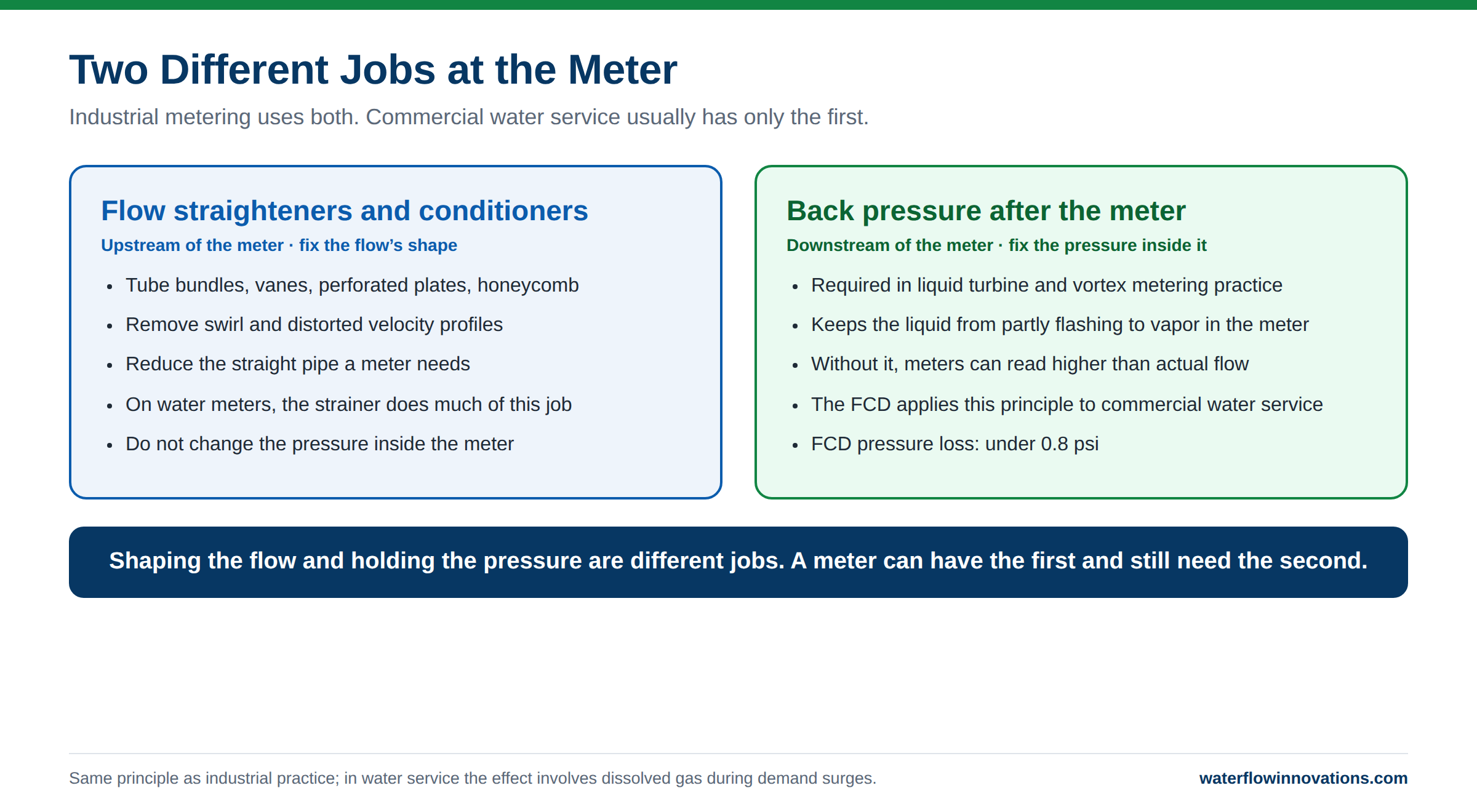
A meter can have the first and still need the second.
Flow Straighteners and Flow Conditioners: Upstream of the Meter
Elbows, tees, valves and pumps upstream of a meter leave the flow swirling or lopsided, and many meters read best when the flow arrives straight and even. The classic fix is a long run of straight pipe. Where there isn’t room, metering standards allow a flow straightener or flow conditioner instead: tube bundles, vanes, perforated plates and honeycomb sections that remove swirl and rebuild the velocity profile. The same idea shows up in HVAC airflow stations, fan-test labs and wind tunnels, where honeycomb straighteners settle the air before it’s measured.
On commercial water meters, the strainer installed ahead of turbine and compound meters does much of this job, which is why meter makers allow shorter straight runs when one is present. These devices do valuable work, but they shape the flow; they don’t hold pressure up inside the meter during demand surges. For more on specific designs, see Flow Straighteners and Flow Conditioners, Velocity Profile Conditioners vs. the FCD, Vane Flow Straighteners and Flow Conditioner vs. Perforated Plate.
Anti-Cavitation Devices: Oil, Gas, Power and Naval Systems
Wherever a liquid takes a large pressure drop, as across a control valve, it can cavitate: vapor bubbles form and then collapse, causing noise, vibration and erosion. Oil and gas, power and nuclear plants control this with anti-cavitation valve trims that split one big pressure drop into several smaller stages, and with downstream restrictors that back up the outlet pressure. Naval engineering adds another reason: cavitation is noise, and quiet valves matter on a submarine.
The FCD isn’t a control valve and doesn’t take a large pressure drop. The connection is the physics: managing pressure so a liquid stays liquid where it counts. More in Anti-Cavitation Devices: How Oil, Gas, Power and Naval Systems Control Pressure Drops.
Not to Be Confused With
A few devices sound similar but do something else entirely:
- Water conditioners and softeners change the water’s chemistry (hardness, scale). They don’t affect what the meter records.
- Pressure reducing valves (PRVs) lower building pressure. The FCD installs before the PRV and isn’t a pressure reducer. See What Is a Pressure Reducing Valve.
- Backflow preventers stop water from flowing back into the public supply.
- Air release valves vent air pockets from high points in a piping system.
- Faucet flow restrictors and aerators limit fixture flow to save water; the FCD doesn’t reduce water use.
More in Not to Be Confused With.
Sources and Standards
- ISO 5167-1 and 5167-2, Measurement of fluid flow by means of pressure differential devices (flow conditioners and straight-length requirements).
- ASME MFC-3M, Measurement of Fluid Flow in Pipes Using Orifice, Nozzle, and Venturi.
- American Petroleum Institute, Manual of Petroleum Measurement Standards, Chapter 5.3, Measurement of Liquid Hydrocarbons by Turbine Meters (flow conditioning and minimum back pressure).
- ANSI/AMCA 210 – ANSI/ASHRAE 51, Laboratory Methods of Testing Fans for Certified Aerodynamic Performance Rating (airflow straighteners).
- AWWA C701 and C702, cold-water turbine and compound meters for customer service; meter makers’ installation guides (strainers and straight-run requirements).
- ISA-RP75.23, Considerations for Evaluating Control Valve Cavitation.
Standards and manufacturer guidance describe industrial practice. Water Flow Innovations applies the same principles to commercial water service; results vary by building.