
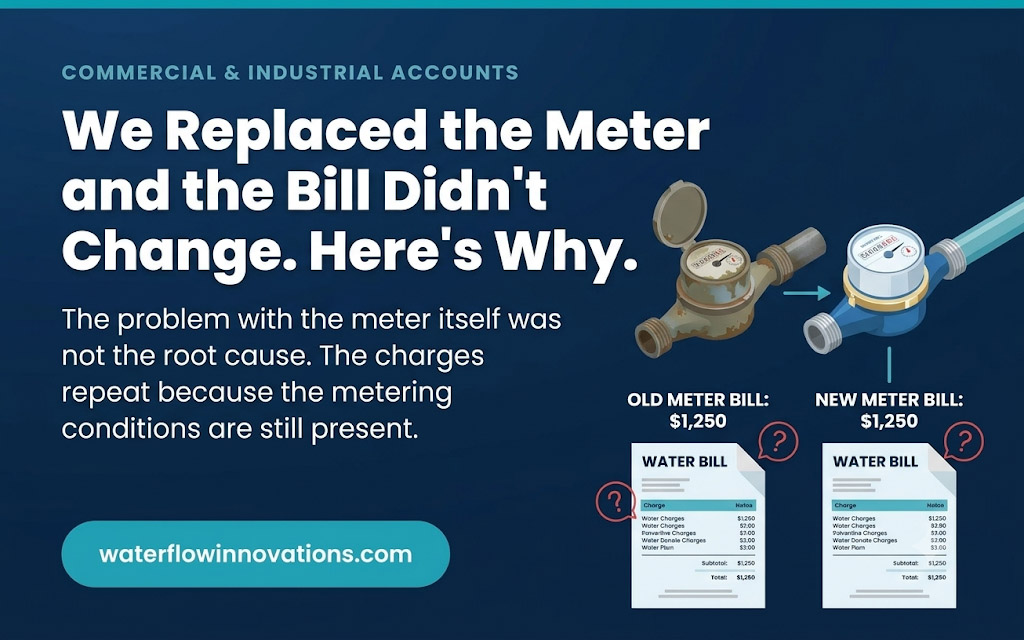
It’s one of the most common stories we hear from facility managers. The water bill climbed for no obvious reason, the team checked for leaks and found none, and eventually someone asked the utility to test or replace the meter. The new meter went in. The next bill looked almost exactly like the last one.
That outcome isn’t bad luck. In most cases, it’s exactly what the physics predicts.
The meter usually isn’t the problem
A water meter is a measuring instrument. It counts the volume that passes through it, and it was calibrated in a lab under smooth, steady flow. When a meter is tested or replaced, the utility is answering one question: is this instrument working within its accuracy standard? Usually the answer is yes, for the old meter and the new one. (If you’re still deciding whether to ask for one, see How to Replace a Business Water Meter. If yours already passed, see My Meter Passed Its Test.)
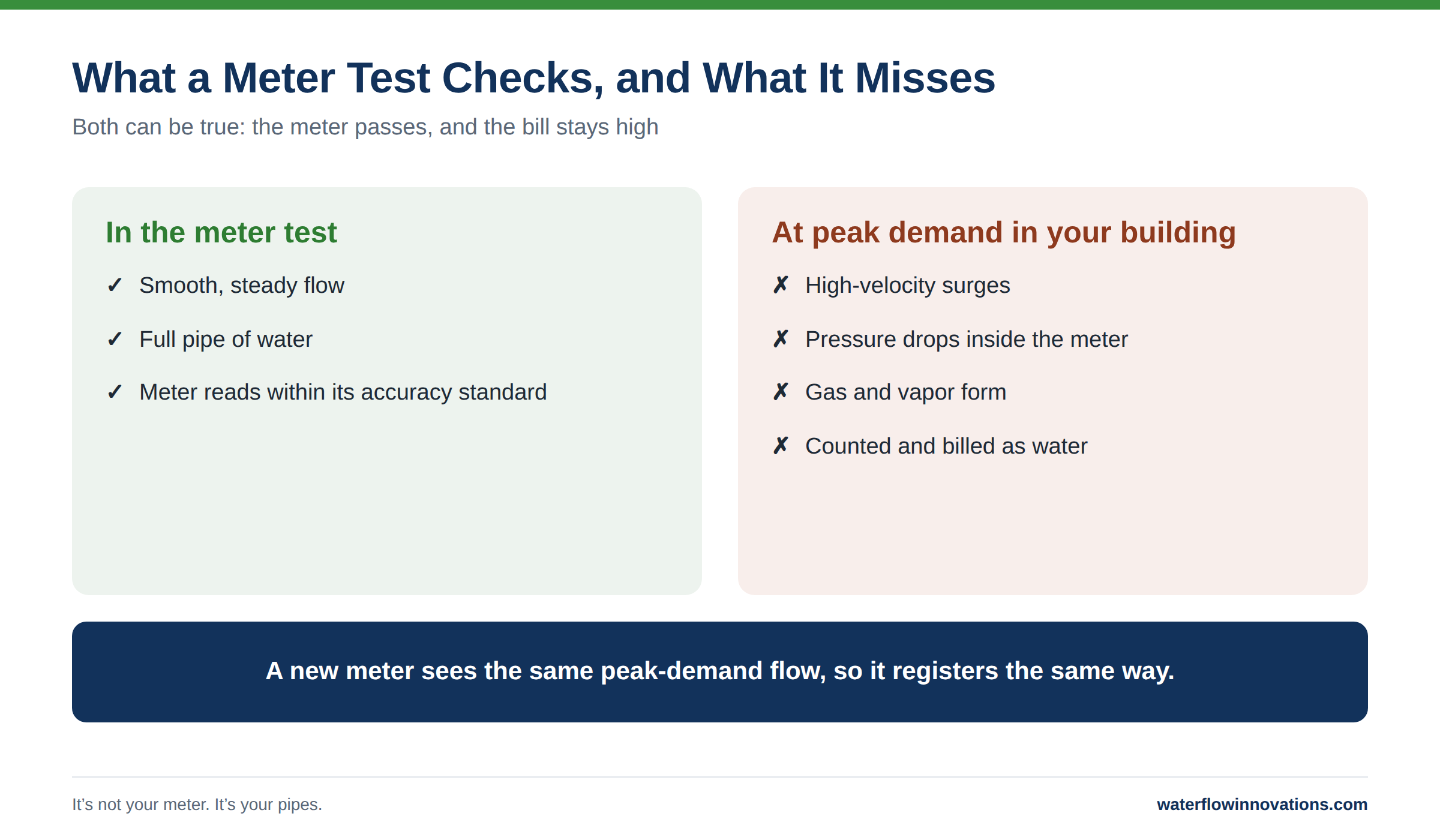
The real issue is what the meter is being asked to measure. During high-demand moments in a building, such as pumps starting, valves opening, tanks filling, or cleaning cycles kicking on, water moves through the meter at high velocity, and pressure inside the meter drops. Dissolved gas comes out of solution and vapor forms. A meter counts volume, and it can’t tell water from gas or vapor, so it records volume that was never water. This is water meter over-registration.
Why a new meter reads the same way
Swap in a brand-new meter and nothing about those flow conditions changes. The same pumps start, the same valves open, and the same surges pass through the meter. The new meter sees the same peak-demand flow and registers it the same way. That’s why the bill barely moves.
It’s also why the utility isn’t wrong when it says the meter tested fine. The meter is doing its job. The conditions inside it during demand surges are the problem, and those are shaped by your building’s own demand and piping.
Fix the conditions, and the reading follows
If the cause is what happens inside the meter during surges, the fix has to work there. A Flow Conditioning Device (FCD) installs immediately after the water meter, on your side of the connection. It creates a small, controlled back-pressure that extends back through the meter, holding pressure up during demand surges so far less gas and vapor form and are counted as water. (See How the FCD Works.)
Nothing else in the building changes. Pressure loss through the FCD is under 0.8 psi across all flow conditions, so fixtures, equipment, and processes downstream work the same as before. It doesn’t reduce the water you use; it corrects what the meter records. Installation takes about an hour with the water off and is done by a licensed plumber or mechanical contractor.
Documented installations typically show up to a 30% reduction in combined water and sewer costs (46% is the highest documented, a rare case), and about 90% of customers reach full ROI in under 12 months.
Signs you’re dealing with flow, not a faulty meter
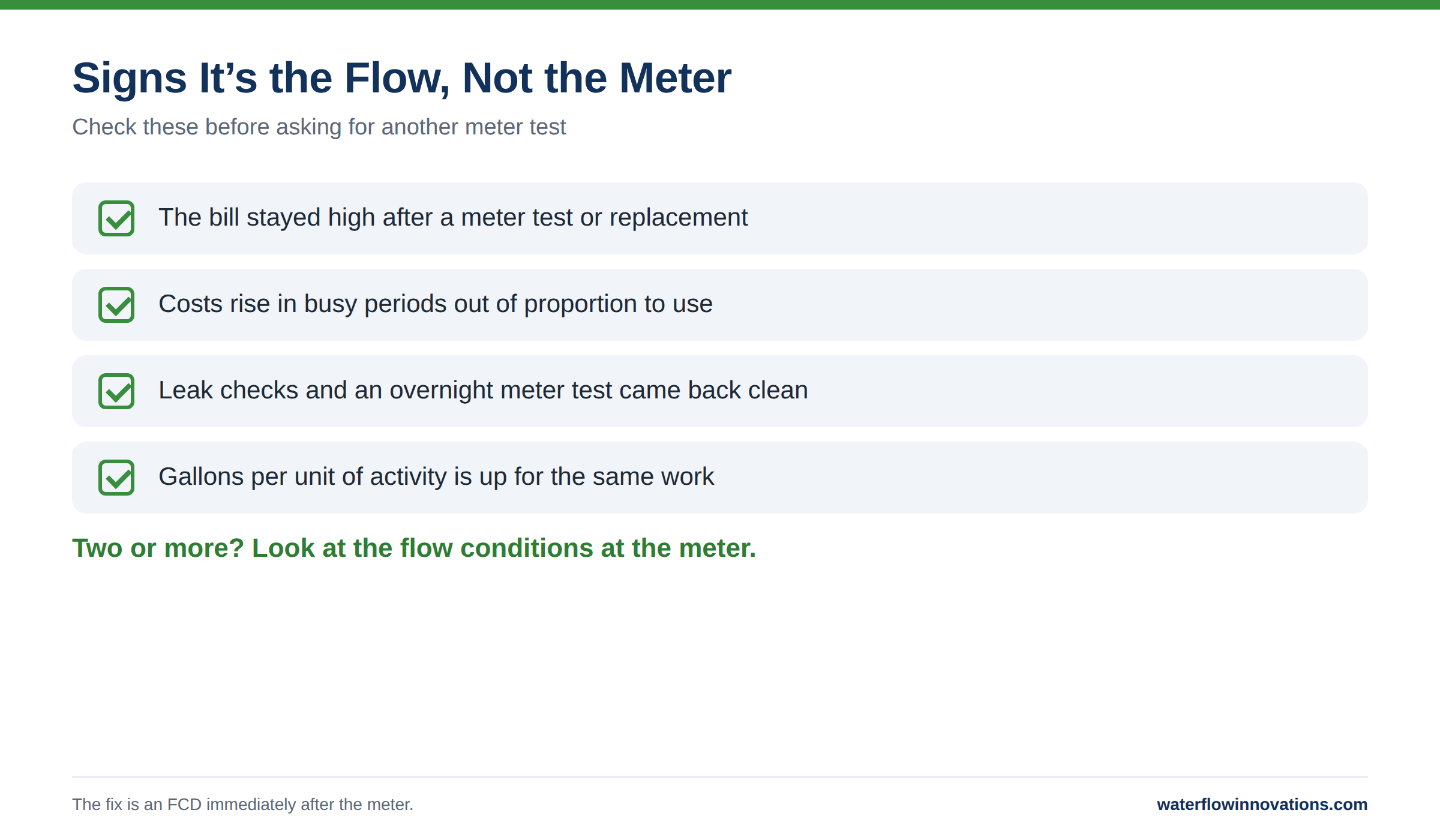
- The bill stayed high after a meter test or replacement.
- Costs rise during busy periods out of proportion to actual use.
- Leak checks and an overnight meter test came back clean.
- Your gallons per unit of activity (per room-night, meal, or unit produced) is up for the same work.
Frequently Asked Questions
Q: Should I still ask the utility to test my meter?
A: It doesn’t hurt, and it rules out a genuinely failed meter. But if the meter passes and the bill stays high, the cause is likely what happens inside the meter during demand surges rather than the meter itself.
Q: Does the FCD replace or modify the utility’s meter?
A: No. The FCD installs on the main water line immediately after the meter, on your side of the connection. The utility’s meter is not touched.
Q: How quickly would I see a difference?
A: The correction starts as soon as the FCD is installed, and it shows on your next full water and sewer billing cycle.
To see what this might mean for your building, try the free Water & Sewer Savings Calculator. It takes a few minutes and needs no contact information.
0 Comments