
Quick Answer
On almost every commercial and industrial service in the United States, the water meter belongs to the utility, not to you. You do not buy it, you do not choose it, and in most cases you cannot replace it yourself. What you can do is request a test, request a replacement, or apply to change the service size, and the outcome of those three requests is very different for your bill. A test tells you whether the meter is registering accurately. A replacement resets a worn meter to a known accuracy band. A size change is the only one of the three that moves your fixed monthly charge, and it is the one almost nobody asks for. Large meters also carry testing obligations that small meters do not, so check the test record before you ask for anything.
Who Owns the Meter on a Commercial Service, and Who Replaces It?
The utility owns the meter and the utility replaces it. That is the default across US water systems, and it has a practical consequence: the replacement is normally free to you.
WSSC Water, which serves commercial and government properties across two Maryland counties, runs a dedicated replacement program for meters above 3 inches and states the position plainly. The work “is free to our customers.” The utility schedules it, the utility pays for it, and the utility carries the cost of the meter itself.
The line of responsibility sits at the meter. WSSC’s program notes that “the property owner is responsible for any on-site plumbing improvements related to this project.” That is the part worth planning for. A meter that has been in a vault for two decades is often sitting against valves, couplings and spool pieces of the same age. When the utility opens the vault to swap the meter, anything on your side that is seized, corroded or out of specification becomes your bill, and it becomes your bill at short notice.
So the request itself costs nothing. The remediation might.
When Does a Business Water Meter Need Replacing?
Three triggers, and only one of them is about age.
Age against expected service life. WSSC puts the typical useful life of a large meter at 15 to 20 years, and launched its program because the average age across its large meters had reached 19. If your facility has not had a meter change in two decades, you are at the end of the published band, not approaching it.
A failed or overdue accuracy test. Meters do not fail suddenly. They drift, and a meter that tests outside the AWWA accuracy band, or has gone past the test interval for its size, is due for attention.
A service that no longer matches the demand. This is the trigger that is almost never acted on, and it is covered in its own section below.
Notice what is not on that list. A high bill is not by itself evidence that the meter needs replacing, and a utility will not treat it as such. The bill has to be reconciled against the tariff first, because a rate class error or a missing exclusion produces exactly the same symptom as a fast meter and is far more common. Our guide to how a commercial sewer bill is calculated sets out the order those checks belong in.
Check the Test Record Before You Ask
Large meters are tested far more often than small ones. Wisconsin, for example, requires a 6-inch meter to be tested every year and a 1-inch meter every ten. Before asking for a replacement, ask the utility in writing for the date and result of the last periodic test on your meter and the interval that applies to its size. If the meter is overdue, the conversation changes from a complaint about a bill into a question about a published obligation. The full test intervals, the accuracy thresholds that trigger a refund, and how to request a test properly are covered in our guide to a faulty water meter on a commercial account.
How Do You Request a Meter Replacement or a Meter Test?
Four steps, in this order. Doing them out of order is how these requests get refused.
- Record the meter. Make, model, size, serial number and register reading, photographed. You want this before anything is touched, because once a meter is pulled it is the utility’s record against yours.
- Pull 12 to 24 months of billed volume. Same month year over year at the same rate. If billed volume moved and production did not, that comparison is the strongest single document you can put in front of a utility.
- Request the periodic test record in writing. Ask for the last test date, the result at each test flow, and the interval that applies to the size. Put it in writing so there is a dated record of the request.
- Then ask for the test or the replacement. Not before. A request that arrives with the meter details, the consumption history and the test record attached is handled differently from one that arrives as a complaint.
Most utilities will test on request, and the rules on fees and refunds vary by state, as the faulty meter guide sets out. For a replacement, the more useful questions are what the utility will install in its place and whether the service is still the right size, which is where the next two sections come in.
What Does a Commercial Meter Replacement Cost?
When the utility initiates the replacement under a program of its own, usually nothing. When you initiate a new installation or a size change, the published fee schedules give a clear picture of what sits behind the request.
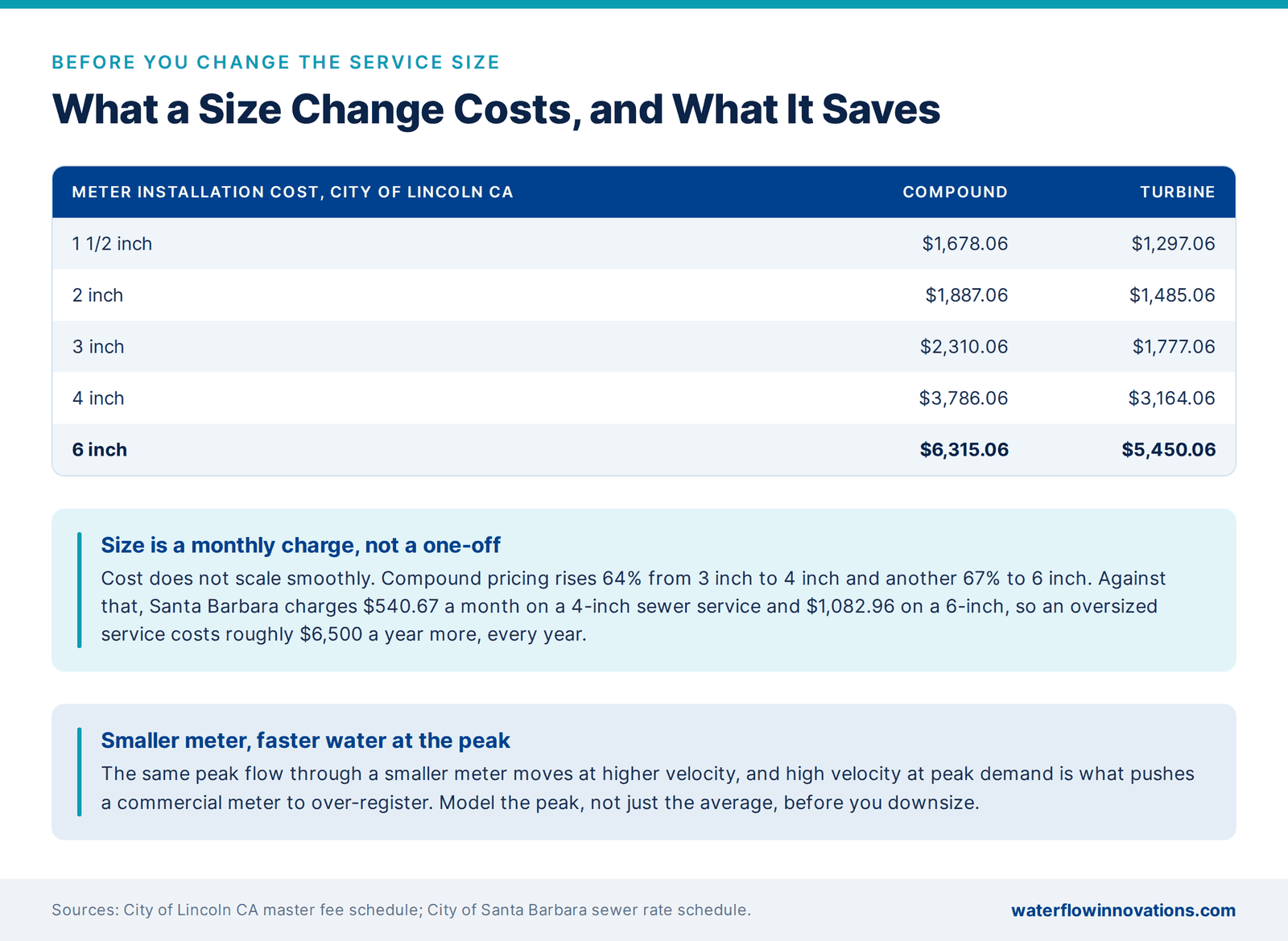
The City of Lincoln, California publishes installation costs by size and meter type:
| Size | Compound meter | Turbine meter |
|---|---|---|
| 1 1/2 inch | $1,678.06 | $1,297.06 |
| 2 inch | $1,887.06 | $1,485.06 |
| 3 inch | $2,310.06 | $1,777.06 |
| 4 inch | $3,786.06 | $3,164.06 |
| 6 inch | $6,315.06 | $5,450.06 |
Two readings of that table matter.
The cost does not scale smoothly. Between 3 inch and 4 inch the compound price jumps 64%, and between 4 inch and 6 inch it jumps another 67%. Size changes are not marginal decisions.
And the meter type is priced separately. A compound meter costs more than a turbine at every size because it is built to register accurately across a wider flow range, with a small register handling low flow and a large one handling high flow. That difference is the whole argument when a facility has a wide swing between its quiet hours and its peak.
Those are one utility’s numbers in one year. Pull your own utility’s current fee schedule rather than budgeting from these.
Should the Replacement Meter Be the Same Size?
This is the question worth asking, and the moment a meter is being changed is the only convenient time to ask it.
The fixed charge on a commercial account is set by service size, not by use. In Santa Barbara’s published schedule a 4-inch commercial sewer service carries a $540.67 monthly charge before a single unit of water moves, and a 6-inch carries $1,082.96. That is roughly $6,500 a year against roughly $13,000 a year, for the same building, on the water that never arrives.
Facilities end up oversized for ordinary reasons. The line was sized for a process that has since been replaced, or for a building footprint that was never built out, or for a fire demand that is now served separately. The service stays as laid, and the fixed charge keeps arriving on that basis for as long as the account exists.
There is a second consideration, and it connects to meter accuracy. An oversized meter spends most of its life at the bottom of its flow range, where meters tend to register low rather than high, so the real cost of oversizing is the fixed charge. Downsizing changes the other end of the range. The same peak flow through a smaller meter moves at higher velocity, and high velocity at peak demand is exactly the condition that pushes a commercial meter to over-register, as the next section explains. Model the peak, not just the average, before you shrink the meter.
Before requesting a size change, get the actual demand profile rather than the design assumption: peak flow, average flow, and how much of the day sits near the low end. Then compare the fixed charge at the smaller size against the installation cost from the fee schedule. Downsizing almost always requires a new service application, utility approval and an inspection, and in many systems a licensed contractor doing the work. It is not a quick change, and the payback is a fixed monthly saving rather than a one-off recovery, which is exactly why it is worth modeling properly.
What Does Not Change When the Meter Is Replaced
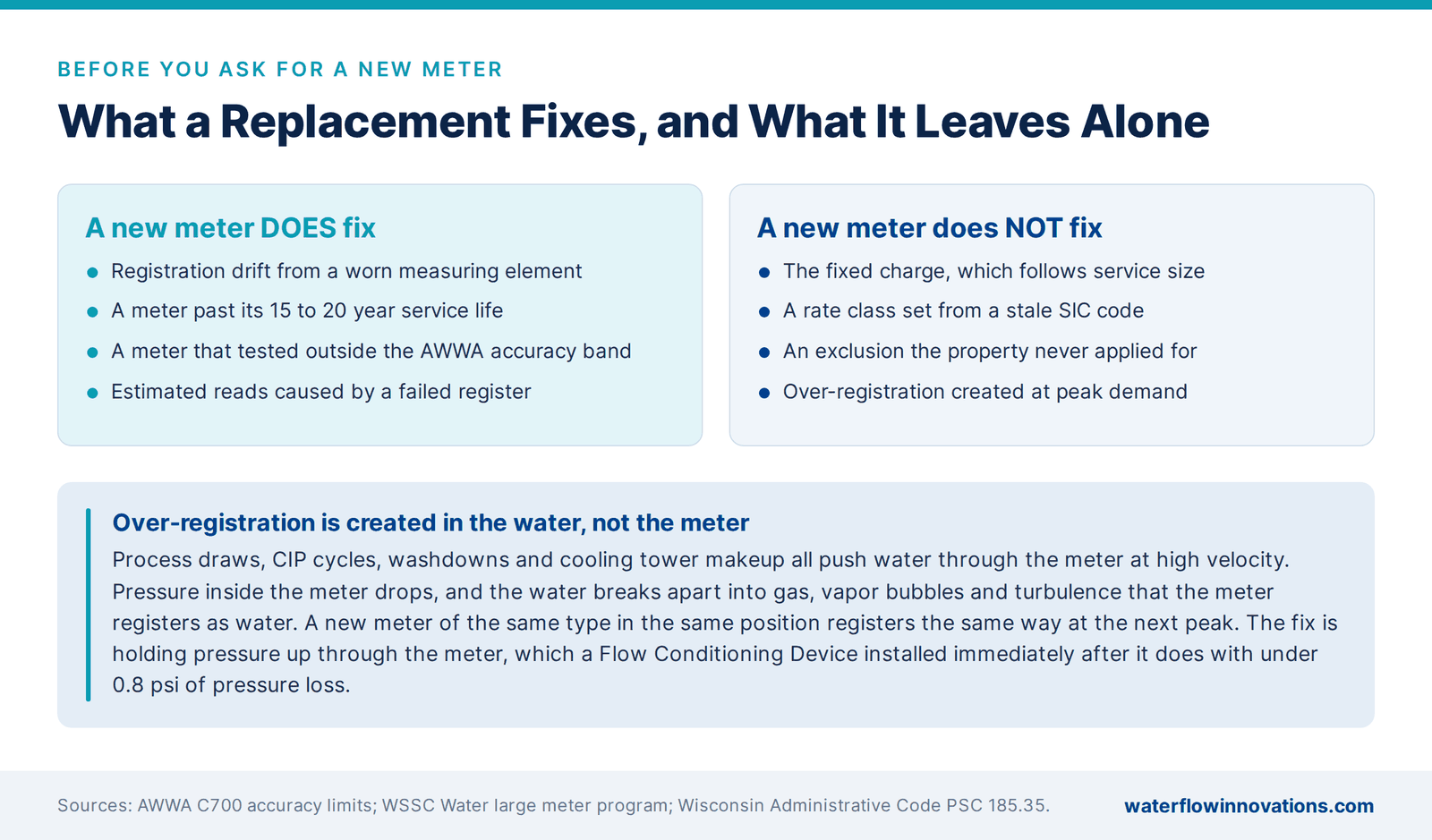
A new meter resets registration accuracy. It does not change what happens inside the meter when the facility is at peak demand, and on a commercial service that is where over-registration comes from.
On a commercial or industrial service, demand peaks are built into the operation: process water draws, CIP cycles, washdowns, cooling tower makeup, restroom peaks at shift change, dish machines during a restaurant rush. At those peaks, water moves through the meter at high velocity, and the pressure inside the meter drops, dissolved gas comes out of solution, and vapor forms. Those expand to fill space that should be occupied by water. A meter measures volume and cannot tell water from gas, so it registers that expanded volume and bills it as water. The piping system around the meter adds to it: valves, fittings, turns and size changes add pressure loss at exactly the moments velocity is highest.
So if a facility runs high-demand flow through its meter, a new meter of the same type in the same position will register the same expanded volume at the next peak. It can pass a test, which is run under controlled flow and pressure, and still over-register in service. That is the difference between what meter over-registration is and when it does not apply and a simple accuracy fault. One is fixed by a replacement. The other is fixed by holding pressure up through the meter when demand peaks.
A Flow Conditioning Device (FCD) does that from its position immediately after the meter. It creates a small, controlled backpressure that extends back through the meter, which keeps the water intact at high velocity so the meter registers water only. Pressure loss to the building stays under 0.8 psi. It corrects the reading; it does not reduce the water the facility actually uses. For the physics behind it, see How the FCD Works.
It is also worth being clear about the bill. Correcting the meter corrects the volume, and on a commercial account that volume drives the water charge and the sewer charge at once, because both are calculated from the same reading. But it does not touch the fixed charge, the rate class or any missing exclusion. Those are tariff questions and they are answered by a bill review, not by a meter change.
How Do You Prepare the Site?
A replacement on a working facility is a short planned shutdown of the water supply to the whole building. Treat it as one.
- Confirm the shutdown window and what it stops. Process water, cooling make-up, wash-down, fire protection if it is on the same service. Some of those cannot simply pause.
- Inspect your side of the vault before the date. Valves, couplings, spool pieces and the bypass if there is one. Anything seized is your cost and your delay, and finding it on the day is the expensive version.
- Photograph the final register reading and get the utility’s reading in writing. A replacement is a billing boundary. Two records of the closing figure is one more than most disputes have.
- Ask what the new meter is. Make, model, type and size. If a compound is being replaced with a turbine, or the size is changing, that affects both your registration accuracy at low flow and your fixed charge.
- Check the first bill after the change line by line. New meter, new register, and often a prorated period. A commercial water and sewer bill is where that will show up first.
Frequently Asked Questions
Who is responsible for replacing a water meter on a commercial property?
The utility, in almost all US systems. It owns the meter, schedules the replacement and carries the cost. The property is responsible for the plumbing on its own side of the meter, which is where unexpected cost appears when an old vault is opened.
Can a business replace its own water meter?
No. The meter is utility property and replacing or tampering with it is a violation of the service agreement in essentially every system. What a business can request is a test, a replacement, or a change of service size.
Should the meter be tested before I ask for a replacement?
Yes. Ask for the last periodic test record first, then the test. A meter that tests within tolerance is unlikely to be replaced on request, and a high bill on an accurate meter points to the tariff or to over-registration at peak demand rather than to the meter itself.
How long does a commercial water meter last?
WSSC Water puts the typical useful life of a large meter at 15 to 20 years. Accuracy drifts across that period rather than failing at the end of it, which is why the testing interval matters more than the age alone.
Does a new water meter lower a water bill?
Only if the old one was registering high because of wear. A new meter resets registration to the AWWA accuracy band. It does not change the fixed charge, the rate class or any exclusion the account qualifies for, and it does not change the high-demand flow conditions that cause over-registration in the first place.
What does it cost to install a larger or smaller commercial water meter?
Published fee schedules put it in the low thousands for most commercial sizes. Lincoln, California lists a 2-inch compound meter installation at $1,887.06 and a 4-inch at $3,786.06. Pull your own utility’s current schedule before budgeting.
Is it worth downsizing a commercial water service?
It is worth checking. The fixed charge scales steeply with size, roughly $540 a month at 4 inch against roughly $1,083 at 6 inch in Santa Barbara’s published schedule. The saving is monthly and permanent, so it compounds in a way a one-off refund does not. Check peak demand at the smaller size before deciding, because a smaller meter sees higher velocity at every peak.
Related reading
- Five signs a commercial water meter is over-reading
- Correcting meter over-registration against low-flow fixtures
- How to read a commercial water and sewer bill
Have the Meter and the Service Size Checked Together
Water Flow Innovations assesses meter installations and billing data for commercial, industrial and multifamily facilities. Send your meter make, model and size plus 12 months of bills, and we will tell you whether the meter is the problem, whether the service is sized for the demand you actually have, and what high-demand flow is doing to your meter reading.
Water Flow Innovations LLC, 2651 Route 412, Coopersburg, PA 18036. Call 1-844-934-8258.
0 Comments