
Hotel operations teams audit almost everything — occupancy, ADR, RevPAR, energy cost per occupied room. Water is usually the exception. It’s treated as a background utility cost that scales predictably with occupancy, which means when it doesn’t scale predictably, nobody’s set up to notice.
Why hotel water demand is uniquely hard on meters
A hotel’s water system experiences some of the sharpest demand swings of any commercial building type: the morning shower surge across dozens or hundreds of rooms in a tight window, laundry operations cycling through loads continuously, pool and spa top-off, and cooling tower makeup for HVAC — often all overlapping during peak hours. Each of these events pulls water through the system in a burst rather than a steady flow, and bursts are exactly the condition that drops pressure inside the meter and lets gas and vapor form.
Water meters measure volume, not composition. They can’t tell water from the gas and vapor that form inside them during a surge — so during your highest-demand hours, the meter may be counting phantom volume as real, billable usage.
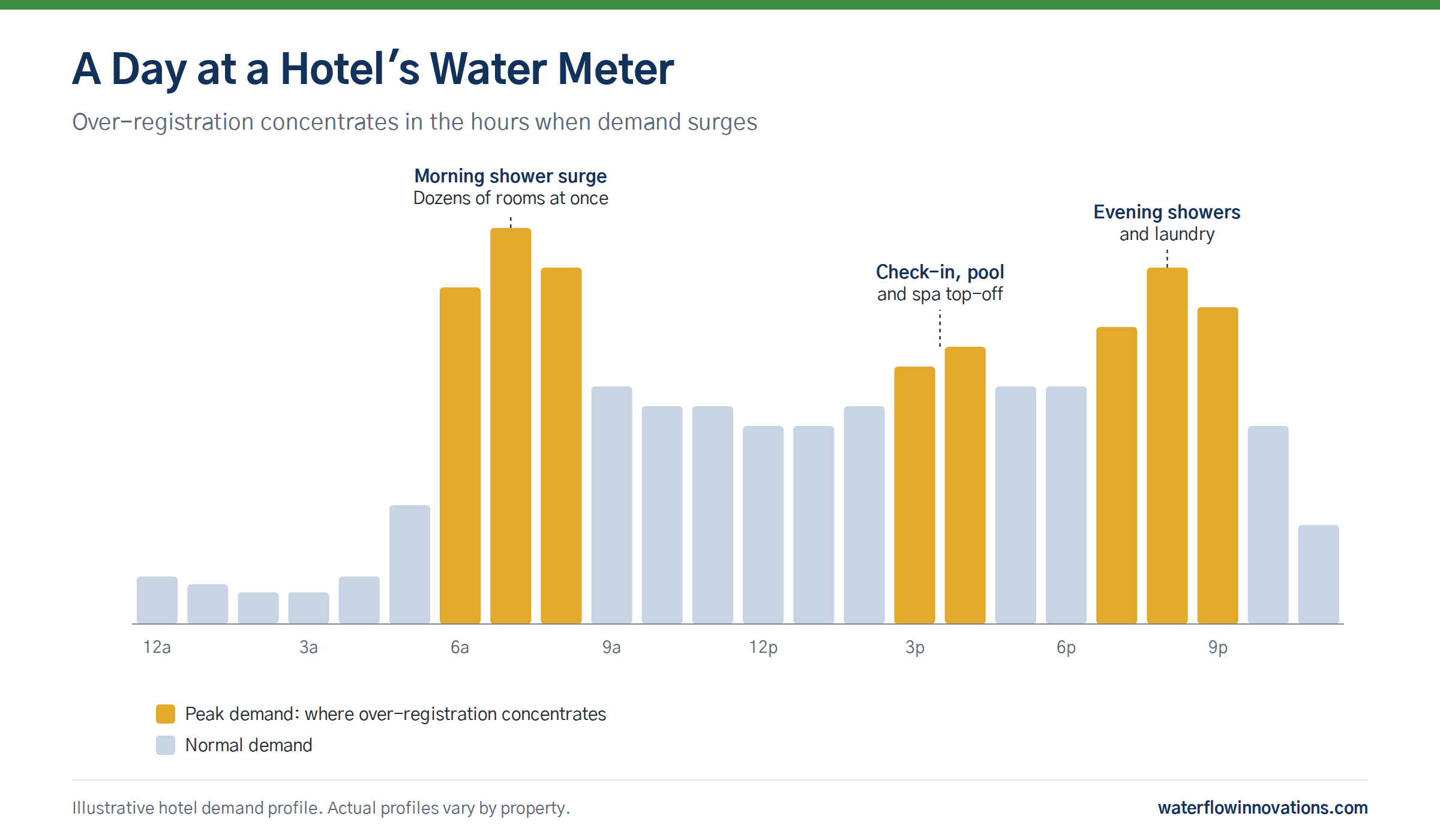
Over-registration concentrates in a hotel’s peak demand hours. Illustrative profile; actual profiles vary by property.
What this looks like on your P&L
A few patterns tend to show up in hotel billing specifically when this is happening:
- Water and sewer costs rising without a corresponding change in occupancy — if RevPAR and occupancy are flat but utility cost per occupied room is climbing, that’s worth investigating.
- Sewer charges moving in lockstep with water charges — since most municipalities calculate sewer fees from
- metered water intake, an inflated water reading inflates your sewer bill by the same margin.
- Cost per occupied room above comparable properties in your brand or portfolio — if you manage or benchmark against other properties, a persistent gap here is a useful signal.
- Water audits that came back clean — engineering teams often check for leaks and confirm usage patterns without ever looking at the flow conditions at the meter, since that’s rarely part of a standard audit scope.
Correcting it without touching guest experience
The fix here doesn’t involve any change to guest rooms, laundry operations, or pool maintenance. A Flow Conditioning Device (FCD) installs immediately after the meter, ahead of your property’s entire internal water distribution, and creates a small, controlled back-pressure that extends back through the meter, holding pressure up during demand surges so far less gas and vapor form and are counted — independent of how your building actually uses water. Installation takes approximately one hour with water off, performed by a licensed plumber or mechanical contractor, and can be scheduled during low-occupancy periods with minimal guest-facing disruption.
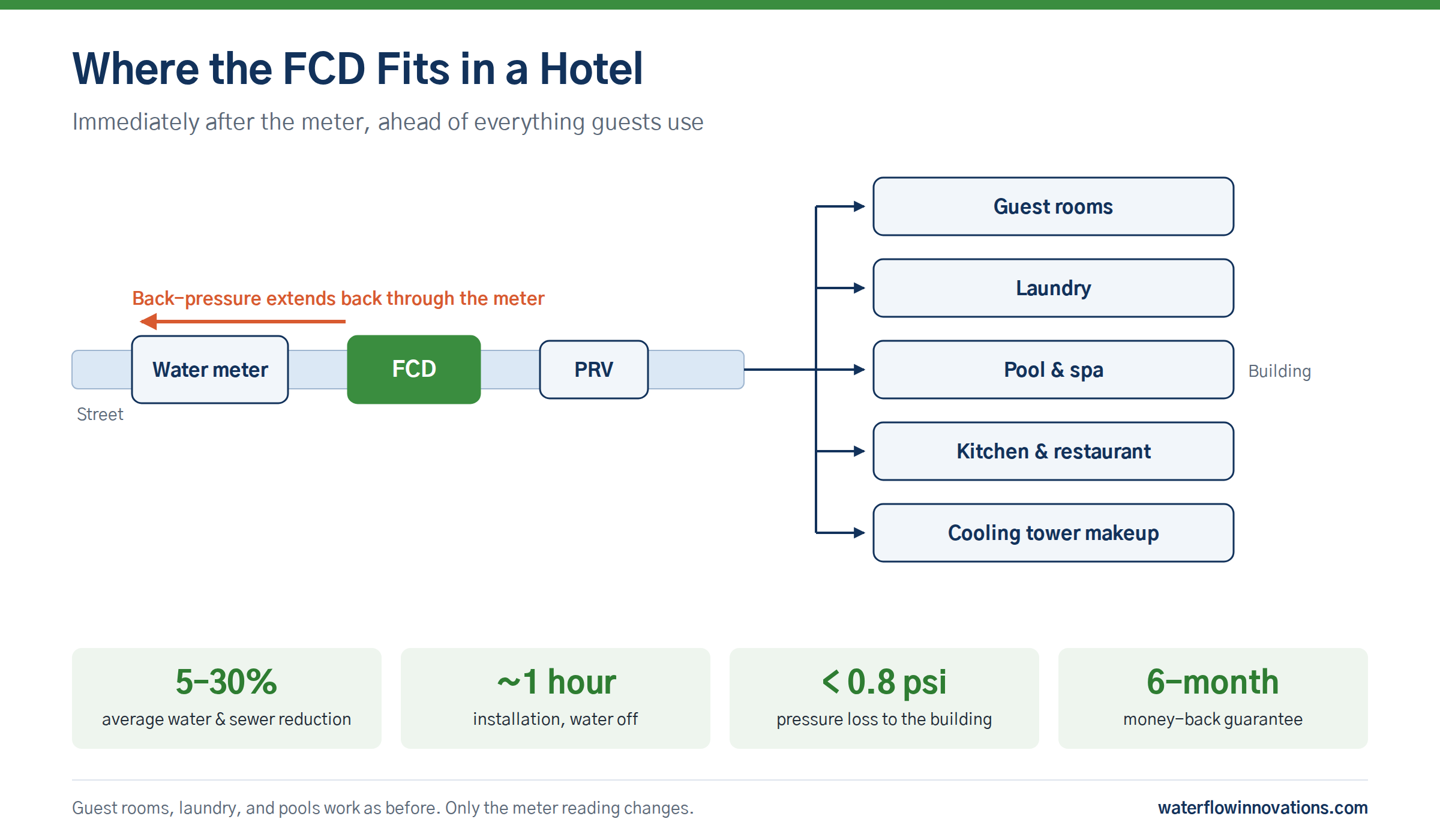
The FCD installs immediately after the meter, ahead of everything guests use.
Documented FCD installations show up to a 30% reduction in combined water and sewer costs (highest documented: 46%), with about 90% of installations reaching full payback in under 12 months — backed by a 6-month money-back guarantee.
To see what this might mean for a specific property, run the numbers through our free savings calculator — no contact information required. More detail specific to hotel and hospitality operations is available on our hotels industry page.
0 Comments