
The Line Item Missing From Your WUE Reporting
Data center facilities teams track Water Usage Effectiveness (WUE) with the same rigor applied to PUE — it’s a metric that shows up in sustainability reports, customer SLAs, and ESG disclosures. But WUE is only as accurate as the meter it’s calculated from, and that’s a variable most facilities teams never have reason to question.
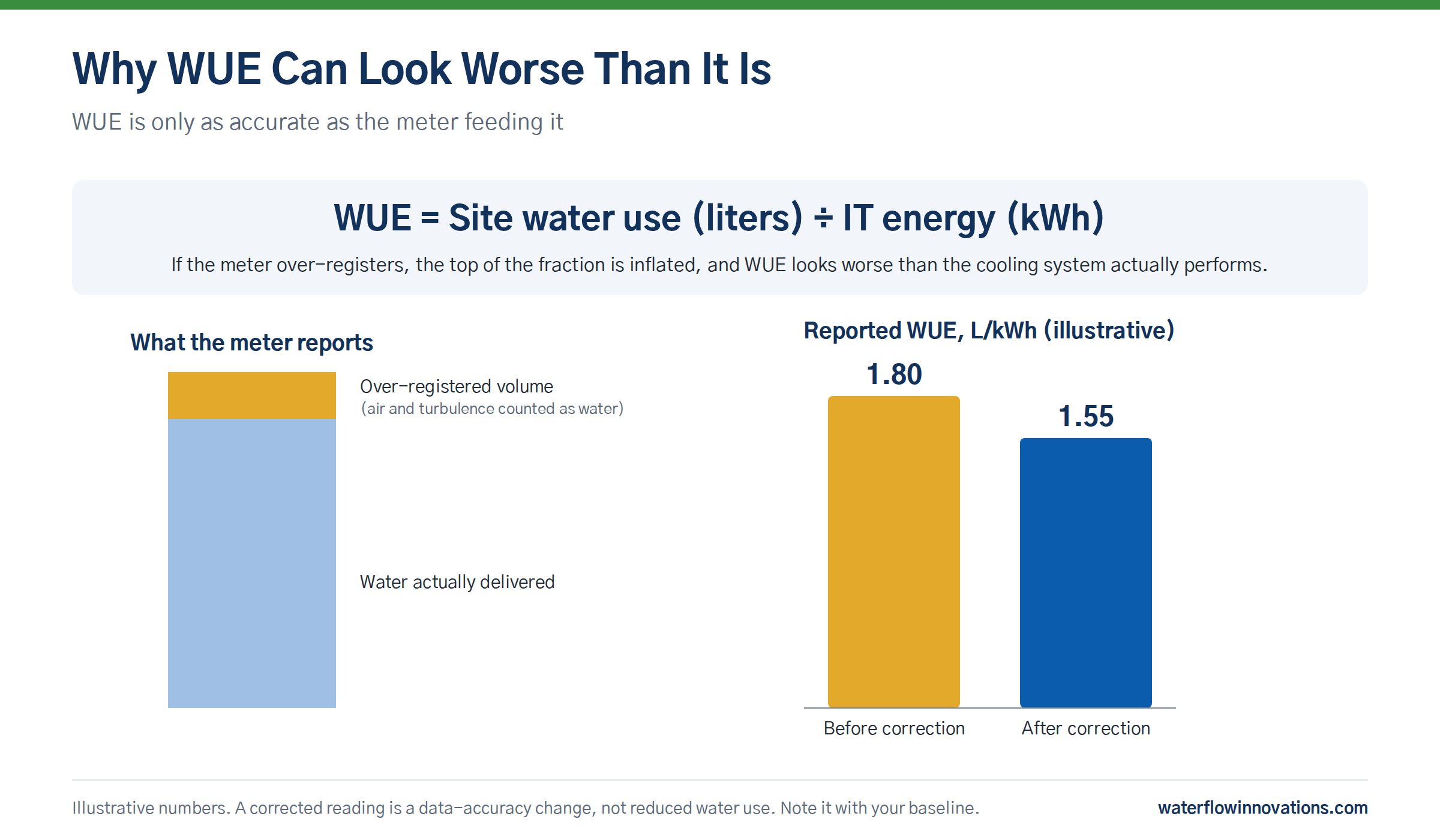
WUE is only as accurate as the meter feeding it. Illustrative numbers; a corrected reading is a data-accuracy change, not reduced water use.
Why data center cooling systems are especially exposed
Cooling tower operation in a data center is a near-continuous cycle: makeup water calls to replace evaporation and blowdown, level-control valves opening and closing to maintain basin levels, and pump starts responding to load changes throughout the day. Each of these events is a demand spike, and demand spikes are precisely the conditions that drop pressure inside the meter and let gas and vapor form.
Water meters measure volume, not composition. They can’t tell water from the gas and vapor that form inside them during a surge, which means a facility with frequent makeup cycling may be paying for, and reporting, more water than actually entered the building.
Where this shows up in the numbers
- Metered intake that doesn’t reconcile against your own cooling load models — if your engineering team’s water balance calculations consistently run lower than what the utility meter reports, that gap is a signal worth investigating rather than dismissing as measurement noise.
- WUE that looks worse than your cooling infrastructure should produce — a well-designed, well-maintained cooling system can still show an inflated WUE if the meter feeding that calculation is over-reading.
- Sewer charges rising in step with water charges — since sewer billing in most municipalities is calculated from metered water intake, a meter over-count inflates both cost lines by the same amount.
- Facility audits that confirm normal operations but don’t explain the bill — a mechanical and controls audit can confirm the cooling system itself is running correctly without ever looking at the flow conditions at the meter, since that’s a different failure mode entirely.
Correcting the measurement without touching the cooling system
A Flow Conditioning Device (FCD) installs immediately after the meter, ahead of all facility water distribution including the cooling plant, and creates a small, controlled back-pressure that extends back through the meter, holding pressure up during demand surges so far less gas and vapor form and are counted — with no modification to cooling tower operation, controls sequencing, or redundancy configuration. Installation takes approximately one hour with water off, performed by a licensed plumber or mechanical contractor, and can be scheduled to avoid any impact to critical operations.
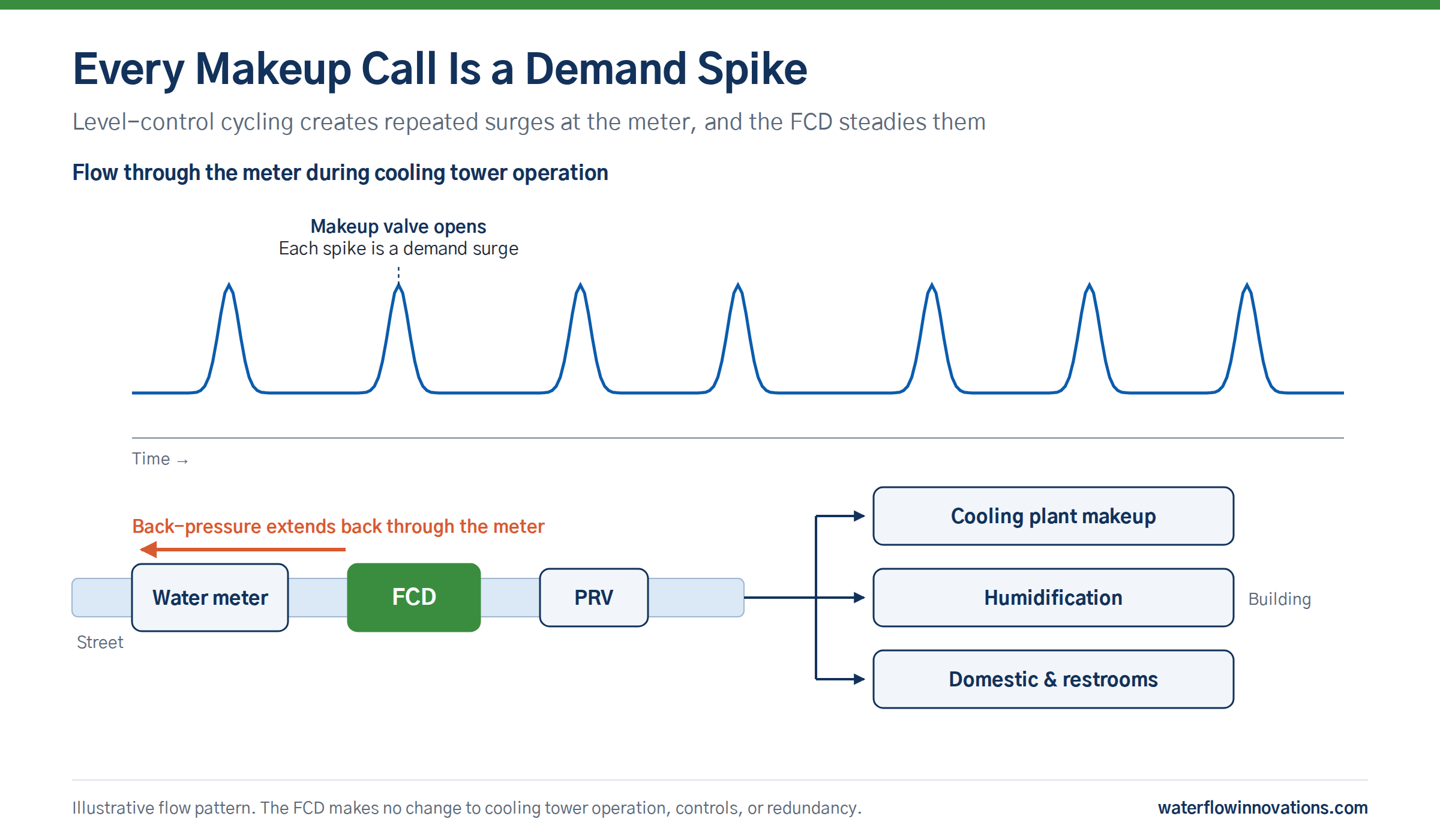
Each cooling tower makeup call is a demand surge at the meter. The FCD steadies conditions there without changing cooling operations.
Documented FCD installations show up to a 30% reduction in combined water and sewer costs (highest documented: 46%), with about 90% of installations reaching full payback in under 12 months, backed by a 6-month money-back guarantee. For facilities reporting WUE externally, correcting the underlying meter reading also means reporting a number that reflects what the cooling system is actually doing. Because that change is a data-accuracy correction rather than reduced water use, note it alongside your baseline when you report.
To estimate the impact for a specific facility, use the free savings calculator — no contact information required. Full technical documentation, including the M&V framework for documenting bill savings, is available in our technical document library, and more detail specific to data center operations is on our data centers industry page.
0 Comments