
Data Center Flow Straighteners: Two Meter Problems, Two Different Fixes
2
5–10 D
2×
<0.8 psi
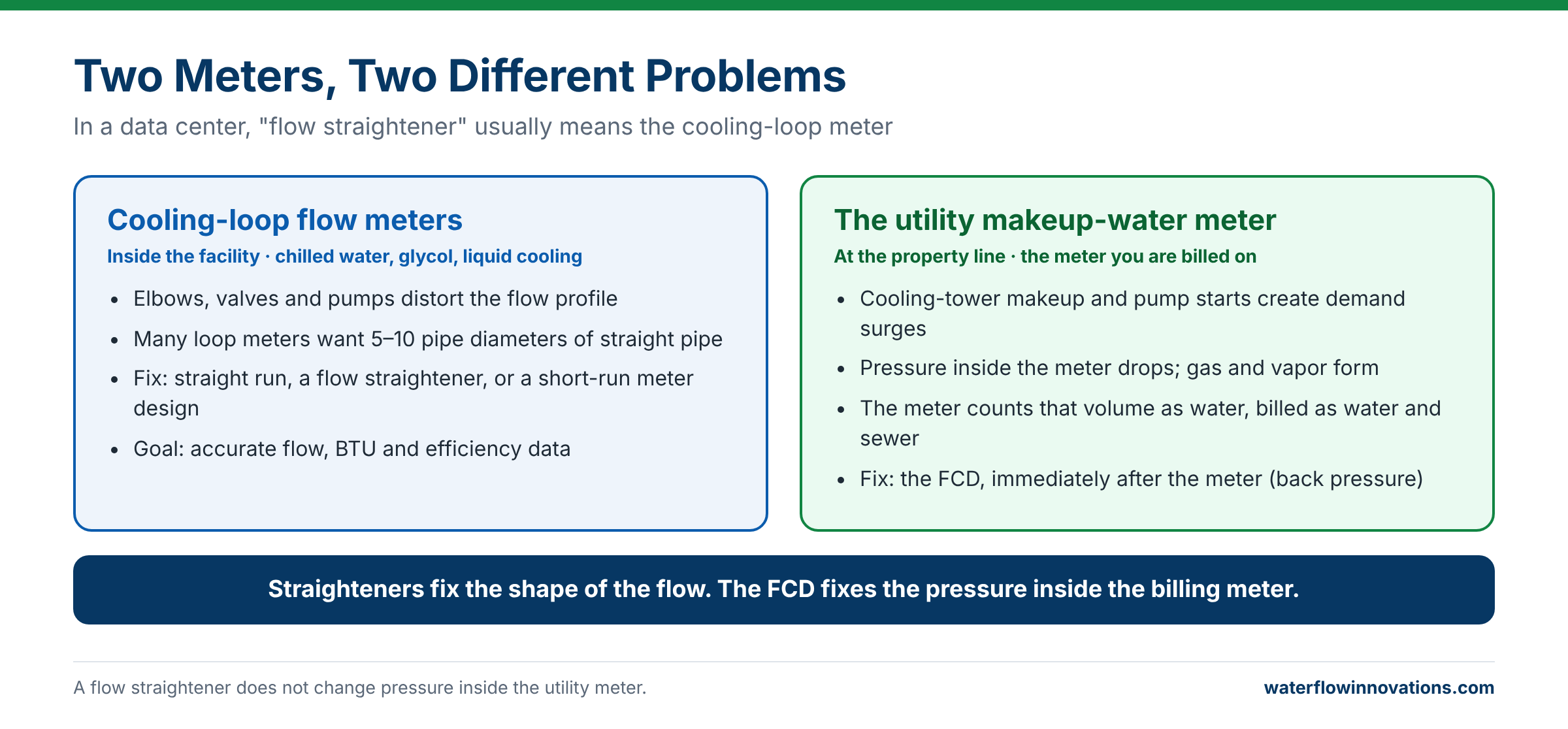
Direct answer: In a data center, a flow straightener usually fixes the cooling-loop meter, not the utility bill. Chilled-water, glycol and liquid-cooling flow meters read best when flow arrives straight and even, so engineers use straight pipe runs, flow straighteners, or meters designed for short runs. The utility meter that bills your makeup water has a different problem: during demand surges, pressure inside it drops, dissolved gas comes out of solution and vapor forms, and the meter counts that volume as water. A straightener doesn’t change that. The Flow Conditioning Device (FCD), installed immediately after the utility meter, does.
Inside the Cooling Loop: Why Engineers Want a Flow Straightener
Data center cooling loops are packed with pumps, valves, elbows and branch connections, and flow meters often have to sit right next to them. Most traditional flowmeters want a run of straight pipe ahead of them, often five to ten pipe diameters, so the flow arrives even and the reading is accurate. In tight mechanical rooms that straight run isn’t always available.
The usual answers are a flow straightener or conditioner ahead of the meter (vanes, tube bundles, perforated plates), a longer straight run, or one of the newer electromagnetic and ultrasonic meters designed to stay accurate with little or no straight pipe. The goal is good data: accurate flow, BTU and efficiency numbers for the building management system. For how straighteners work, see Flow Straighteners and Flow Conditioners and Flow Conditioning Across Industries.
Water Flow Innovations doesn’t supply loop flow meters or straighteners. Your controls contractor or meter manufacturer is the right source for those.
At the Utility Connection: The Meter You’re Billed On
Every data center that uses evaporative or tower cooling buys makeup water through a utility meter, often a large turbine or compound meter. Cooling-tower makeup valves, pump starts and load swings send demand surges through that meter many times a day. During each surge, water speeds up through the meter and pressure inside it drops. Dissolved gas comes out of solution and vapor forms, and the meter counts that volume as water. This is water meter over-registration.
Because sewer is usually calculated from the same meter reading, every over-read gallon is billed twice. On a facility buying millions of gallons a year, that adds up quickly, and it also inflates the water figures that feed WUE and sustainability reports. See Data Center Water Costs for the reporting side.
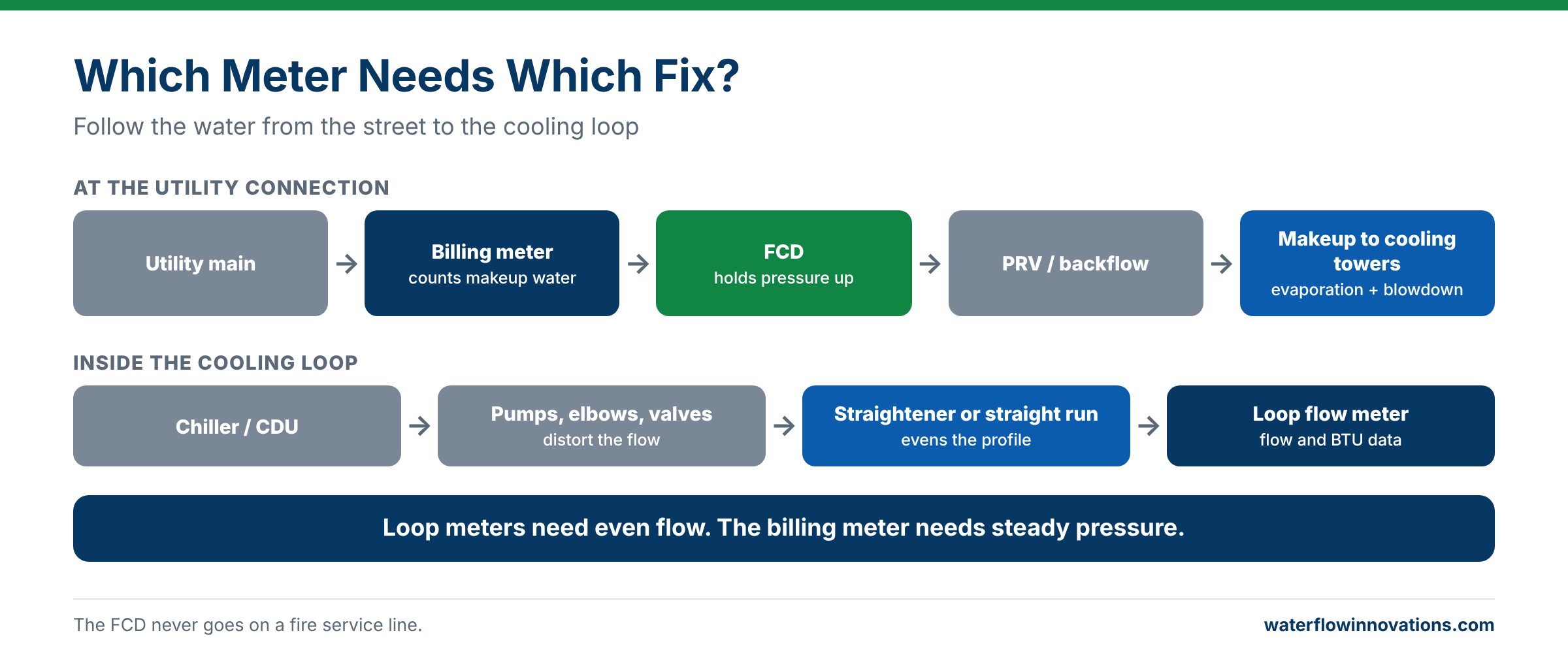
A flow straightener ahead of this meter wouldn’t help. It evens out the flow’s shape, but it doesn’t hold pressure up inside the meter when demand jumps. Industrial liquid metering has handled this for decades with back pressure after the meter; see Back Pressure on Meters.
Straightener or FCD? Side by Side
| Flow straightener | Flow Conditioning Device (FCD) | |
|---|---|---|
| Which meter | Cooling-loop flow and BTU meters | The utility billing meter (makeup water) |
| Where it goes | Upstream of the loop meter | Immediately after the utility meter, before the PRV and backflow preventer |
| What it fixes | Swirl and an uneven velocity profile | Pressure drop inside the meter during demand surges |
| What you get | Accurate loop data for operations and efficiency metrics | A billing meter that counts water, not gas and vapor, on both water and sewer |
| Who supplies it | Your meter manufacturer or controls contractor | Water Flow Innovations |
What This Means for a Data Center
- Loop meters: follow the meter maker’s straight-run guidance, or use a straightener or a short-run meter design.
- The utility meter: check whether it over-registers during demand surges. The Flow Conditioning Device (FCD) installs immediately after the utility meter and creates a small, controlled back-pressure that extends back through the meter, holding pressure up during demand surges so far less gas and vapor form and are counted as water. Pressure loss is under 0.8 psi, and nothing downstream changes. It corrects what the meter records; it doesn’t reduce the water the facility uses.
- Large services: FCDs are custom-built for each site, including large-diameter mains, and sized from the meter, pipe size, pressure and demand profile.
- Fire protection: the FCD is never installed on a fire service line.
- Cooling-tower water that evaporates: separately, many utilities offer a sewer credit for it; see Evaporation Sewer Credit.
Documented installations typically show up to a 30% reduction in combined water and sewer costs (46% highest documented, a rare case); results vary by building.
Part of our data center coverage. For the full industry overview, see Data Centers.
Sources and Standards
- Power Magazine and DatacenterDynamics, flow measurement in data center liquid cooling (straight-run requirements of five to ten pipe diameters, and short-run meter designs).
- Emerson, Rosemount 8795 magnetic flow sensor for data center chilled water and glycol loops (accuracy with limited straight pipe).
- Badger Meter, measuring flow with zero straight-run requirements in building HVAC and plumbing.
- American Petroleum Institute, Manual of Petroleum Measurement Standards, Chapter 5.3 (minimum back pressure after liquid turbine meters).
- AWWA C701 and C702, cold-water turbine and compound meters for customer service.
Standards and manufacturer guidance describe industrial practice. Water Flow Innovations applies the same principles to commercial water service; results vary by building.