
As the year winds down, many business owners start looking at equipment purchases with taxes in mind. One question we hear often: can a Flow Conditioning Device (FCD) qualify for Section 179 or bonus depreciation this year? The short answer is that it may, but every business’s situation is different, and the final call belongs to your tax advisor. The part you can control is timing. Here’s a plain-language overview to bring to that conversation. (For the full overview, see Tax Incentives & Section 179.)
This article is general information, not tax advice.
What Section 179 is
Section 179 of the U.S. tax code lets many businesses deduct the cost of qualifying equipment in the year it’s placed in service, instead of depreciating it over many years. Bonus depreciation is a related provision that can allow a large first-year deduction as well. Both have rules, limits, and annual thresholds that change over time.
Why an FCD may be relevant
The FCD is a physical piece of equipment, custom-built in 316L stainless steel and installed on a building’s main water line immediately after the meter. Whether it qualifies, and under which provision, depends on factors like:
- how your business uses the property
- whether the equipment is considered part of the building’s structure or a separate asset
- the year it’s placed in service
- your business’s overall tax situation
Those are exactly the questions your accountant is equipped to answer.
Why the timing matters
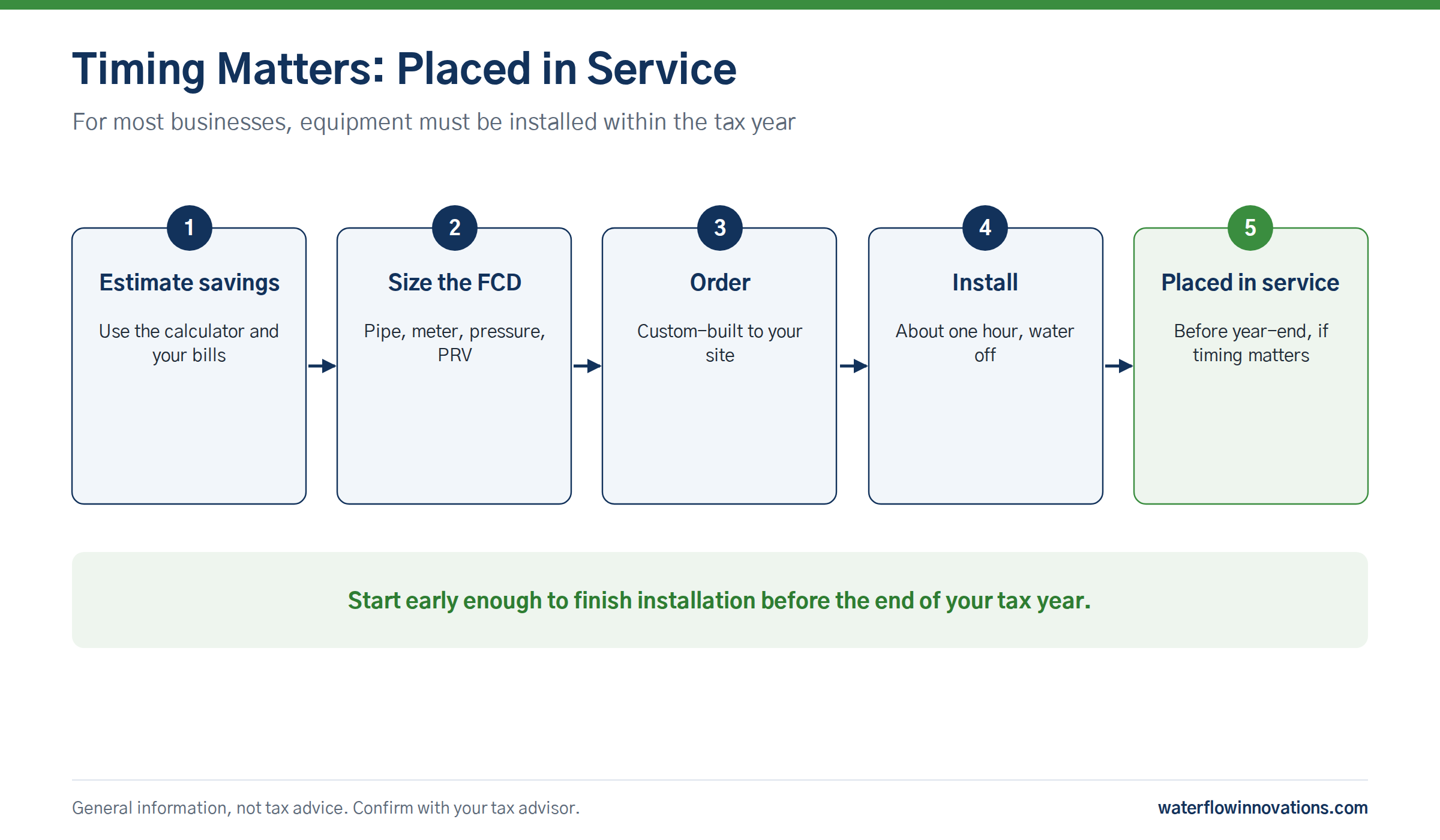
For most businesses, equipment has to be placed in service within the tax year to count for that year. That generally means installed and working, not just ordered. Because an FCD installation takes about an hour, installation itself is rarely the bottleneck. Sizing and ordering simply need to start early enough to finish before year-end. FCD sizing typically takes about 2 business days once we have your pipe size, meter, and pressure details.
The savings side of the equation
A tax benefit is a bonus. The core value is the recurring reduction in water and sewer costs. During demand surges, water moves through the meter at high velocity and pressure inside the meter drops. Dissolved gas comes out of solution and vapor forms, and the meter counts that volume as water. The FCD creates a small, controlled back-pressure that extends back through the meter, holding pressure up so far less gas and vapor form and are counted. (See How the FCD Works.)
Documented installations typically show up to a 30% reduction in combined water and sewer costs (46% is the highest documented, a rare case), and about 90% of customers reach full ROI in under 12 months, before any tax benefit.
Questions to bring to your tax advisor
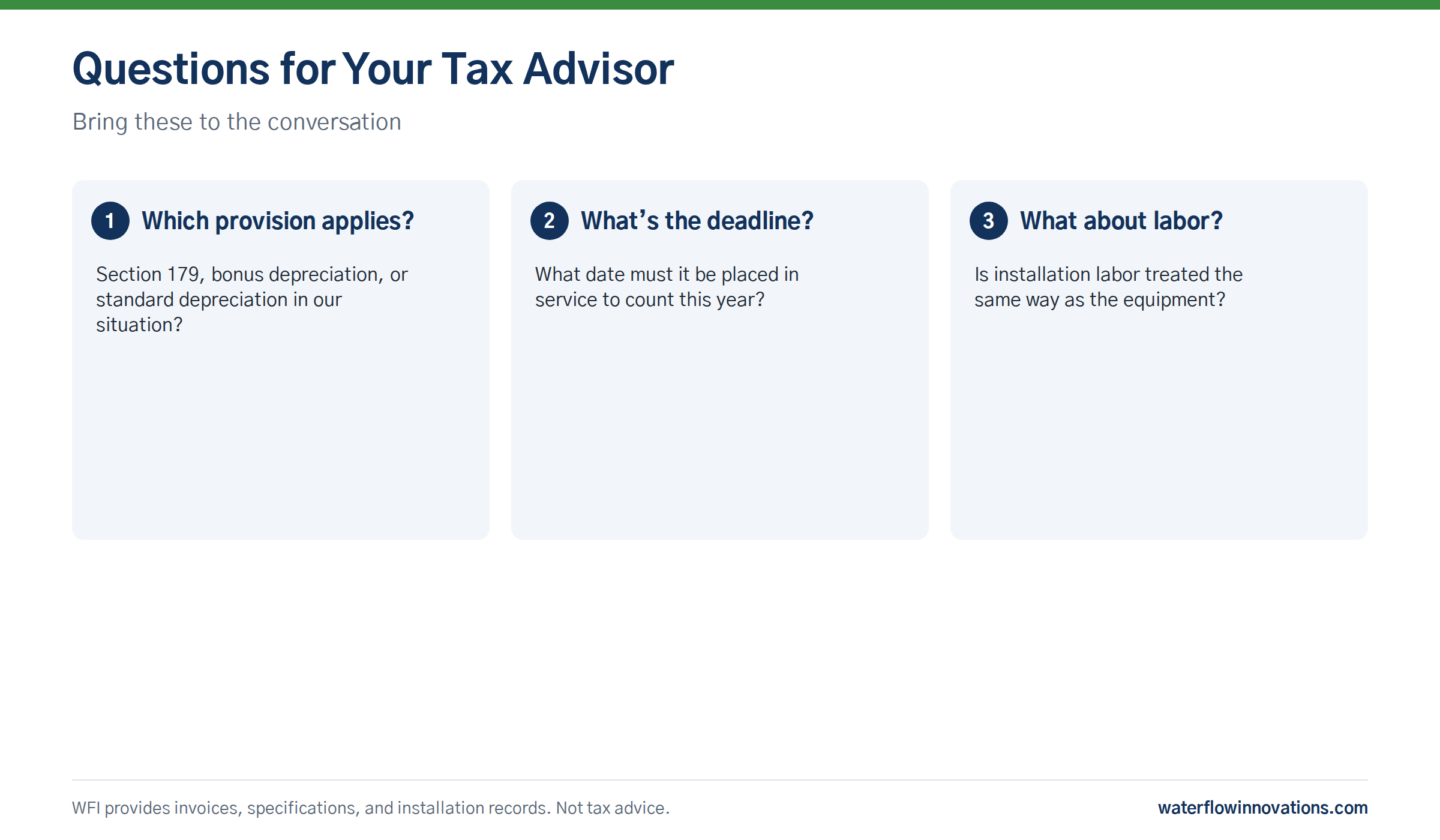
- Does the FCD qualify for Section 179, bonus depreciation, or standard depreciation in our situation?
- What date must it be placed in service to count for this tax year?
- Is installation labor treated the same way as the equipment?
Frequently Asked Questions
Q: Can WFI tell me whether I qualify?
A: No. We can provide equipment documentation and invoices, but eligibility must be confirmed by your tax advisor.
Q: Does installation have to be finished by December 31?
A: For calendar-year businesses, equipment generally must be placed in service within the tax year. Confirm the exact requirement with your advisor.
Q: What documentation will I receive?
A: An invoice, equipment specifications, and installation records, which are typically what an accountant needs.
To estimate your savings before talking to your advisor, try the free Water & Sewer Savings Calculator.
0 Comments