
Legionella Flushing and Your Water Meter: What Hospitals Should Know
2017
ASHRAE 188
Keep
<0.8 psi
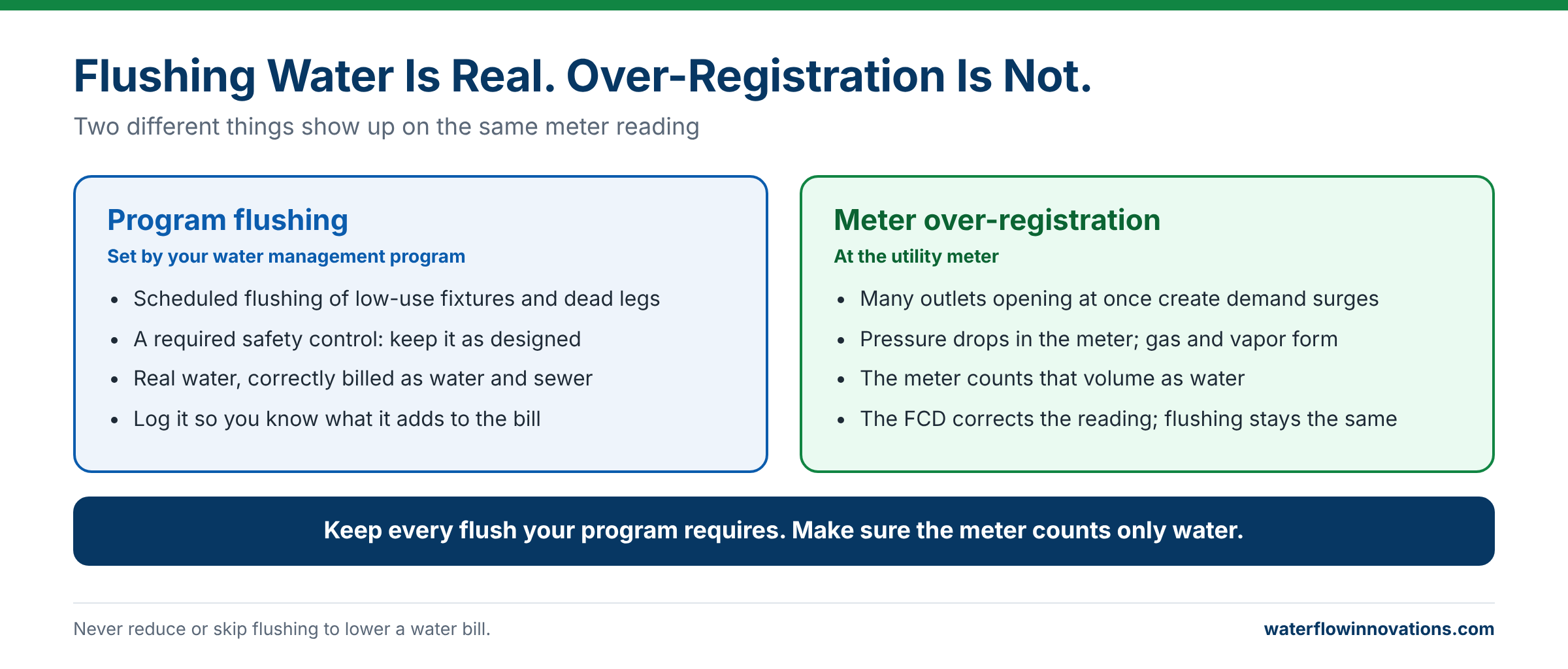
Direct answer: Flushing required by your water management program is real water use, and it should continue exactly as your program team designed it. Separately, the utility meter can over-register during demand surges: when many outlets open at once, pressure inside the meter drops, dissolved gas comes out of solution and vapor forms, and the meter counts that volume as water. The Flow Conditioning Device (FCD), installed immediately after the utility meter, corrects that reading on water and sewer. It does not treat water, does not control Legionella, and makes no practical change to temperature, disinfectant levels or flow at the fixtures.
This page explains how utility water meters record and bill water. It is not medical, infection-control, engineering or regulatory advice, and it is not a substitute for your facility’s water management program. Decisions about flushing, water temperatures, disinfection, sampling and any change to the building water system belong to your water management program team and the requirements that apply to you, including CMS, The Joint Commission, ASHRAE Standard 188, CDC guidance, and state and local health authorities. Water Flow Innovations does not provide Legionella risk assessments, water treatment, water testing or infection-control services.
Why Hospitals Flush
Since 2017, the Centers for Medicare & Medicaid Services (CMS) has required hospitals, critical access hospitals and nursing homes to have water management policies and procedures to reduce the risk of Legionella and other waterborne pathogens (memo QSO-17-30). Those programs must consider ASHRAE Standard 188 and the CDC’s water management toolkit, and The Joint Commission added its own water management standard for hospitals in 2022.
Stagnant water is one of the conditions these programs manage, so many include routine flushing of infrequently used fixtures and dead legs, plus flushing of unoccupied areas before they return to service. The details, which outlets, how often and for how long, belong to your water management program team.
Nothing on this page suggests reducing or skipping flushing. It is a safety control, and the water it uses is real.
What the Meter Sees
A hospital’s utility meter carries everything: patient care, kitchens, laundry, sterile processing, cooling and program flushing. Flushing routes, shift changes, booster pumps and large equipment all create demand surges, moments when many outlets open at once and flow through the meter jumps.
During a surge, water speeds up through the meter and pressure inside it drops. Dissolved gas comes out of solution and vapor forms, and the meter counts that volume as water. This is water meter over-registration. Because sewer is usually billed from the same reading, every over-read gallon is billed twice.
The flushing water itself is correctly billed. What the FCD addresses is the extra volume the meter adds during surges, from any source.
Accounting for Flushing Water
- Log flushing volumes. Your program records already show which outlets are flushed and for how long. Estimating the gallons lets you see what flushing adds to the bill, and plan for it.
- Separate program water from the base. Compare months with and without extra flushing (for example, a unit returning to service) so changes in the bill aren’t mistaken for leaks or waste.
- Rule out leaks. When the building’s use is lowest, check whether the meter moves more than expected; see the overnight meter test for the method.
- Watch the meter during surges. If the bill runs consistently above what departments, equipment and logged flushing account for, surge-driven over-registration is worth checking.
Where the FCD Fits, and Where It Doesn’t
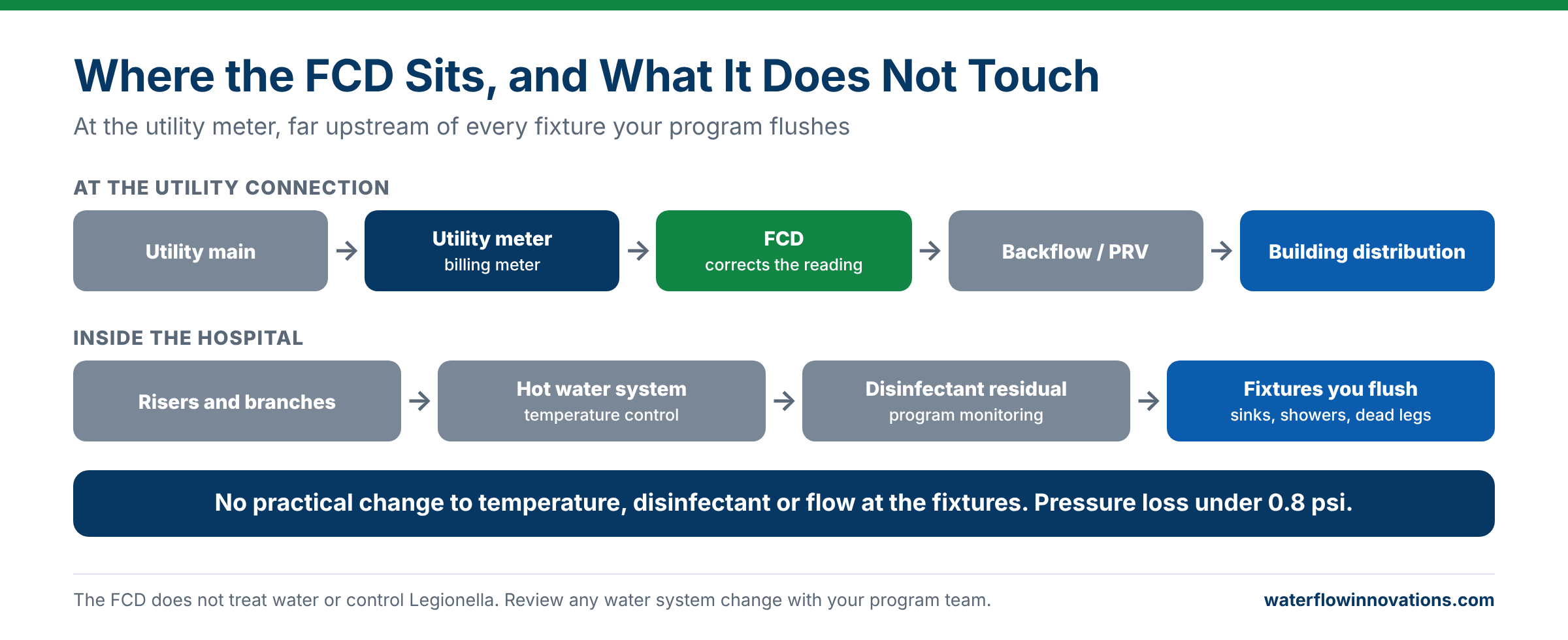
The FCD installs immediately after the utility meter, at the property line, far upstream of every fixture your program flushes. It creates a small, controlled back-pressure that extends back through the meter, holding pressure up during demand surges so far less gas and vapor form and are counted as water. Pressure loss is under 0.8 psi across all flow conditions.
- It does not treat or condition the water, add or remove disinfectant, change hot-water temperatures, or control Legionella or any other pathogen.
- It does not reduce the water you use, including flushing water. It corrects what the meter records.
- It is never installed on a fire service line.
- The FCD carries IAPMO, NSF, ANSI and CAN 61 certifications, among others; see Technical Information.
Before any installation, share the plan with your water management program team. ASHRAE 188 programs review changes to the building water system, and an FCD at the service entrance is one. We provide the specifications and installation details they need.
Documented installations typically show up to a 30% reduction in combined water and sewer costs (46% highest documented, a rare case); results vary by building.
Part of our healthcare coverage. For the full industry overview, see Healthcare.
Sources and Standards
- Centers for Medicare & Medicaid Services, QSO-17-30: Requirement to Reduce Legionella Risk in Healthcare Facility Water Systems (2017, revised 2018).
- ASHRAE Standard 188, Legionellosis: Risk Management for Building Water Systems.
- CDC, Developing a Water Management Program to Reduce Legionella Growth & Spread in Buildings (toolkit), and Healthcare Facility Water Management resources.
- The Joint Commission, Standard EC.02.05.02 (water management program; effective January 1, 2022).
- American Petroleum Institute, Manual of Petroleum Measurement Standards, Chapter 5.3 (minimum back pressure after liquid meters).
Standards and manufacturer guidance describe industrial practice. Water Flow Innovations applies the same principles to commercial water service; results vary by building.