
Quick Answer
A water meter rarely fails outright. As it wears it drifts, and most often it drifts slow, which favors the customer. When a commercial bill runs high and the tariff checks out, the more likely cause is how the meter behaves at peak demand, not a fault in the meter itself. The meter belongs to the utility, so you cannot replace it or open it, but you can request a test, and many utilities run one without charge once a year. What happens next is set by rule rather than by negotiation. California Water Service refunds an overcharge when a meter is found registering more than 2% fast, capped at six months. Wisconsin obliges the utility to recalculate bills for the period of inaccuracy once a displacement meter registers above 102%, or a compound or current meter above 103%. Those thresholds, and the date of your last periodic test, frame the conversation. If the meter passes and the volume still outruns production, the question moves from the meter to the flow conditions it is measuring.
What Does a Faulty Water Meter Look Like on a Commercial Account?
Not like a spike. A spike is almost always a leak, a valve left open, or a process change. A drifting meter produces something much quieter.
- Billed volume rises while production is flat. The clearest single symptom, and the only one that survives scrutiny. Same month, year over year, at the same rate.
- Volume no longer tracks the thing that drives it. Units produced, wash cycles, occupancy, vehicles through the bay. When the ratio moves and the operation did not, the measurement is in question.
- The busiest periods grow fastest. Over-registration is created at peak demand, so billed volume climbs most in the months and shifts with the heaviest draw (production runs, CIP cycles, peak service hours), while quiet periods stay close to normal. A shutdown week that suddenly registers volume points to a leak instead.
- Two meters on one site disagree. Where a submeter or a check meter exists, compare the totals. A gap that grows month over month is a measurement problem, not a billing one.
- The utility has started estimating. Estimated reads on a commercial account often mean the register is unreadable or the remote read has failed, which is a fault in itself.
What is not a symptom: a high bill on its own. On a commercial account a high bill is produced just as easily by a rate class error, an oversized service or an unclaimed exclusion, and those are far more common. Reconcile the bill against the tariff first. Our guide to how a commercial sewer bill is calculated sets out that arithmetic, and the order matters: tariff first, meter second.
Can a Water Meter Actually Be Faulty, or Is That a Myth?
It can, and the standards allow for it.
Under AWWA C700 a new positive displacement meter is expected to register between 98.5% and 101.5% at normal and high flow, and no less than 97% at the AWWA-specified low flow. That is a tolerance band around a meter in new condition. It is not a promise that holds for fifteen years.
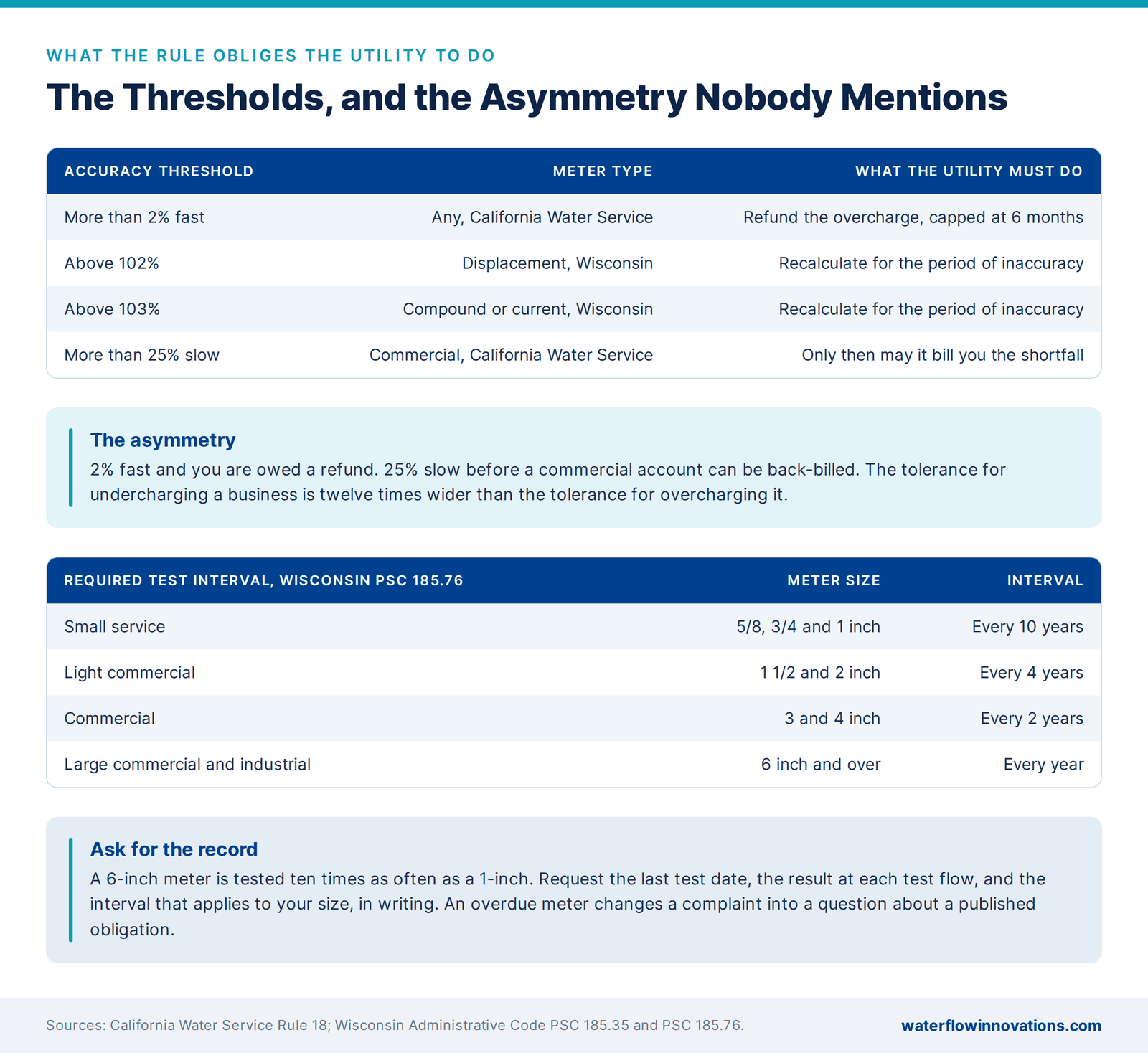
Regulators then set the point at which drift becomes actionable, and they set it by meter type. Wisconsin requires the utility to recalculate bills for the period of inaccuracy once a displacement meter registers above 102%, or a compound or current meter above 103%, under Administrative Code PSC 185.35. California Water Service uses a flatter threshold in its published Rule 18: more than 2% fast triggers a refund.
Notice the asymmetry in the California rule, because it tells you how the system actually thinks. A meter must be only 2% fast before the utility owes you money. For a commercial account, a meter has to be more than 25% slow before the utility can bill you for the shortfall. The tolerance for undercharging a business is twelve times wider than the tolerance for overcharging it.
Why Do Commercial Meters Drift Faster Than Small Ones?
Because of what passes through them and how often, and the regulators have already priced that in.
Wisconsin publishes its periodic test schedule in Administrative Code PSC 185.76:
| Meter size | Required test interval |
|---|---|
| 5/8, 3/4 and 1 inch | 10 years |
| 1 1/2 and 2 inch | 4 years |
| 3 and 4 inch | 2 years |
| 6 inch and over | 1 year |
A 6-inch meter is tested ten times as often as a 1-inch. That schedule is not arbitrary. It reflects that large meters run harder, see wider flow swings, and carry far more money per percentage point of error.
Three things sit behind a reading that has moved on a commercial service, and they do not all push in the same direction.
Wear on the measuring element. A displacement meter has moving parts in the water path. Years of abrasive or hard water wear them, and a worn meter most often registers slow, especially at low flow. Wear is the classic meter fault, and it usually works in the customer’s favor.
Sizing against the demand. A meter sized for a peak the facility no longer reaches spends most of its life at the bottom of its flow range, where meters tend to register low, and the fixed charge is paid for capacity nobody uses. A right-sized or downsized meter sees higher velocity at every peak, which matters for the third cause.
High-demand flow at the measuring element. This is the one that is specific to commercial and industrial sites, the one most often missed, and the one that pushes the reading high.
What Pushes a Commercial Meter Reading High?
High demand. Every commercial and industrial site has peaks built into the operation: process water draws, CIP cycles, washdowns, cooling tower makeup, restroom peaks at opening and shift change, dish machines during a restaurant rush. At those peaks, water moves through the meter at high velocity, and the pressure inside the meter drops, dissolved gas comes out of solution, and vapor forms.
Those expand to fill space inside the meter that should be occupied by water. A meter measures volume and cannot tell water from gas or vapor, so it registers that expanded volume and bills it as water. The piping system around the meter adds to it: valves, fittings, turns and size changes add pressure loss at exactly the moments velocity is highest.
This is not a fault in the meter. A meter in perfect condition behaves the same way under the same conditions, which is why a meter can pass a test, run under controlled flow and pressure, and still over-register at the building’s peak demand. It’s not your meter. It’s your pipes.
This distinction decides what fixes the problem. A meter that has simply worn out is fixed by a replacement. Over-registration at peak demand is not, because a new meter of the same type in the same position registers the same expanded volume at the next peak. That is the difference between a faulty meter and meter over-registration, and the remedies are not the same.
The remedy for over-registration is to hold pressure up through the meter when demand peaks. A Flow Conditioning Device (FCD) installs immediately after the meter and creates a small, controlled backpressure that extends back through the meter. That keeps the water intact at high velocity, so the meter registers water only, with pressure loss to the building under 0.8 psi. It corrects the reading; it does not reduce the water the facility actually uses. For the physics behind it, see How the FCD Works.
Who Is Responsible for a Faulty Water Meter, You or the Utility?
The utility, in almost every US system. It owns the meter, it reads it, it tests it and it replaces it. You do not buy it and you may not open it.
The responsibility line sits at the meter itself. Everything on your side of it, including the valves, couplings and vault, is yours. Our guide to replacing a business water meter covers what that means when an old meter is pulled, and when a change of service size is worth asking for.
On cost of testing, the rules are more generous than most facilities realize. California Water Service states that no charge is made for a test requested by a customer, except where the request comes within six months of installation or more than once a year, in which case the customer pays. In other words, one free test a year is the baseline, not a favor.
On the money, the limits are the thing to read carefully. California Water Service refunds an overcharge based on corrected readings “for the period the meter was in use but not to exceed a period of six months.” Six months, no matter how long the meter was wrong. Wisconsin’s rule is framed around the period of inaccuracy rather than a fixed cap. Find the rule that applies where your facility sits before you build an expectation, because the gap between those two approaches is the difference between a six-month refund and a multi-year one.
How Do You Get a Faulty Meter Tested, Properly?
The order matters. A request that arrives as a complaint gets handled as a complaint.
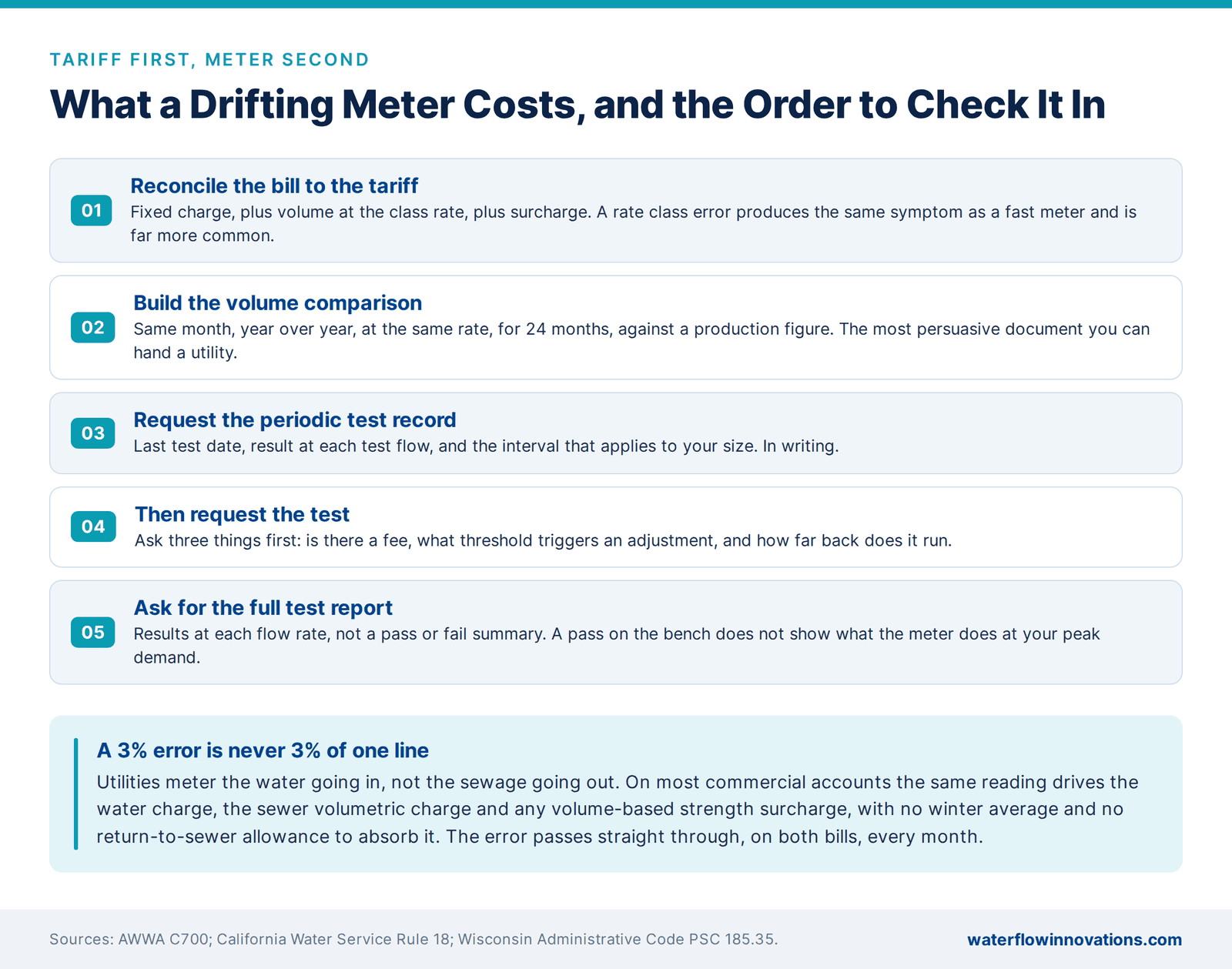
- Reconcile the bill to the tariff first. Fixed charge, plus volume at your class rate, plus surcharge. If the arithmetic does not reconcile, the problem is billing, not measurement, and a meter test will come back clean and cost you the argument.
- Build the volume comparison. Same month, year over year, at the same rate, for 24 months, against a production figure. This is the single most persuasive document you can put in front of a utility.
- Record the meter. Make, model, size, serial and current register reading, photographed and dated.
- Request the periodic test record in writing. Last test date, the result at each test flow, and the interval that applies to your size. If the meter is overdue against the published schedule, say so plainly and cite the rule.
- Then request the test. Ask three questions before it happens: is there a fee and under what circumstances, what accuracy threshold triggers an adjustment, and how far back does an adjustment run.
- Ask for the meter to be preserved. Once a meter is pulled it is the utility’s property and its record. Ask in writing for the test report at each flow rate, not a pass or fail summary.
A full water meter assessment covers the installation and the flow conditions as well as the registration, which matters because a passing test will not tell you what the meter does at your peak demand.
What Happens on the Sewer Bill?
This is the part that doubles the number, and it is the reason a 2% meter error is worth more on a commercial account than most facility managers assume.
Utilities meter the water going in, not the sewage going out. So on most commercial accounts the same reading that produces the water charge also produces the sewer volumetric charge, and where a strength surcharge is billed by volume, it produces that too. A meter registering 3% high does not cost you 3% of one line. It costs you 3% of the water charge, 3% of the sewer volumetric charge and 3% of any volume-based surcharge, every month, because both bills are calculated from the same reading.
On a commercial account there is no winter average and no return-to-sewer allowance to absorb the difference. The error passes straight through.
Frequently Asked Questions
Can a commercial water meter be faulty?
Yes. AWWA C700 sets the accuracy band for a new positive displacement meter at 98.5% to 101.5% at normal and high flow, which is a tolerance rather than a guarantee. Meters drift with wear, which is why regulators require large meters to be tested far more often than small ones. Separately, a meter in good condition can over-register during high-demand periods because of the flow conditions it is measuring.
What are the symptoms of a faulty water meter on a business account?
Billed volume rising while production stays flat, volume no longer tracking the operational driver behind it, volume growing fastest in the busiest periods, a growing gap between a submeter and the utility meter, and estimated reads appearing on the bill.
Who is responsible for a faulty water meter?
The utility owns, tests and replaces the meter. The property is responsible for everything on its own side of it, including the valves and the vault, which is where unexpected cost appears when an old meter is pulled.
Who pays for a water meter test?
Usually the utility. California Water Service makes no charge for a test requested by a customer unless the request comes within six months of installation or more than once a year. Confirm your own utility’s policy in writing before requesting.
How fast does a meter have to be before the utility refunds anything?
It depends on the rule that applies. California Water Service refunds when a meter registers more than 2% fast. Wisconsin obliges recalculation once a displacement meter registers above 102%, or a compound or current meter above 103%.
How far back can a refund go for a faulty meter?
California Water Service caps it at six months regardless of how long the meter was in use. Wisconsin frames the obligation around the period of inaccuracy instead. The difference between those two approaches is substantial, so check the rule where your facility sits.
Does replacing the meter fix the problem?
It fixes wear. It does not change the fixed charge, the rate class, any unclaimed exclusion, or the high-demand flow conditions at the measuring element. Where high-demand flow is pushing registration high, a new meter of the same type in the same position registers the same way at the next peak.
Related reading
- Five signs a commercial water meter is over-reading
- High water bill with no visible leak: what to check next
- What a Flow Conditioning Device actually does
Have the Meter and the Bill Checked Together
Water Flow Innovations assesses meter installations and billing data for commercial, industrial and multifamily facilities. Send your meter make, model and size plus 12 months of bills, and we will tell you whether the registration is the problem, whether the tariff is being applied correctly, and what high-demand flow is doing to the number.
Water Flow Innovations LLC, 2651 Route 412, Coopersburg, PA 18036. Call 1-844-934-8258.
0 Comments