
When a facility’s water and sewer costs are too high, the standard playbook has been the same for decades: reduce consumption at the point of use. In an office building, apartment community, or hotel, that means low-flow toilets, faucet aerators, and efficient showerheads. In an industrial or process-driven facility, the equivalent move is upgrading to more water-efficient process equipment — closed-loop cooling retrofits, efficient spray nozzles and wash-down systems, or optimized batch cycling. Both genuinely reduce consumption, and both have earned their place in sustainability and capital planning. But they’re not the only lever available, and for a lot of facilities, they’re not the fastest one either.
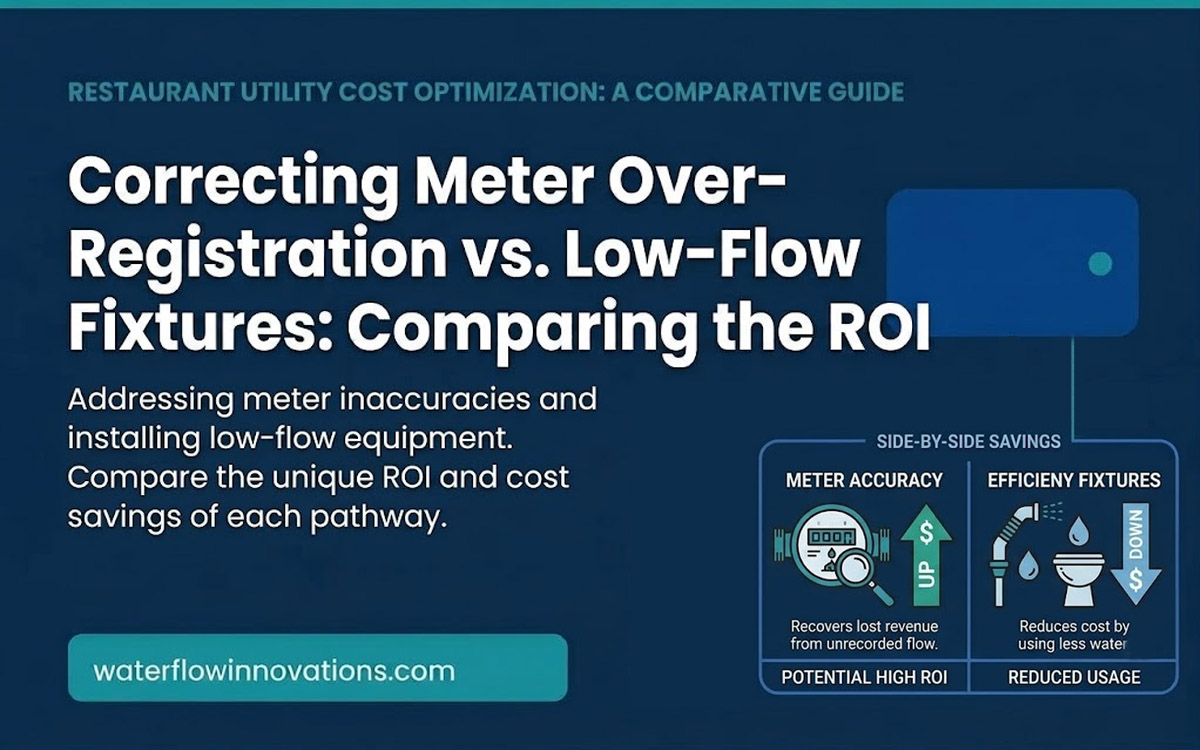
Here’s an honest comparison of two different approaches to the same problem: reducing consumption at the fixture level, versus correcting meter over-registration at the source.
What each approach actually addresses
Low-flow fixtures and efficient process equipment reduce the actual volume of water used — less water flows through the faucet, the toilet, the showerhead, the spray nozzle, or the cooling loop, so less water is consumed and billed.
Meter over-registration correction addresses a different problem entirely: it doesn’t reduce how much water your facility uses. Instead, it corrects a measurement error — gas and vapor that form inside the meter during demand surges and get counted as billable water even though nothing was actually delivered. A Flow Conditioning Device (FCD) installs at the meter itself, upstream of your building’s plumbing, and eliminates the conditions that cause that over-count.
These aren’t competing solutions to the same problem. In many facilities, they’re addressing two entirely separate sources of cost — which means they can be complementary rather than an either/or choice.
Capital cost and disruption
Low-flow fixture retrofits typically mean replacing toilets, faucets, and showerheads across some or all of a facility — a project that scales with unit count and often requires scheduling around occupancy, coordinating with tenants or guests, and disposing of the old fixtures. For a large multifamily or hospitality property, this can mean weeks of staged work. Industrial process-equipment upgrades carry a parallel cost: retrofitting a cooling tower, replacing wash-down equipment, or reconfiguring batch cycling on a production line typically means scheduled downtime, engineering review, and capital budgeting cycles measured in months, not days — for a data center or food processing plant, that disruption to operations is often the harder cost to absorb than the equipment itself.
Meter correction, by contrast, is a single installation at one point: the meter. A licensed plumber or mechanical contractor installs the FCD in approximately one hour, with water off for that window, and the work is complete. There’s no per-unit disruption, no tenant coordination, and no ongoing maintenance — it’s custom-built for the facility’s exact specifications and installed once.
Payback timeline
Fixture retrofits typically pay back over a period of years, since the per-unit cost adds up across a large property and the per-fixture savings, while real, are incremental.
Meter over-registration correction tends to pay back faster because the intervention is a single point of correction rather than hundreds of individual fixtures. Documented results for FCD installations show an water and sewer bill reduction of up to 30% (with a highest documented reduction of 46%), and roughly 90% of installed customers reach full return on investment in under 12 months.
Which one is right for a given facility?
If a facility’s fixtures or process equipment are genuinely old and inefficient — pre-1994 toilets, non-aerated faucets, an aging open-loop cooling system — a retrofit is worth doing on its own merits, and it will reduce real consumption regardless of what’s happening at the meter.
But fixture or equipment upgrades don’t address meter over-registration at all. A facility can replace every toilet in the building, or overhaul its cooling tower, and still be paying for phantom volume at the meter if that’s a separate, unaddressed issue. Conversely, a facility with reasonably modern fixtures and equipment but an unexplained high bill is very possibly dealing with a meter accuracy problem that no amount of equipment replacement will touch.
The two approaches are best evaluated separately, not against each other. For a facility trying to decide where to start, meter correction has the advantage of a single, fast, low-disruption installation with a documented rapid payback — making it a natural first step before undertaking a larger capital project.
Curious what the FCD’s impact would look like for a specific facility? The free savings calculator gives an instant, personalized estimate in about 30 seconds, with no contact information required.
0 Comments