
Home » Essential Guides »
Back Pressure on Meters: Why Industrial Metering Standards Require It
API 5.3
After
Reads high
<0.8 psi
Direct answer: Industrial metering standards require back pressure after liquid meters because without it the meter can read high. When liquid speeds up through a meter, pressure inside it drops. If it drops too far, part of the liquid flashes to vapor or cavitates, and the meter counts that volume as flow. The American Petroleum Institute’s turbine meter standard (MPMS Chapter 5.3) gives a minimum back pressure at the meter outlet to prevent it, and turbine and vortex meter makers specify the same. The Flow Conditioning Device (FCD) applies this principle to commercial water service.
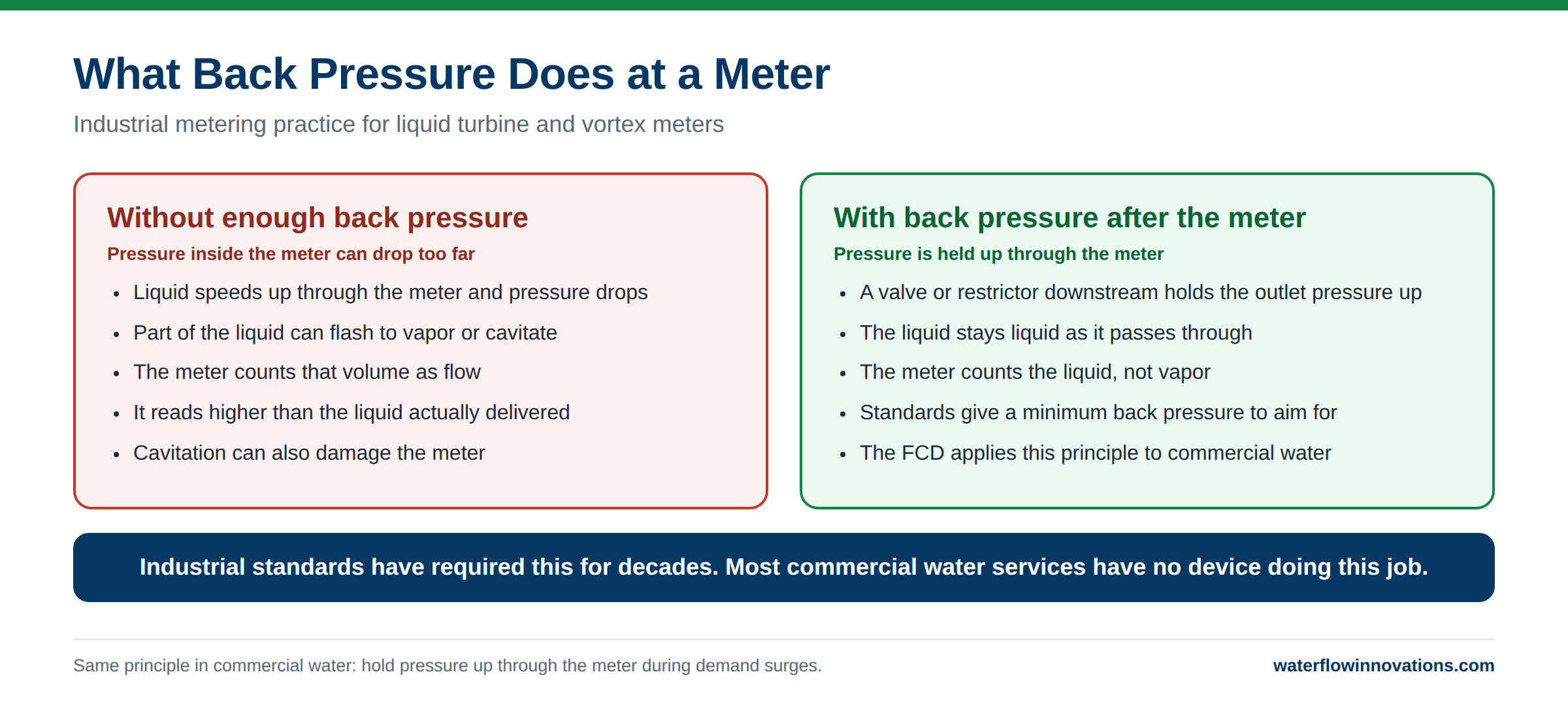
Industrial practice: hold pressure up after the meter.
What Back Pressure Is
Back pressure is the pressure held on the outlet side of a device. On a liquid meter, it’s the pressure in the pipe just downstream of the meter. Every meter takes some pressure drop as liquid passes through its measuring element, and the lowest pressure point is inside the meter, where the liquid moves fastest. Back pressure raises that low point.
In industrial metering, back pressure is usually provided by a control valve or back-pressure valve a few pipe diameters downstream of the meter, or by a fixed restrictor. Its only job is to keep the pressure inside the meter high enough that the liquid stays liquid.
The Physics in Plain Terms
- Faster flow means lower pressure. When water speeds up through a meter’s measuring element, its pressure drops. This is Bernoulli’s principle, and the lowest pressure is inside the meter, where the water moves fastest.
- Lower pressure means less gas stays dissolved. The amount of gas a liquid can hold in solution rises and falls with pressure (Henry’s law). When pressure drops, dissolved gas comes out as bubbles, and if it drops far enough, vapor forms.
- Back pressure raises the low point. Holding pressure up on the outlet side of the meter raises the lowest pressure inside it, so far less gas and vapor form and are counted as volume.
That rule, published by turbine meter makers and reflected in API MPMS Chapter 5.3, is written for volatile liquids. Commercial water works on the same three relationships, driven by demand surges.
Air conditioning: refrigerant is a liquid in the line leading to the expansion valve. When it passes the valve, its pressure drops and it boils off. HVAC technicians keep the liquid line under enough pressure, and cool enough, to prevent “flash gas” from forming before the refrigerant reaches the valve, because flash gas there robs the system of capacity. Lower pressure, and a liquid turns partly to vapor.
Nature: a river runs fastest through its narrows and slows where it widens again. Wind does the same, funneling through mountain passes and between tall buildings and speeding up through the gap. Where flow squeezes through a narrow space, it speeds up, and where it speeds up, its pressure drops. Inside a meter, the measuring element is the narrows.
A bottle of soda: it looks still until you open it. Releasing the pressure lets dissolved gas come out of solution as bubbles. That’s Henry’s law.
Water moving through a meter during a demand surge follows the same physics on a smaller scale: dissolved gas comes out of solution, and vapor forms where pressure drops lowest. Back pressure keeps the liquid a liquid, just as the refrigerant line does.
What Happens Without It
When the pressure inside a meter drops too far, two things can happen. Flashing: part of the liquid turns to vapor and stays vapor. Cavitation: vapor bubbles form at the low-pressure point and then collapse as the pressure recovers. Either way, the meter sees a mixture of liquid and vapor and counts all of it as flow.
- The meter reads high. Turbine meter makers warn that flashing makes the meter indicate significantly more flow than is actually passing.
- The meter can be damaged. Collapsing bubbles erode rotors and bearings.
- The error is invisible on the meter itself. The meter is working as designed; it’s measuring a mixture it was never meant to see.
What the Standards and Meter Makers Say
- API MPMS Chapter 5.3 (liquid hydrocarbons by turbine meters) provides an expression for the minimum back pressure at the meter outlet to prevent cavitation, for use when the manufacturer doesn’t give one.
- Turbine meter makers publish the same kind of rule. A common one is back pressure equal to about twice the meter’s pressure drop plus about one and a quarter times the liquid’s vapor pressure.
- Vortex meter makers specify a minimum downstream pressure and recommend a back-pressure valve downstream of the meter, or a higher inlet pressure, to avoid flashing and cavitation.
- Liquid metering practice in oil and gas treats the downstream control valve as part of the meter run, specifically to keep a minimum back pressure on the meter.
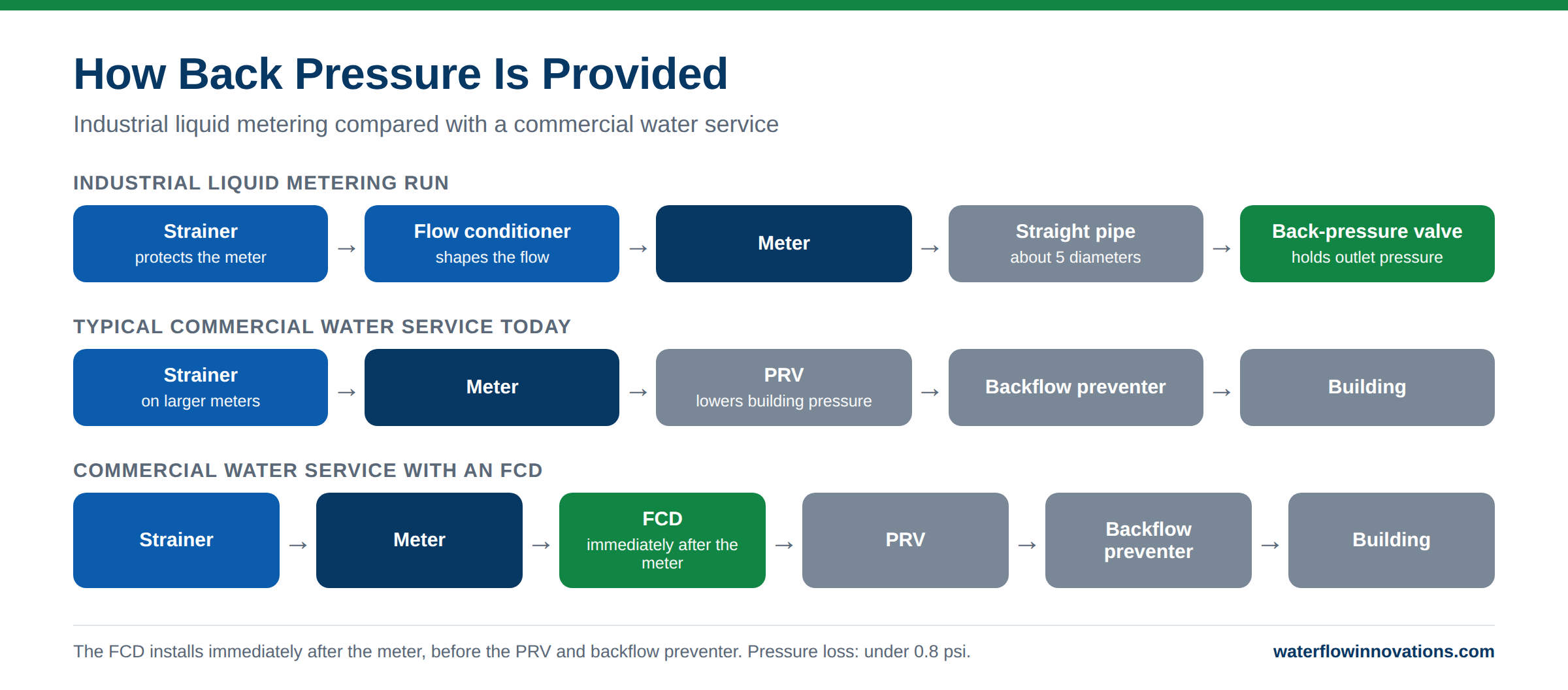
Most commercial water services have no device holding pressure up after the meter.
Why Commercial Water Service Is Different
An industrial meter run is designed around the meter: strainer, flow conditioner, straight pipe and a back-pressure valve. A typical commercial water service is designed around the building. Water passes through the utility meter and goes straight to the pressure-reducing valve (PRV), the backflow preventer and the building. Nothing after the meter is there to hold pressure up through it.
Most of the time that doesn’t matter. During demand surges, such as pumps starting, valves opening, tanks filling or shift changes, flow through the meter jumps and pressure inside it drops. Dissolved gas comes out of solution and vapor forms, and the meter counts that volume as water. Because sewer is usually calculated from the same reading, the over-read is billed twice. This is water meter over-registration.
The FCD: Back Pressure for Commercial Water
The FCD installs immediately after the meter and creates a small, controlled back-pressure that extends back through the meter, holding pressure up during demand surges so far less gas and vapor form and are counted as water. Pressure loss is under 0.8 psi, and nothing downstream changes. It corrects the reading; it doesn’t reduce the water you use. Documented installations typically show up to a 30% reduction in combined water and sewer costs (46% highest documented, a rare case).
Same principle, different conditions. The industrial rules mainly address volatile liquids such as LPG and hot condensate. In commercial water service, the effect is driven by demand surges: pressure inside the meter drops, dissolved gas comes out of solution and vapor forms. The principle is the same: hold pressure up through the meter so it counts the liquid.
Related: Anti-Cavitation Devices and Water Meter Strainers.
Sources and Standards
- American Petroleum Institute, Manual of Petroleum Measurement Standards, Chapter 5.3, Measurement of Liquid Hydrocarbons by Turbine Meters, section 5.3.6 (minimum back pressure at the meter outlet to prevent cavitation).
- Emerson Daniel, Liquid Turbine Flow Meters Technical Guide (back pressure = 2 × meter pressure drop + 1.25 × vapor pressure; effects of insufficient back pressure).
- Emerson Rosemount 8800 vortex flowmeter reference manual (minimum back pressure for liquids to prevent cavitation).
- Omega Engineering, liquid turbine flowmeter manual (downstream pressure to prevent flashing and cavitation; flashing indicates flow higher than actual).
- Society of Petroleum Engineers, PetroWiki, “Liquid meters” (downstream control valve to maintain minimum back pressure).
- Bernoulli’s principle and Henry’s law, as covered in standard fluid mechanics and physical chemistry texts.
Standards and manufacturer guidance describe industrial practice. Water Flow Innovations applies the same principles to commercial water service; results vary by building.
Common Questions
What is back pressure on a meter?
Why do liquid meters need back pressure?
Which standards require back pressure?
The American Petroleum Institute’s turbine meter standard, MPMS Chapter 5.3, gives a minimum back pressure at the meter outlet to prevent cavitation. Turbine and vortex meter makers publish similar requirements.