
Home » Essential Guides »
After-Meter Valves Explained: The Names, the Claims, and What to Ask
Many
1
8
Up to 30%
Direct answer: After-meter valves are devices installed on the customer’s side of a commercial water meter to correct how much volume the meter records. They’re sold as water-saving valves, smart valves, flow management devices, flow optimization valves and more. Most explain the result as “compressing air.” The Flow Conditioning Device (FCD) is explained by what happens inside the meter during demand surges: pressure drops, dissolved gas comes out of solution and vapor forms. Whatever the name, ask about certifications, sizing, placement, pressure loss, typical results and how savings will be verified.
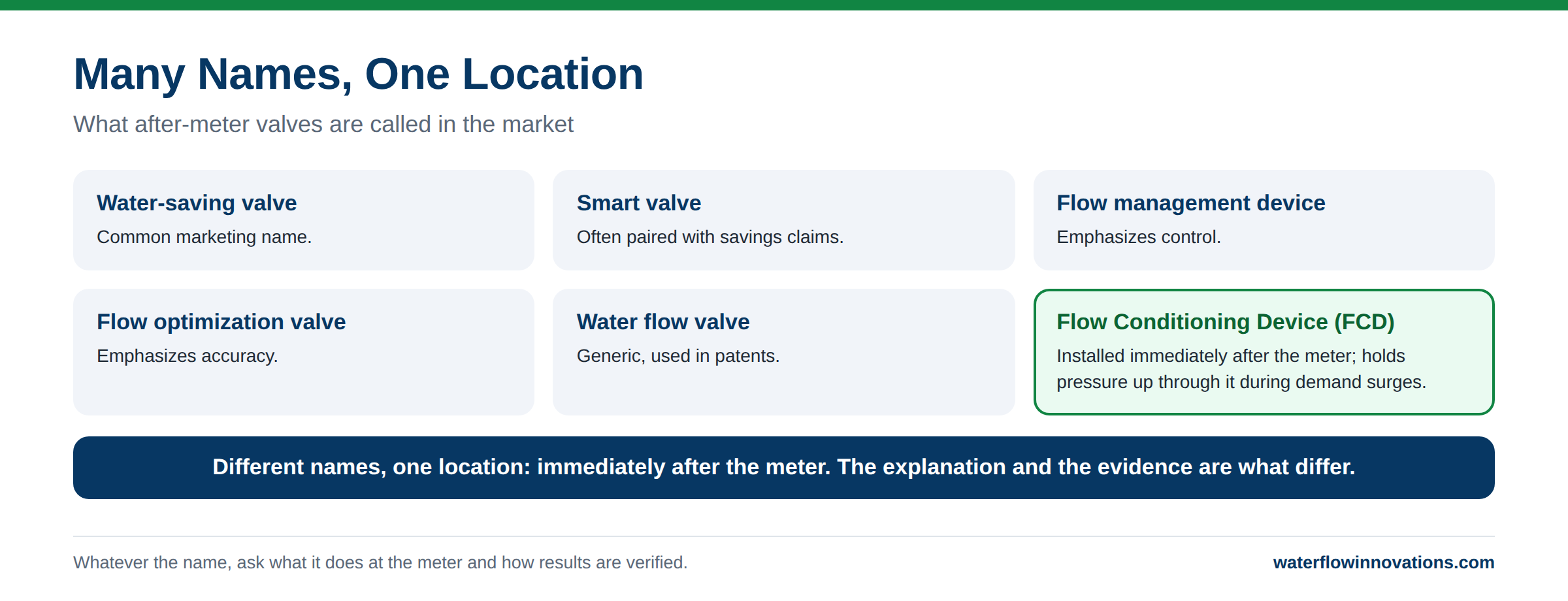
Different names, one location. The explanation and the evidence are what differ.
The Names You’ll See
“Water-saving valve,” “water saver valve,” “smart valve,” “flow management device,” “flow optimization valve” and “water flow valve” are all used for devices installed after a commercial water meter. Patents in this area describe valves positioned between the meter and the building that create back pressure on the meter. The names differ; the location is the same.
The name doesn’t tell you much. What matters is how the device is explained, how it’s sized and placed, and what evidence stands behind it.
How They’re Explained
Many after-meter valves are explained as “compressing air”: the idea that air travels with the water and the valve squeezes it before it reaches the meter. Water Flow Innovations explains the FCD differently, based on what happens inside the meter itself. During demand surges, flow through the meter jumps and pressure inside it drops. Dissolved gas comes out of solution and vapor forms, and the meter counts that volume as water. The FCD holds pressure up through the meter during those surges so far less gas and vapor form.
The explanation matters because it shapes expectations. It explains why results depend on how a building uses water, such as how sharp its demand surges are, how the meter is sized and where the PRV sits, and why the FCD doesn’t remove air, reduce water use or change anything downstream. Industrial metering has used the same pressure principle for decades; see Back Pressure on Meters.
Eight Questions to Ask Before You Buy
- What certifications does it have? Look for NSF/ANSI 61 for drinking water contact and plumbing listings such as IAPMO.
- How is it sized? It should be sized to your meter size and type, pipe size, pressure and PRV location, not one size for everyone.
- Where does it install? Immediately after the meter and before the PRV and backflow preventer. Ask what happens to performance if it goes after the PRV.
- What is the pressure loss? Ask for a number across all flow conditions. The FCD’s is under 0.8 psi.
- What results are typical? Ask for typical results, not just the best case. The FCD typically shows up to a 30% reduction in combined water and sewer costs; 46% is the highest documented and rare.
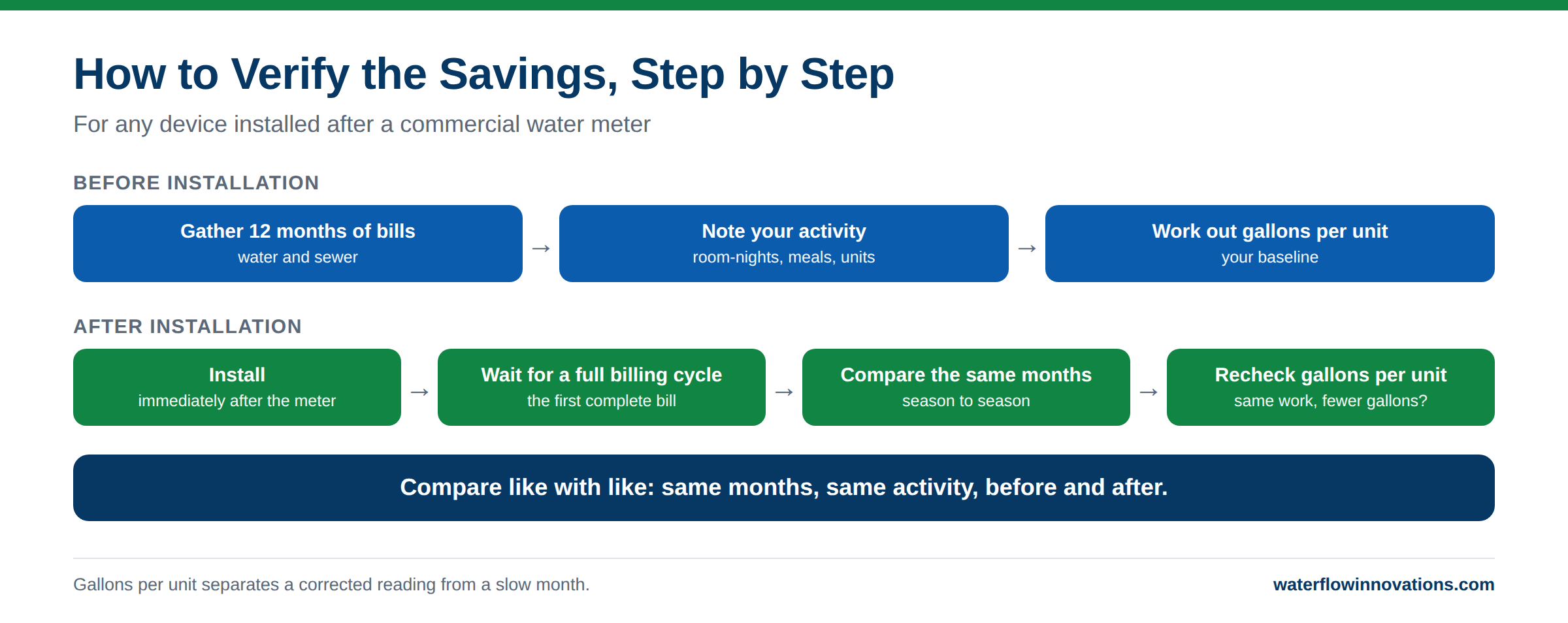
- How will savings be verified? Before-and-after bills over the same months, adjusted for activity. Track your gallons per unit to see it clearly.
- What does it not do? It shouldn’t claim to cut water use, remove air from the building’s plumbing or fix problems downstream of the meter.
- Who installs it? A licensed plumber or mechanical contractor, following the maker’s sizing and placement.
Claims to Be Careful With
- A fixed percentage for every building. Results depend on the building’s demand pattern, meter and piping.
- Reduced water use. A device after the meter corrects the reading; the building uses the same water.
- Fixes throughout the building. Quieter pipes, steadier fixtures or less water hammer at faucets are downstream issues. Any effect on water hammer or pressure is at the meter only.
- No verification plan. Savings should show up on bills you can compare month to month.
Related: Not to Be Confused With and How the FCD Works.
Sources and Standards
- NSF/ANSI 61, Drinking Water System Components – Health Effects, and NSF/ANSI 372 (lead content).
- IAPMO listing and the Uniform Plumbing Code.
- U.S. patent literature on valves installed between the water meter and the building that create back pressure on the meter (for example, U.S. Patent 9,057,181).
- American Petroleum Institute, Manual of Petroleum Measurement Standards, Chapter 5.3 (back pressure on liquid meters).
Standards and manufacturer guidance describe industrial practice. Water Flow Innovations applies the same principles to commercial water service; results vary by building.