
Home » Essential Guides »
Your Bill Audit Came Back Clean. Why Is the Water Bill Still High?
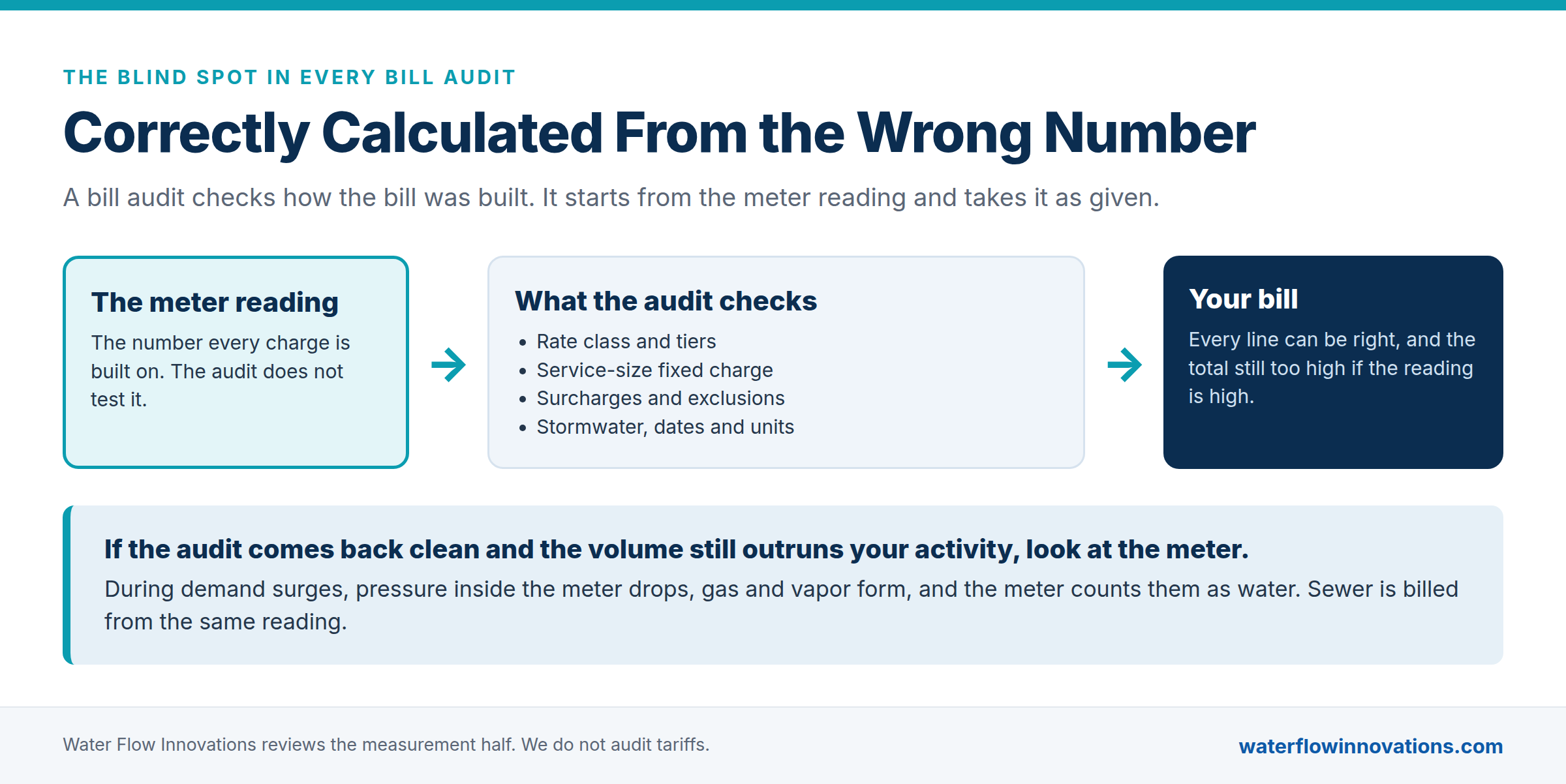
A bill audit checks how your bill was built. It starts from the meter reading and takes it as given. When the reading itself is high, every line can be right and the total still too high.
9
3
1
Up to 30%
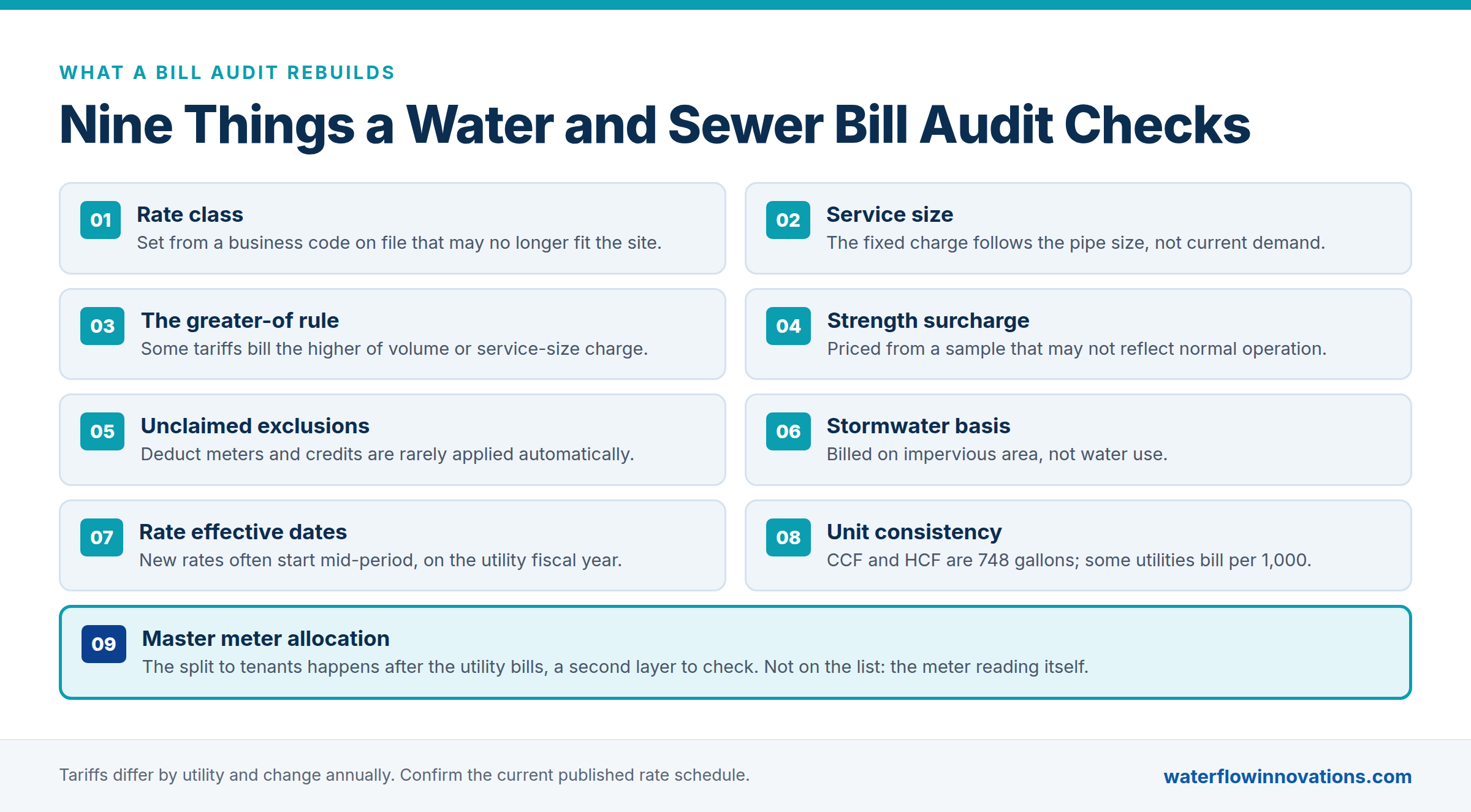
Direct answer: A bill audit can confirm your bill was calculated correctly and still miss why it’s too high. An audit rebuilds the bill from the utility’s published tariff, checking rate class, fixed charges, surcharges, exclusions, stormwater and rate dates. But every audit starts from the meter reading and takes it as given. If the meter over-registers during demand surges, the audit confirms every line was calculated correctly from the wrong number. When an audit comes back clean and your volume still outruns your activity, the question has moved from the bill to the meter.
What a Bill Audit Actually Does
A bill audit takes the published rate schedule, your service size, your rate class and twelve months of meter reads, and recomputes every charge. Where the rebuilt number and the billed number differ, the auditor has a finding. Specialist bill-audit firms, and some utilities on request, do this work, and it’s worth doing: the errors it finds tend to repeat quietly every month.
The Nine Things a Bill Audit Checks
Three Possible Outcomes
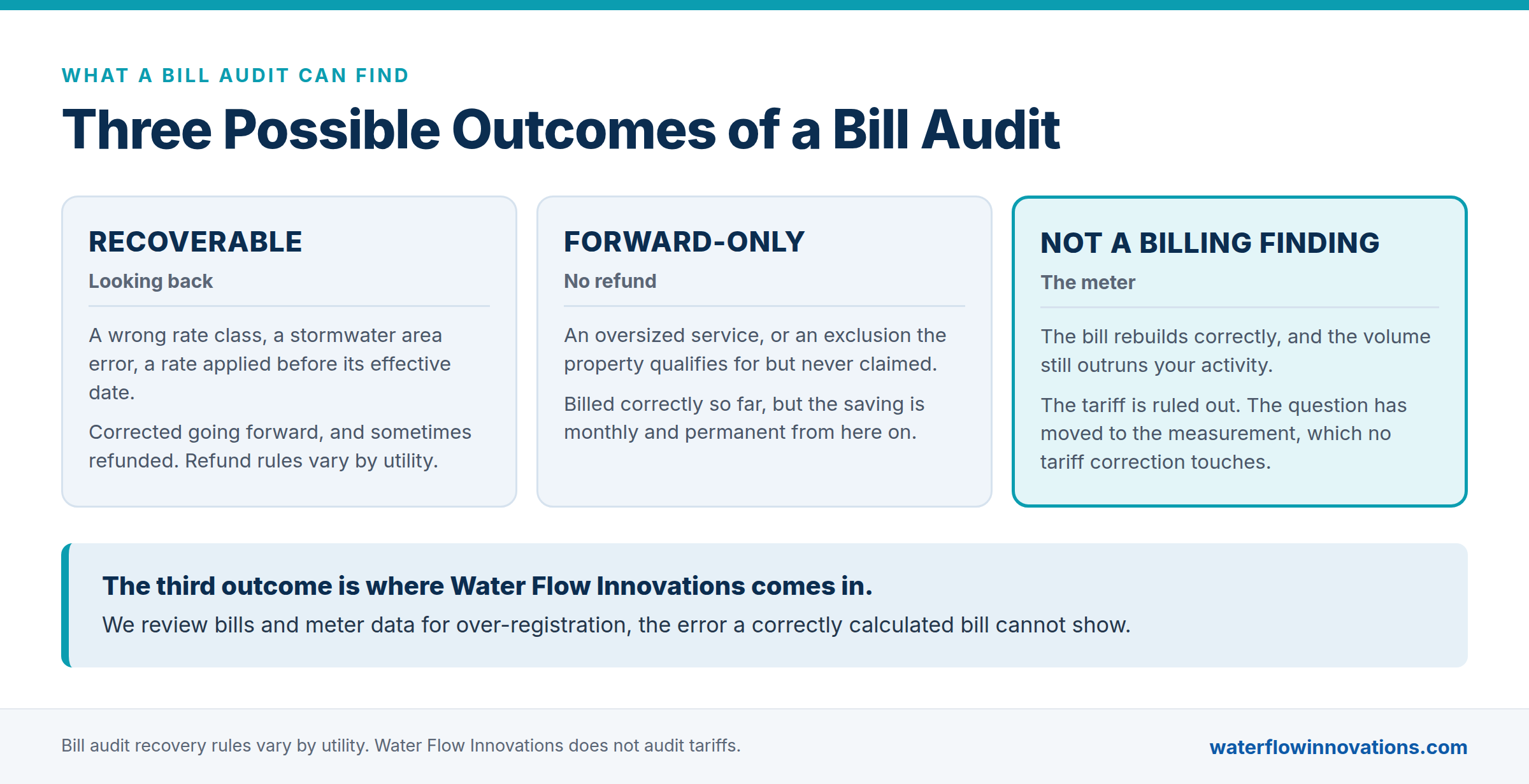
- Recoverable: a wrong rate class, a stormwater area error, or a rate applied before its effective date. Corrected going forward and sometimes refunded; rules vary by utility.
- Forward-only: an oversized service, or an exclusion never claimed. No refund, but the saving is monthly and permanent from then on.
- Not a billing finding: the bill rebuilds correctly and the volume still outruns your activity. The tariff is ruled out; the question has moved to the measurement.
The Blind Spot: The Reading Itself
Every charge an audit checks is built on the meter reading. If that reading is high, the audit will find the bill correctly calculated, because it is, from a number that’s too high.
During demand surges, when valves open, pumps start or many fixtures run at once, water speeds up through the meter and pressure inside it drops. Dissolved gas comes out of solution and vapor forms, and the meter, which measures volume, counts that volume as water. It isn’t a fault in the meter; a meter in perfect condition behaves the same way under the same surge, and it can still pass its accuracy test on a bench. Because the sewer charge is calculated from the same reading, the over-count is billed twice. See Water Meter Over-Registration and Sewer Double-Impact Billing. See Water Meter Over-Registration and Sewer Double-Impact Billing.
Signs You’ve Reached the Blind Spot
- The audit came back clean, or its findings didn’t explain the size of the bill.
- Your gallons per unit of activity is higher than last year for the same work.
- The gap is widest in your busiest months.
- An overnight meter test is clean, so water isn’t escaping.
- The meter passes its accuracy test, and the bill stays high anyway.
What Fixes the Measurement Half
Replacing the meter rarely helps, because a new meter in the same spot sees the same surges. The Flow Conditioning Device (FCD) works on the conditions instead. It installs immediately after the meter, ahead of the pressure-reducing valve and backflow preventer, and creates a small, controlled back-pressure that extends back through the meter, holding pressure up during demand surges so far less gas and vapor form and are counted. Pressure loss is under 0.8 psi and nothing downstream changes. It corrects the reading; it doesn’t reduce the water you use. Documented installations typically show up to a 30% reduction in water and sewer costs (46% highest documented), starting on the next full billing cycle.
Who Does What
Water Flow Innovations does not audit tariffs or rate classes. For billing errors, a specialist bill-audit firm or your utility is the right place to start. We look at the other half: whether the volume your bill is built on is being measured correctly, and what it costs you if it isn’t. Many facilities benefit from both, and the two don’t overlap. For reading your own bill, see the Water & Sewer Bill Review Guide.