
Quick Answer
Air in a commercial water line is real, but it is rarely what is inflating your water and sewer bill. Dissolved air collects at the high points of a main, and a line that has just been refilled after a repair can push air through your meter, which on a displacement meter can briefly register as volume. Those events are one-off, and a utility will correct a reading it can verify. The charge that repeats on every bill comes from something different. During high-demand periods water moves through the meter so fast that the pressure inside it drops, dissolved gas comes out of solution, and vapor forms right at the measuring element. The meter counts volume and cannot tell water from vapor, so the expanded volume is billed as water, and again as sewer. That is not air you can bleed from a line. It forms at the meter, at every peak, and it is corrected by holding pressure up through the meter.
Is There Really Air in My Water Lines?
Yes, and some of it is by design. Water is not pure liquid moving through a sealed pipe. It carries dissolved air, and under normal pressurized operating conditions that is a measurable fraction of the volume. AWWA Manual M51 notes that water typically carries about two percent dissolved air by volume under normal pipeline conditions. That air comes out of solution as pressure and temperature change, and it collects as pockets at the high points of a transmission main.
Utilities plan for it. Air-release valves sit at those high points to vent small pockets continuously, and air/vacuum valves handle the large volumes that move when a line is filled or drained. On force mains and long transmission runs these valves are standard. The reason they exist is that trapped air is not harmless: it reduces the cross-sectional area the water can use, it makes pumps work harder, and it magnifies pressure surges that can damage pipe and fittings.
So air in the system is a genuine engineering reality. The question for a facility manager looking at a high bill is narrower: is that air what the meter is charging me for?
Can Air Make a Water Meter Read High?
It can, in one specific situation. Most commercial and municipal meters are displacement or multi-jet designs that measure the volume of whatever passes through the measuring chamber. They do not test whether that volume is water. When a line is opened for a repair and then refilled, the air ahead of the returning water is driven through the service, and as it passes the meter the measuring element turns. For a short period the meter advances on air.
This is a known, transient event. It happens after a main break, a shutoff for plumbing work, or a hydrant flush on your side of the connection. It is also correctable: because it is tied to a specific date and a specific piece of work, a utility can see it and adjust the reading when you report it. The important word is transient. It happens once, around an event, and then it stops.
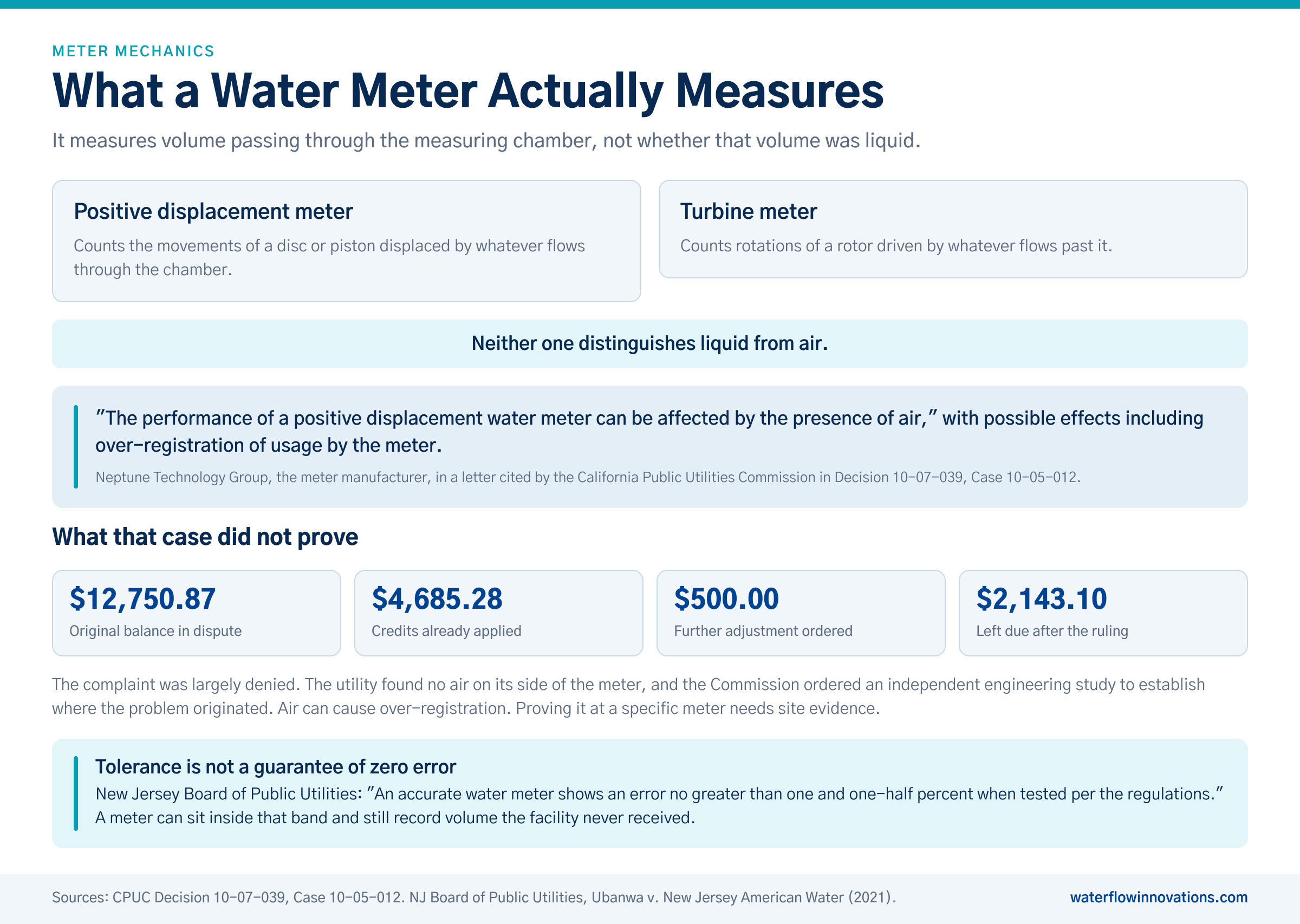
What this does not explain is a charge that comes back every month with no repair, no shutoff and no work order behind it. Stray air is an event. A commercial over-charge that tracks your busy hours is a pattern. Those are two different problems, and only one of them is air in the line.
Air Problem, or Over-Registration? Read the Symptoms
Real air in a line announces itself. You can hear it and see it. Over-registration is silent and shows up only on the bill. Sorting one from the other before you call anyone saves a wasted service visit.
LOOKS LIKE TRAPPED AIR
- Outlets that sputter or spit, then run clean.
- Banging or hammering in the pipework when valves close.
- Cloudy or milky water that clears from the bottom of the glass up.
- Noise or irregular flow right after a main repair or a shutoff.
- Intermittent. It comes with an event and goes away.
LOOKS LIKE OVER-REGISTRATION
- Metered volume climbs while production, headcount and equipment stay flat.
- The gap is widest in your high-demand months and hours.
- No air symptoms at all, at any tap or outlet.
- The meter passes a standard accuracy test.
- Steady and repeating, bill after bill, with nothing to point to.
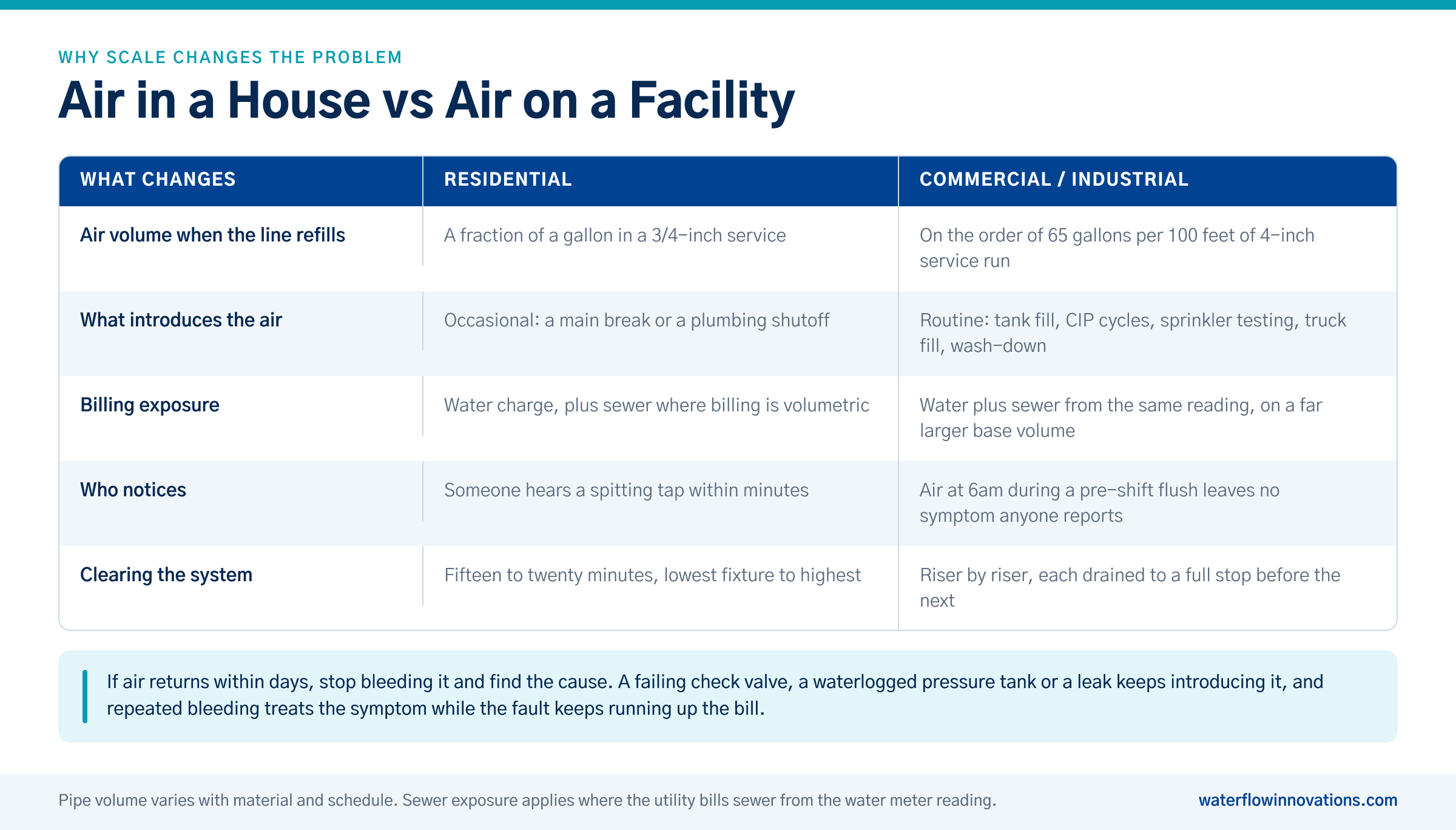
If the list on the right describes your account, the problem is not air travelling in from somewhere else. It is being created at the meter, and it is worth understanding exactly how, because the fix follows directly from the mechanism.
The Charge That Repeats Is Gas Created at the Meter
Every commercial and industrial site has high-demand periods when water moves through the service at high velocity: process draws, clean-in-place cycles, washdowns, cooling tower makeup, and the restroom and HVAC peaks that come with occupancy. At those moments the physics at the meter changes.
At high velocity the pressure inside the meter drops sharply. Dissolved gas comes out of solution, and where pressure falls lowest, vapor forms, right at the measuring element. It is the same family of effects that forms bubbles behind a fast boat propeller. Sudden demand, like a large valve opening or a pump starting, also sends a brief low-pressure wave back through the meter, which can drop pressure far more than steady flow does. Those bubbles expand to fill space inside the pipe that should be occupied by water. The meter measures volume, cannot tell water from gas, and registers the expanded volume as water. Because sewer charges are commonly calculated from the water meter reading, you pay for it twice.
Four well-established principles of fluid mechanics describe it, and they are published on the Water Flow Innovations site:
- Continuity, Q = A x v. The same water passes through the meter in the same pipe, so velocity through the meter is set by demand, not by the device that follows it.
- Bernoulli. Pressure and velocity trade off. Where velocity is high through a restriction, static pressure at the meter falls.
- Pressure loss, scaling with velocity squared. Because velocity is squared, doubling the flow speed roughly quadruples the effect. That is why over-registration concentrates in a few high-demand hours rather than spreading evenly across the day.
- Gas release, lower pressure frees more gas. The further pressure drops inside the meter, the more dissolved gas comes out of solution and the more vapor forms. Hold pressure up through the meter and far less of it forms.
This is also why a meter replacement does not fix it. A new meter of the same type in the same position sees the same velocity and the same pressure drop at the next peak, and registers the same way. For the full physics, see How the FCD Works.
What Actually Fixes It
The correction is not to remove air, because the problem is not air arriving from elsewhere. The correction is to hold pressure up through the meter, so far less gas and vapor form in the first place. A Flow Conditioning Device (FCD) installs immediately after the meter and creates a small, controlled backpressure. Because water is nearly incompressible, that higher pressure extends back upstream through the meter, the same way you feel pressure build along a hose when you put a thumb over the end.
The result is higher, steadier static pressure inside the meter during the exact high-demand moments when it would otherwise drop. The flow rate does not change, the same gallons pass through, and pressure loss to the building is under 0.8 psi. The meter registers water rather than expanded volume. It corrects the reading; it does not reduce how much water the facility actually uses.
Install order: Water meter, then FCD, then the pressure-reducing valve, then the backflow preventer, then the building. The FCD goes before the PRV, where line pressure is higher and the correction is greatest. A licensed plumber or mechanical contractor installs it with the water off for about an hour.
What to Do First
- Reconcile the bill to the tariff. Confirm the fixed charge for your service size, the volumetric rate at your class, and any sewer strength surcharge. A rate-class error produces a high bill that has nothing to do with air or the meter, and it is the most common cause.
- Rule out real air. If you have sputtering outlets, water hammer or milky water, especially after recent main work, that is genuine trapped air. Ask the utility about air-release valves on your service and whether a recent repair could have driven air through your meter. A verified event can be adjusted.
- Then look at the meter and the flow. If the symptoms are silent and the charge tracks your busy hours, the cause is over-registration at the meter, and it is correctable at the source.
A full water meter assessment covers the installation and the flow conditions together, so you find out which of the three is actually costing you before you spend anything fixing the wrong one.
Frequently Asked Questions
Can air in the water line really make my meter read high?
Briefly, yes. Displacement and multi-jet meters register the volume of whatever passes the measuring element, so air driven through after a repair or shutoff can advance the meter. It is transient, tied to an event, and a utility can adjust a reading it can verify. It does not explain a charge that repeats every month.
How do I tell air in the lines from an over-reading meter?
Air you can hear and see: sputtering outlets, banging pipes, cloudy water, usually after main work. Over-registration is silent, shows up only on the bill, is worst in your high-demand months, and keeps repeating with nothing to point to.
Will an air-release valve lower my water bill?
An air-release valve protects the pipeline from trapped air, surges and capacity loss. That is a sound reason to have one. It does not address gas and vapor that form at the meter during high demand, which is a separate, recurring cause of over-registration.
Why does my bill spike during our busiest periods?
Because the effect scales with the square of velocity. The faster water moves through the meter, the further pressure drops and the more gas and vapor form. A building that looks fine on average can lose the most during a few peak hours a day.
Does replacing the meter solve it?
No, if the cause is over-registration. A new meter of the same type in the same position sees the same velocity and pressure drop at the next peak and registers the same way. Replacement fixes a worn or failed meter, not the flow conditions around it.
Is this the same thing as a faulty meter?
No. The meter is not defective. It is reporting the volume that physically passed through it. The error is created upstream of the number, in the flow. See Faulty Water Meter on a Commercial Account for the distinction.
How much pressure does the fix cost my operations?
Under 0.8 psi across all flow conditions. Nothing downstream of the meter changes: not your process, your production line, or your pressure-sensitive equipment. The FCD corrects what the meter records; the building receives the same water as before.
Have the Air, the Meter and the Flow Checked Together
Water Flow Innovations assesses meter installations and flow conditions for commercial, industrial and multifamily facilities. Send your meter make, model and size plus twelve months of bills, and we will tell you whether you have a real air issue, a rate-class error, or over-registration at the meter, and what each one is costing you.
Water Flow Innovations LLC, 2651 Route 412, Coopersburg, PA 18036. Call 1-844-934-8258.
Sources
AWWA Manual M51, Air Valves (dissolved air and air valve function). Uni-Bell PVC Pipe Association, Air Valves: Improving the Performance of Pressure Pipelines. AWWA C700 and M6, displacement meter accuracy and operation. Water Flow Innovations, How the FCD Works (published mechanism and equations).
0 Comments