
Quick Answer
A commercial sewer bill is not calculated from measured wastewater. Utilities meter the water going in, not the sewage going out, so every figure on the sewer line is derived from your water meter reading. On a commercial or industrial account that reading is run through four multipliers: a fixed charge set by the size of your service, a volumetric rate set by your rate class, a strength surcharge if your discharge exceeds the utility’s BOD, TSS or ammonia thresholds, and in many tariffs a floor that charges you the greater of the volumetric total or the meter-size charge. None of the protections written into the residential side of the tariff reach a commercial account. There is no winter average, no return-to-sewer allowance, and no assumption that part of your water went outdoors. Every gallon the meter records is billed as sewage unless you have applied for an exclusion and been granted it.
What Actually Goes Into a Commercial Sewer Bill?
Four inputs. Only one of them changes month to month, and all four are applied to the same number.
- Service size. Your meter size sets a fixed charge that appears on every bill whether the facility ran or not. In Santa Barbara’s published schedule a 4-inch commercial service carries a $540.67 monthly charge before a single unit of water is used. A 6-inch carries $1,082.96.
- Rate class. Commercial, industrial and high-strength classes are billed at different volumetric rates, and some utilities assign the class from your SIC code rather than from anything you do.
- Billable volume. Taken straight from the water meter reading. On a commercial account this is normally 100% of it.
- Strength surcharge. Charged on discharge above published concentration thresholds for BOD, TSS, COD or ammonia. Billed per pound or per unit of volume on top of everything else.
Written as a formula:
Commercial sewer charge = fixed charge (by service size) + (metered volume x class volumetric rate) + strength surcharge
The important structural point is that the meter reading feeds the volumetric term and the surcharge term, and the utility applies your rate class to both. An error in the reading does not add a fixed amount to the bill. It multiplies through every term that depends on volume.
The line-by-line guide to a commercial water and sewer bill shows where each of these appears on a statement.
How Do You Calculate a Commercial Sewer Bill Step by Step?
- Confirm your service size and your rate class on the bill. These two fields set the fixed charge and the volumetric rate before any water moves.
- Take the metered volume for the period in the unit your utility bills in. HCF and CCF both mean 100 cubic feet, which is 748 gallons.
- Apply the class volumetric rate to the full metered volume, unless a deduct meter or an approved exclusion has been granted and is actually being applied.
- Check whether the tariff charges the greater of two figures. Several utilities bill the higher of the volumetric total or the service-size charge, which puts a floor under the bill in any low-production month.
- Add the strength surcharge if your discharge is sampled above threshold, then add stormwater, which is calculated from impervious area and has nothing to do with this arithmetic.
Three real tariffs below show what that produces on a commercial and industrial account.
Worked Example 1: What the Rate Class Alone Is Worth
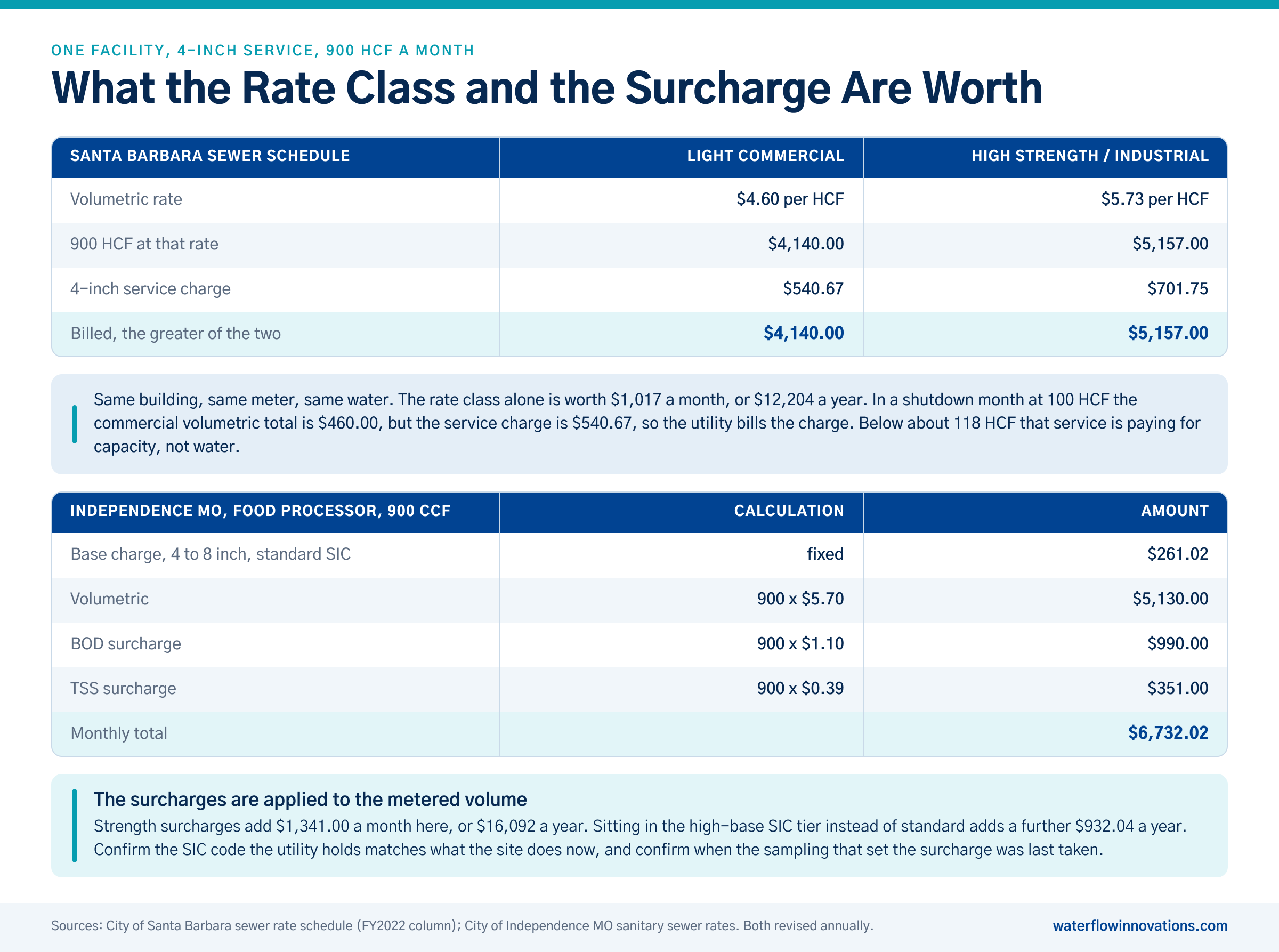
Santa Barbara’s published sewer rate schedule separates light commercial from high-strength and industrial, and charges each the greater of a volumetric total or a meter-size charge.
Take a facility on a 4-inch service using 900 HCF in a month.
| Light commercial | High strength and industrial | |
|---|---|---|
| Volumetric rate | $4.60 per HCF | $5.73 per HCF |
| 900 HCF at that rate | $4,140.00 | $5,157.00 |
| 4-inch service charge | $540.67 | $701.75 |
| Billed (greater of the two) | $4,140.00 | $5,157.00 |
Same building, same meter, same water. The rate class alone is worth $1,017 a month, or $12,204 a year.
Now run the same facility through a shutdown month at 100 HCF. The light commercial volumetric total is $460.00, but the 4-inch service charge is $540.67, so the utility bills $540.67. Below roughly 118 HCF a month, a 4-inch commercial service in that tariff is paying for capacity rather than for water. That is the argument for checking whether the service is sized for the demand the facility actually has today, not the demand it had when the line was laid.
Worked Example 2: Rate Class Set by SIC Code, Plus Strength Surcharges
Independence, Missouri publishes a non-residential schedule with two base-charge tiers, standard SIC and high-base SIC, and adds strength surcharges by the unit of volume rather than by the pound.
For a food processor on a 4-inch service inside the city, on the public system, using 900 CCF:
| Line | Calculation | Amount |
|---|---|---|
| Base charge, 4 to 8 inch, standard SIC | fixed | $261.02 |
| Volumetric | 900 x $5.70 | $5,130.00 |
| BOD surcharge | 900 x $1.10 | $990.00 |
| TSS surcharge | 900 x $0.39 | $351.00 |
| Monthly total | $6,732.02 |
The same volume without surcharges is $5,391.02. The strength surcharges add $1,341.00 a month, which is $16,092 a year, and they are applied to the metered volume. They also move with the classification: if the account sits in the high-base SIC tier rather than standard, the base charge is $338.69 instead of $261.02, another $932.04 a year for nothing that happens inside the building.
Two things follow for a facility manager. Confirm the SIC code the utility has on file matches what the site does now, because buildings that changed process or ownership sit in the wrong tier for years. And confirm when the sampling that set your surcharge rate was last taken, because a sample pulled during an atypical production run can price your discharge for a long time afterwards.
This is the line item that hits food and beverage processing, meat and poultry, and breweries hardest, and it is why reducing a factory’s water and sewer cost starts with the tariff rather than with the equipment.
How a Strength Surcharge Is Actually Calculated
Where a utility charges by the pound rather than by the unit of volume, the conversion is standard across the industry:
Pounds = (measured concentration minus threshold, in mg/L) x (volume in million gallons) x 8.34
Santa Barbara’s FY2022 schedule sets the thresholds at 750 mg/L for BOD, 850 mg/L for TSS and 90 mg/L for ammonia, with surcharges of $0.32, $0.42 and $0.98 per pound respectively.
Worked through for illustration, on the same 900 HCF month, with BOD sampled at 1,200 mg/L:
- 900 HCF is 673,200 gallons, which is 0.6732 million gallons
- Concentration above threshold: 1,200 minus 750 = 450 mg/L
- Pounds: 450 x 0.6732 x 8.34 = 2,527 lb
- Surcharge: 2,527 x $0.32 = $808.49 for the month
That arithmetic is illustrative. The point it makes is not. The volume term in that calculation comes from the same water meter that produced the volumetric charge, so a meter reading high inflates the surcharge as well as the volume line.
What Does Not Apply to a Commercial Account
Most published guidance on sewer billing describes the residential side of the tariff. Three of those provisions do not reach a commercial or industrial account, and assuming otherwise costs money.
No return-to-sewer allowance. Charleston Water System applies a 0.95 factor to one residential class only. Every other customer class, commercial and industrial included, is billed on 100% of metered water. Water that evaporates from a cooling tower, is incorporated into a product, or goes to storm is billed as sewage all the same.
No winter averaging. Where utilities cap sewer volume at a cold-month average, it is almost always a residential provision. The City of Longview states the commercial position plainly in its published method: commercial accounts are metered monthly. You pay on actual volume every month of the year.
No automatic exclusions. Deduct meters, evaporation credits and irrigation exemptions exist on most tariffs, but none is applied on the utility’s initiative. The property applies, the utility approves, an approved contractor usually installs, and the utility inspects. Finding and claiming them is the substance of water and sewer bill reduction work.
For a multi-tenant or mixed-use property served by one meter, there is a further layer: the utility calculates from the master meter, and the allocation between tenants happens after that. Master meter and occupancy-based billing covers how those arrangements work.
Why the Meter Reading Is the Number That Matters Most
Look again at what the four terms have in common.
The volumetric charge is the meter reading times a rate. The strength surcharge is the meter reading times a rate, or a concentration times a volume drawn from the same reading. Under a tiered tariff the meter reading also decides which tier the marginal unit falls into. The only term that does not move with the reading is the fixed service charge.
So on a commercial account, a meter registering 4% high does not produce a 4% overcharge on one line. It produces a 4% overcharge on the volumetric term, a 4% overcharge on the surcharge term, and it does that on the water bill and the sewer bill simultaneously, because both charges are calculated from the same reading.
Meters are accurate within a tolerance, not absolutely. Under AWWA C700 a new positive displacement meter is expected to register between 98.5% and 101.5% at normal and high flow, and no less than 97% at the AWWA-specified low flow. Regulators set the point at which error becomes actionable: in Wisconsin, a displacement meter registering above 102%, or a compound or current meter above 103%, obliges the utility to recalculate bills for the period of inaccuracy under Wisconsin Administrative Code PSC 185.35.
On a facility the conditions that push a meter toward the top of that band are operational rather than accidental, and they are covered in what meter over-registration is and when it does not apply and how to tell whether your meter is over-reading.
How Do You Check a Commercial Sewer Bill Against the Tariff?
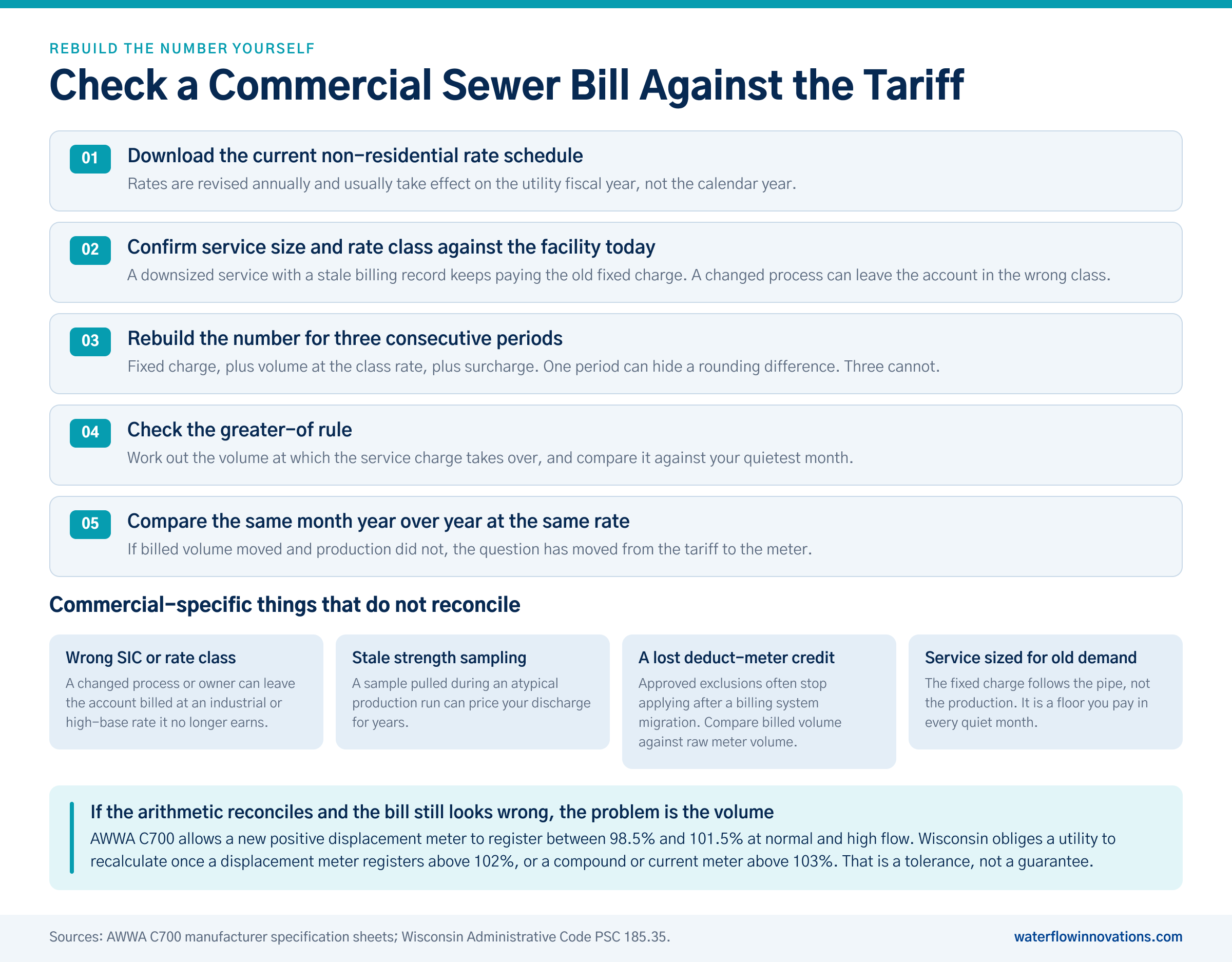
- Download the current non-residential rate schedule. Rates are revised annually and usually take effect on the utility’s fiscal year, not the calendar year. Check the effective date rather than assuming last year’s sheet still applies.
- Confirm service size and rate class against the facility as it operates today. A downsized service with a stale billing record keeps paying the old fixed charge indefinitely, and a changed process can leave the account in the wrong class.
- Rebuild the number for three consecutive periods. Fixed charge, plus volume at the class rate, plus surcharge. One period can hide a rounding difference; three cannot.
- Check the greater-of rule. If your tariff bills the higher of volumetric or service-size charge, work out the volume at which the floor takes over and compare it against your quietest month.
- Compare the same month year over year at the same rate. If billed volume moved and production did not, the question has moved from the tariff to the meter.
If the arithmetic reconciles and the bill still looks wrong, the problem is upstream of the calculation, in the volume itself. That is the point to look at the meter and the flow conditions around it rather than at the tariff. A water meter assessment covers the installation and the registration; a bill review covers the tariff, the class and the exclusions. The two questions are different and they need answering in that order.
Frequently Asked Questions
How is a commercial sewer bill calculated?
From the water meter reading, not from measured wastewater. A fixed charge set by service size, plus the metered volume at your rate class volumetric rate, plus any strength surcharge on BOD, TSS, COD or ammonia above the utility’s published thresholds. Several tariffs then bill the greater of the volumetric total or the service-size charge.
What is HCF or CCF on a commercial sewer bill?
Both mean 100 cubic feet, which is 748 gallons. A 900 HCF month is 673,200 gallons. Some utilities bill in units of 1,000 gallons instead, so check the unit before comparing rates between utilities.
Does winter averaging apply to commercial accounts?
Almost never. It is a residential provision that exists to stop summer irrigation being billed as sewage. Commercial and industrial accounts are billed on actual metered volume every month, which Longview, Texas states explicitly in its published method.
Can we be billed sewer charges for water that never reaches the sewer?
Yes, and on a commercial account it is the default. Evaporative cooling losses, water incorporated into a product, truck fill and wash-down to storm are all billed as sewage unless the property has applied for a deduct meter or a specific exclusion and been granted it.
What is a BOD or TSS surcharge and how is it calculated?
A charge on discharge strength above published thresholds. Some utilities bill it per unit of volume, such as Independence, Missouri at $1.10 per CCF for BOD. Others bill per pound of excess load, calculated as concentration above threshold in mg/L multiplied by volume in million gallons multiplied by 8.34.
Why is our fixed sewer charge so high when we barely used any water?
Because the fixed charge is set by service size, not by use, and several tariffs bill the greater of the volumetric total or that charge. In Santa Barbara’s schedule a 4-inch commercial service carries a $540.67 monthly charge regardless of production.
Does a water meter error affect the sewer charge too?
Yes, and on a commercial account it compounds. The same reading drives the volumetric charge, the strength surcharge where that is billed by volume, and the tier position, on both the water bill and the sewer bill.
Have the Arithmetic Checked Against Your Tariff
Water Flow Innovations reviews water and sewer billing and meter data for commercial, industrial and multifamily facilities. Send 12 months of bills plus your meter make, model and size, and we will rebuild the sewer calculation from your utility’s published non-residential schedule, confirm the rate class and service size are right, and identify which exclusions the facility qualifies for. If the billing is already correct, that is the answer you will get.
→ Sewer Double Impact Calculator
→ Request a Commercial Bill Review
Water Flow Innovations LLC, 2651 Route 412, Coopersburg, PA 18036. Call 1-844-934-8258.
0 Comments