
Who or What Is Really to Blame for My High Water Bill?
5
1
Up to 30%
Under 0.8 psi
Direct answer: No single suspect is to blame; a high commercial water bill is usually a conspiracy of everyday causes. Fixtures with fast-closing valves, pumps, process equipment, and busy hours all create sudden demand surges, and every surge passes through one place: the water meter. There, pressure drops, dissolved gas comes out of solution and vapor forms, and the meter counts that volume as water. Replacing pipes, adding storage tanks, or slowing operations is costly or impossible. The Flow Conditioning Device (FCD) installs immediately after the meter and holds pressure up during every surge, whatever caused it, so the meter records closer to the water actually delivered.
The Usual Suspects
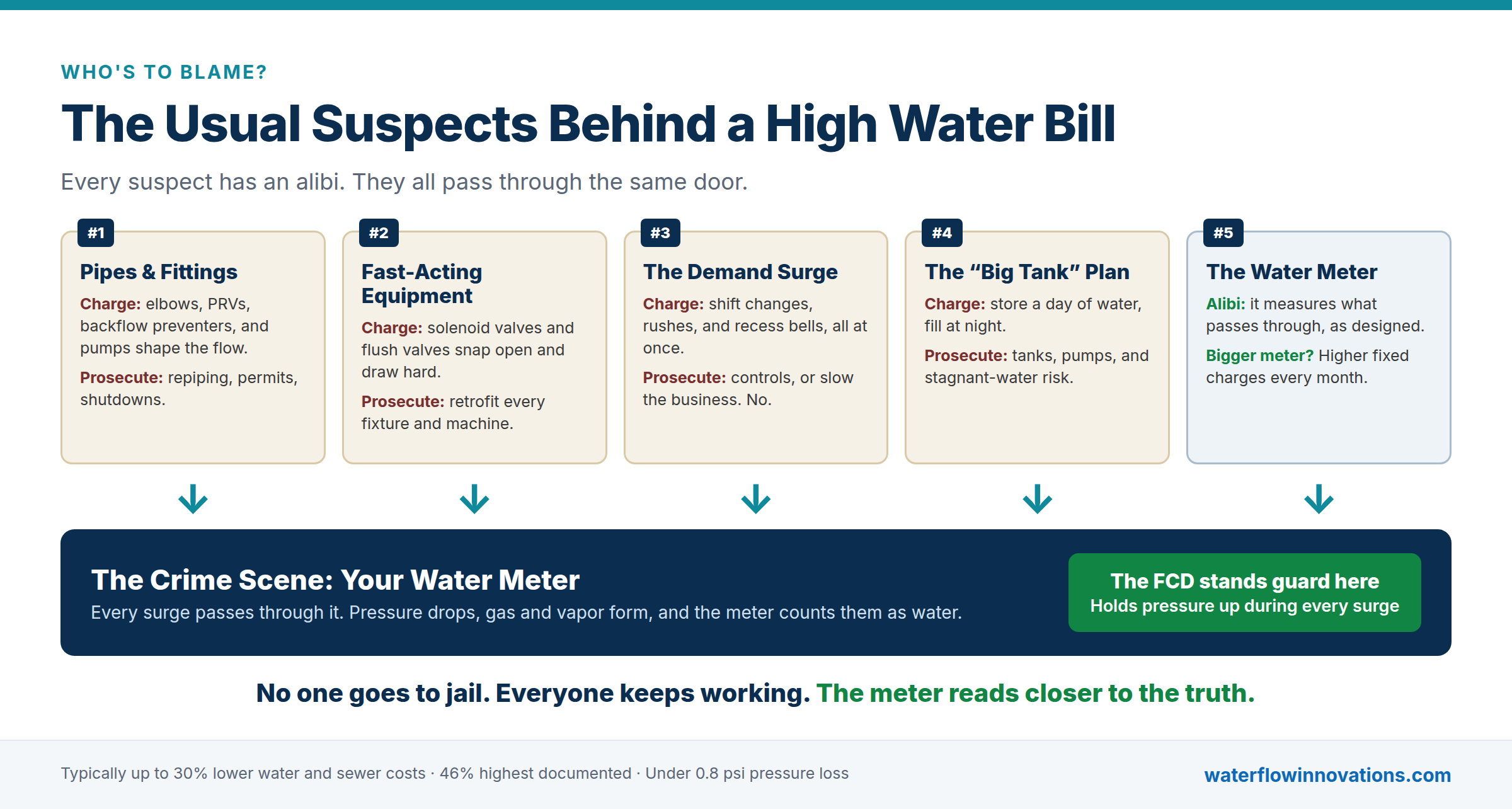
The Crime Scene: Your Water Meter
Every gallon your building uses passes through one place first: the utility water meter. That makes it the crime scene.
Here’s what happens there, many times a day. A valve snaps open, a pump kicks on, or a dozen fixtures run at once. Water rushes through the meter, and pressure inside it drops. Dissolved gas comes out of solution and vapor forms, and the meter, which measures volume, counts that volume as water. Then the sewer charge, calculated from the same reading, bills it again.
No one at the scene meant any harm. That’s what makes it so hard to solve.
The Line-Up
Suspect #1: The Pipes and Fitting
The charge: Elbows, tees, reducers, PRVs, backflow preventers, and booster pumps near the meter shape how water hits it.
The alibi: Many are required by code, and every building needs pipes.
The cost of prosecuting: Repiping means major expense, permits, and shutdowns. Even perfectly straight pipe doesn’t stop surges: a surge comes from how fast water is drawn, not the shape of the pipe.
Suspect #2: The Fast-Acting Equipment
The charge: Dishwashers, washers, ice machines, sterilizers, and process equipment use solenoid valves that snap open and shut, creating some of the sharpest pressure surges in a building. A single flushometer-valve toilet can draw about 25 to 35 gallons a minute for a few seconds.
The alibi: That equipment is how the business runs.
The cost of prosecuting: Slow-closing valves, water hammer arrestors, and expansion tanks help protect pipes, and they’re good practice. But they’re needed at every fixture and machine, and they’re designed to stop banging pipes, not to correct a meter reading.
Suspect #3: The Demand Surge Itself
The charge: Shift changes, lunch rushes, check-out hours, and recess bells send everyone to the water at once. One meter-sizing guide notes schools with uniform recess periods saw flows of 150 gallons a minute, with peaks reaching 210.
The alibi: That’s just people using a building.
The cost of prosecuting: Controls that stagger equipment take engineering and money, and they can’t schedule restrooms, showers, or kitchens. Slow down production or sell less? Of course not. No one should shrink a business to fix a meter reading.
Suspect #4: The “Big Tank” Plan
The charge: Store a full day’s water in a large tank, fill it slowly at night, and pump from the tank by day.
The alibi: It sounds clever on paper.
The cost of prosecuting: A large tank, booster pumps, energy, maintenance, backflow protection, and space. And stored, slow-moving water raises the risk of Legionella and other bacteria, which means a formal water management plan. You’d trade a billing problem for a health-management problem.
Suspect #5: The Water Meter
The charge: It reads high.
The alibi: It’s innocent. It measures the volume that passes through it, exactly as designed, and it usually passes its accuracy test.
The cost of prosecuting: A bigger meter means higher fixed charges every month, upsizing costs, and possible under-reading at low flows. A new meter of the same size, in the same spot, sees the same surges.
Why Prosecuting Every Suspect Doesn’t Work
It’s a conspiracy: no suspect acts alone. The pipes shape the flow, the equipment snaps valves open, the people arrive all at once, and the meter faithfully counts what passes through it. Go after one suspect, and the others keep working.
Chasing them one by one means rebuilding plumbing, retrofitting every machine, adding controls, or adding tanks, each with its own cost, downtime, and side effects. Even then, you can’t schedule people.
But every suspect has one thing in common: they all pass through the same door. Solve the case there, and you don’t need to arrest anyone.
The Peacekeeper: No One Goes to Jail
The Flow Conditioning Device (FCD) doesn’t arrest anyone. It doesn’t replace your pipes, change your equipment, schedule your people, or slow your business. It simply stands at the door every suspect passes through.
Installed immediately after the water meter, the FCD creates a small, controlled back-pressure that extends back through the meter. During every demand surge, no matter which suspect caused it, it holds pressure up inside the meter, so far less gas and vapor form and are counted as water. Per the manufacturer, it also reduces water hammer and stabilizes pressure at the meter.
Everyone keeps doing their job. The pipes carry water, the equipment runs, the people come and go, and the meter keeps measuring, just more accurately.
- Typically up to 30% lower water and sewer costs (46% highest documented, a rare case)
- Under 0.8 psi pressure loss; nothing downstream of the meter changes
- About a one-hour install, with savings starting on the next full billing cycle
- Patented by AquaFlow Technologies, Inc.
Good practices like soft-start pumps and slow-closing valves are still worth having for your equipment. The FCD works alongside them, correcting the reading at the meter regardless of what causes the surge.