
Your Water Meter Passed Its Test. Why Is Your Bill Still High?
~1.5%
0
Up to 30%
Under 0.8 psi
Direct answer: A meter "passes" when it reads within tolerance on a test bench at steady, controlled flow, but that test never recreates the demand surges in a working building. During those surges, water speeds up through the meter, pressure inside it drops, and gas and vapor form and are counted as water. So a meter can pass its test and still over-register every day in service. The Flow Conditioning Device (FCD) installs immediately after the meter and holds pressure up during those surges, with documented installations averaging a reduction of up to 30% in water and sewer costs.
Same Meter, Two Very Different Conditions
What a “Passing” Meter Actually Means
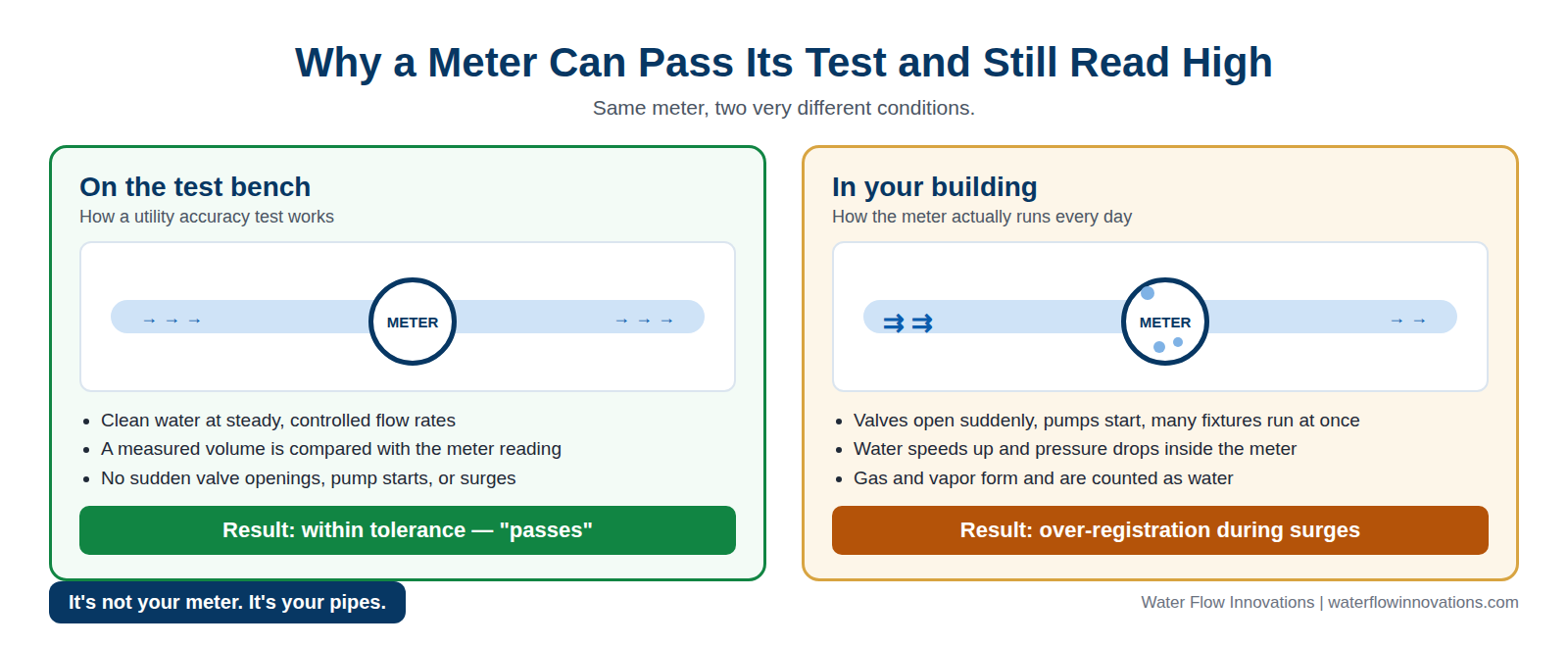
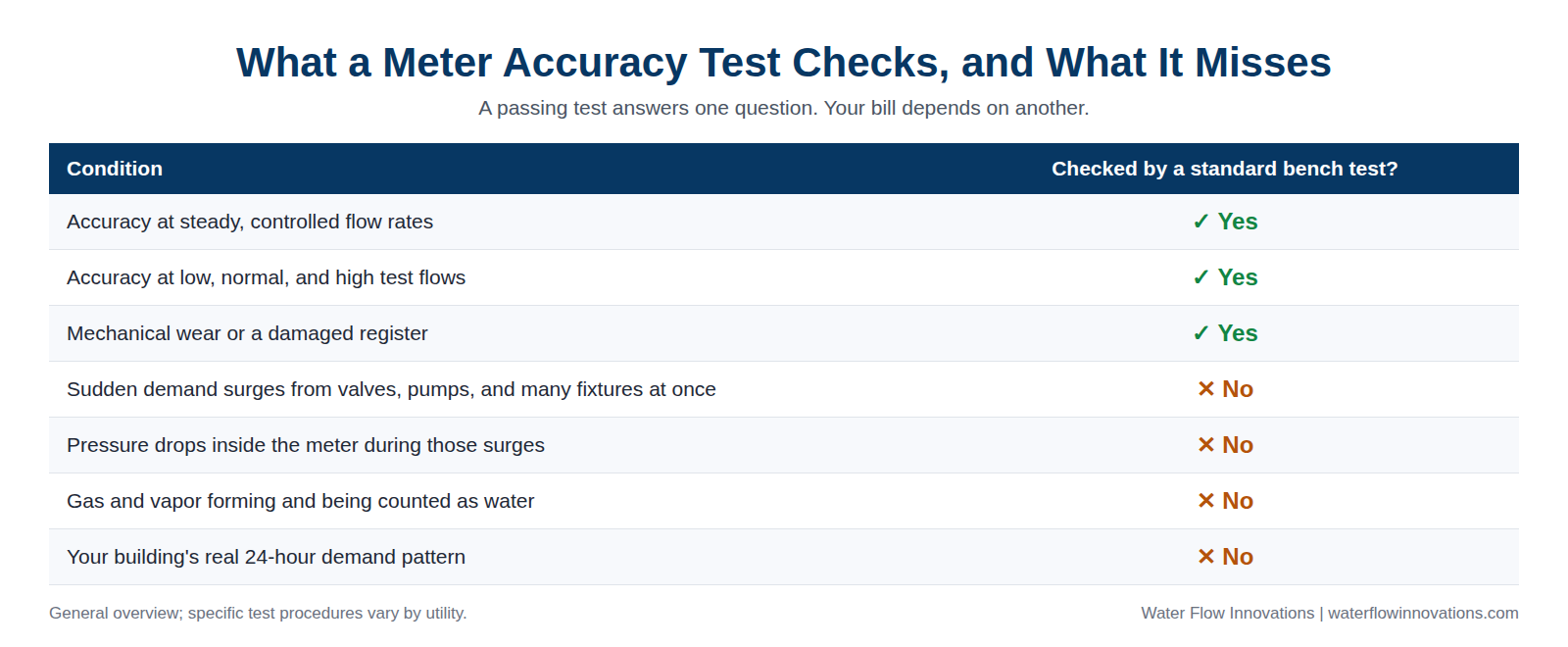
When a utility tests a meter, it runs a measured volume of clean water through it at steady, controlled flow rates, usually on a test bench, and compares what the meter recorded with what actually went through. If the difference falls within the allowed tolerance, the meter passes. Under standards from the American Water Works Association (AWWA), that’s typically within about 1.5% at normal flows, with a wider allowance at the lowest flows.
A passing result is useful. It tells you the meter isn’t worn out, damaged, or broken. What it doesn’t tell you is how the meter behaves in your building.
Why a Meter Can Pass and Still Read High
Valves open suddenly, booster pumps kick on, wash-down systems start, and dozens of fixtures run at once. During those demand surges, water speeds up through the meter and pressure inside it drops. Dissolved gas comes out of solution and vapor forms, and the meter counts that volume as water. None of that happens on the test bench, so the test can’t see it.
The meter isn’t broken. The conditions it’s measuring in are the problem. It’s not your meter. It’s your pipes.
Where the Extra Gallons Come From
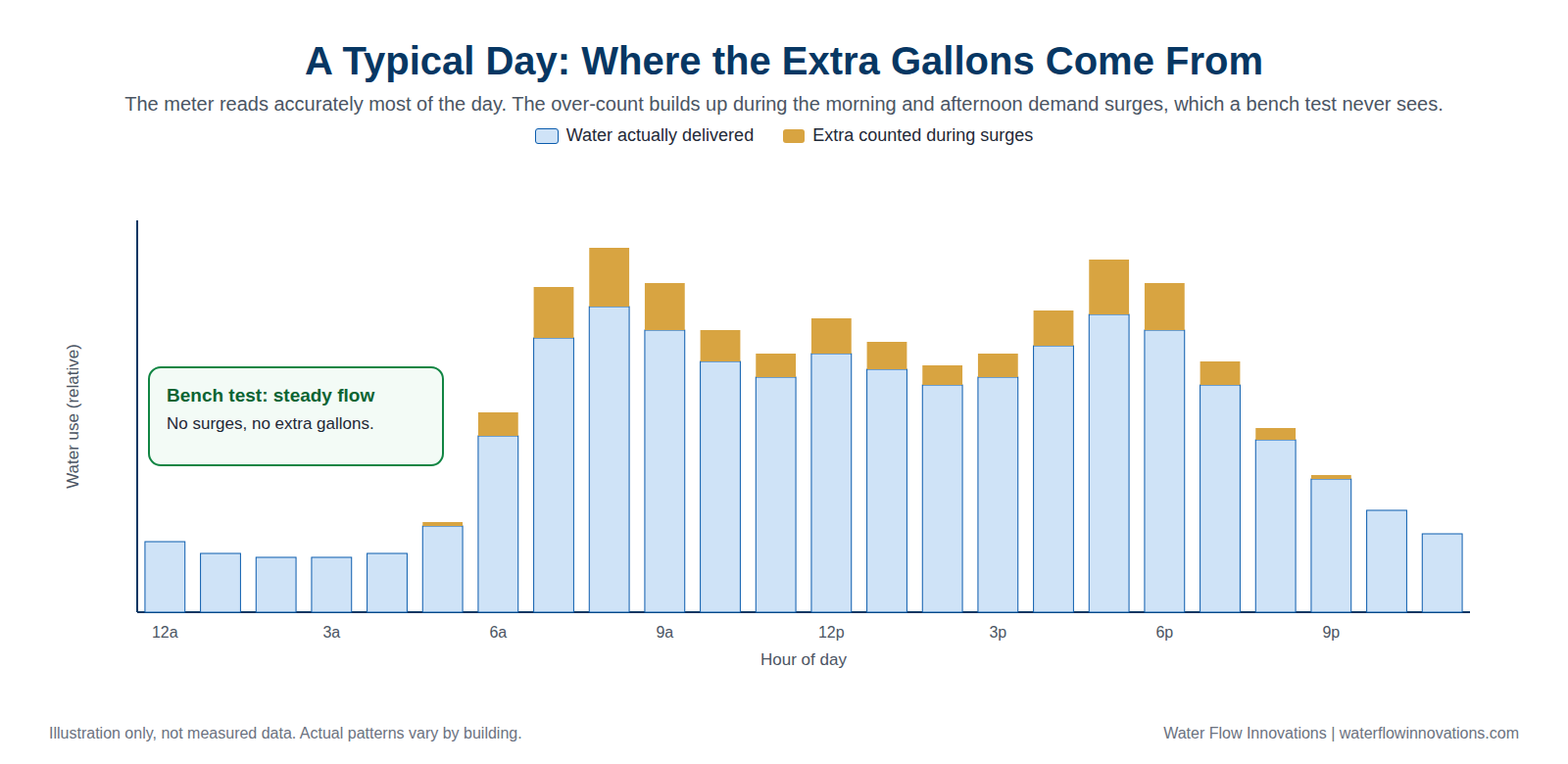
Over-registration doesn’t happen all day. Overnight and during quiet periods, flow is steady and the meter reads accurately. The over-count builds up during the busiest hours, when surges are frequent and sharp. That’s why a building with a “passing” meter can still see a bill that climbs faster than its activity, especially during peak months or shifts.
If Your Meter Passed, Look for These Signs Instead
Your bill climbs faster than your activity
Water use on the bill rises faster than occupancy, production, or operating hours, especially during peak periods.
Usage doesn’t match your own records
Your submeters, production records, or occupancy data account for less water than the utility meter reports.
A clean leak check, but the bill stays high
Nothing is leaking, yet the bill doesn’t come down. The extra volume is being counted inside the meter, not lost in your pipes.
Sewer charges rise in step with water
Most sewer bills are calculated from the same metered intake, so an over-read inflates both charges at once.
Correcting the Reading, Not the Meter
Because the meter itself is fine, replacing it rarely helps. A new meter in the same conditions behaves the same way. The Flow Conditioning Device (FCD) works on the conditions instead. It installs immediately after the meter and creates a small, controlled back-pressure that extends back through the meter, holding pressure up during demand surges so far less gas and vapor form and are counted. Your building uses water exactly as before, and pressure loss across the FCD is under 0.8 psi across all flow conditions.
Documented installations show up to a 30% reduction in water and sewer costs, with the highest
documented result at 46%. Savings start on the next full billing cycle.
Passing Meter Tests: Common Questions
What does it mean when a water meter "passes" its test?
If my meter passed, can it still over-register?
Should I ask the utility to test my meter again?
How can I tell if surges are inflating my bill?
How does the Flow Conditioning Device (FCD) help?
Find Out What Your “Passing” Meter Is Really Costing You
Model your building’s 24-hour flow pattern in the free calculator, or send us your bills for a free savings analysis before you commit to anything.