
Home » Savings Guides »
Gallons Per Unit: The Number That Shows Whether Your Water Meter Is Over-Registering
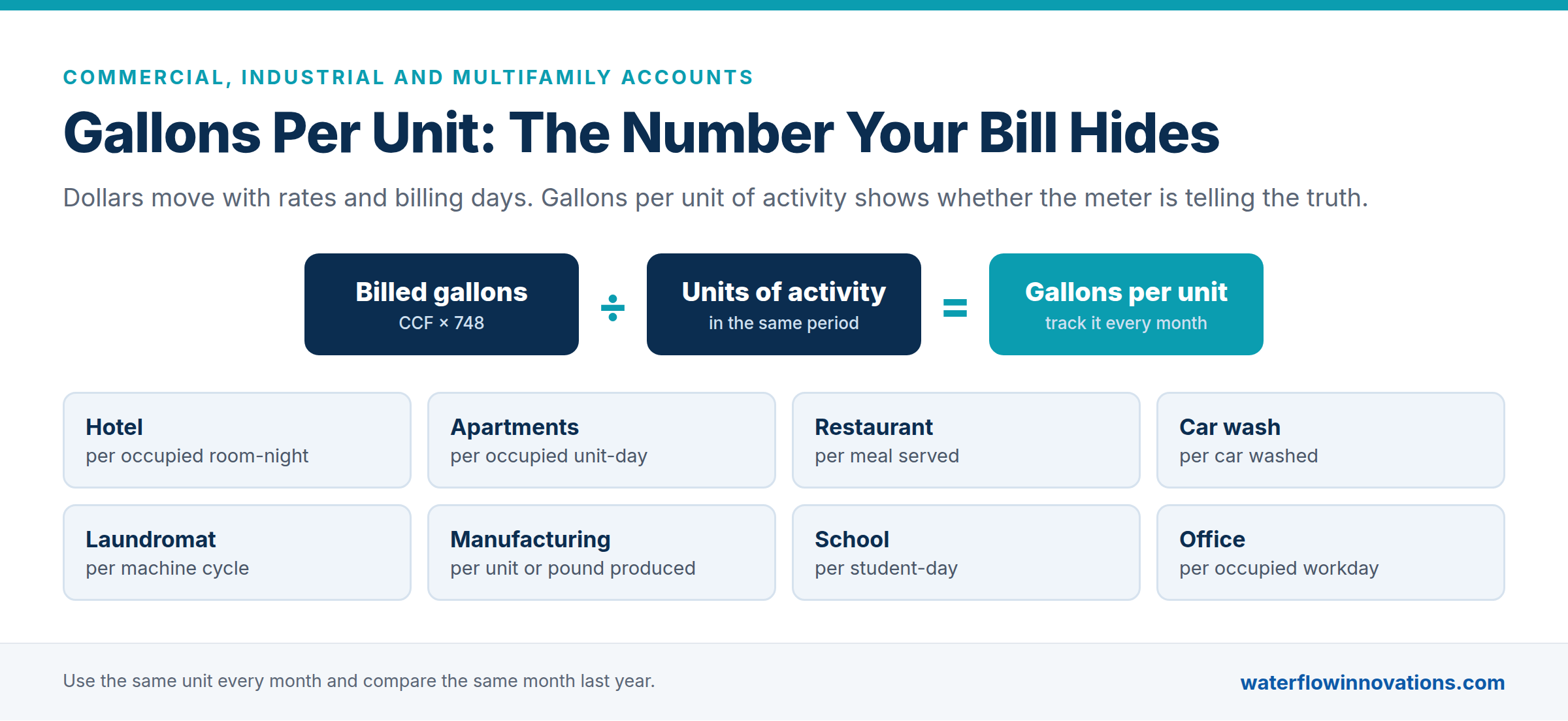
Your bill’s dollar total moves with rates and billing days. Gallons per unit of activity shows whether you’re using more water for the same work, and whether your meter is telling the truth.
4
1 night
748
Free
Direct answer: Track gallons per unit of activity, not dollars, to see whether your meter is over-registering. Divide billed gallons by occupied room-nights, meals served, cars washed or units produced, and compare with the same month last year. If it holds steady, rate changes or a busier month explain the bill. If it climbs, either water is escaping (an overnight meter test will show it) or the meter is over-registering during demand surges, which is usually worst in your busiest months and is billed again on sewer.
Why the Dollar Total Misleads
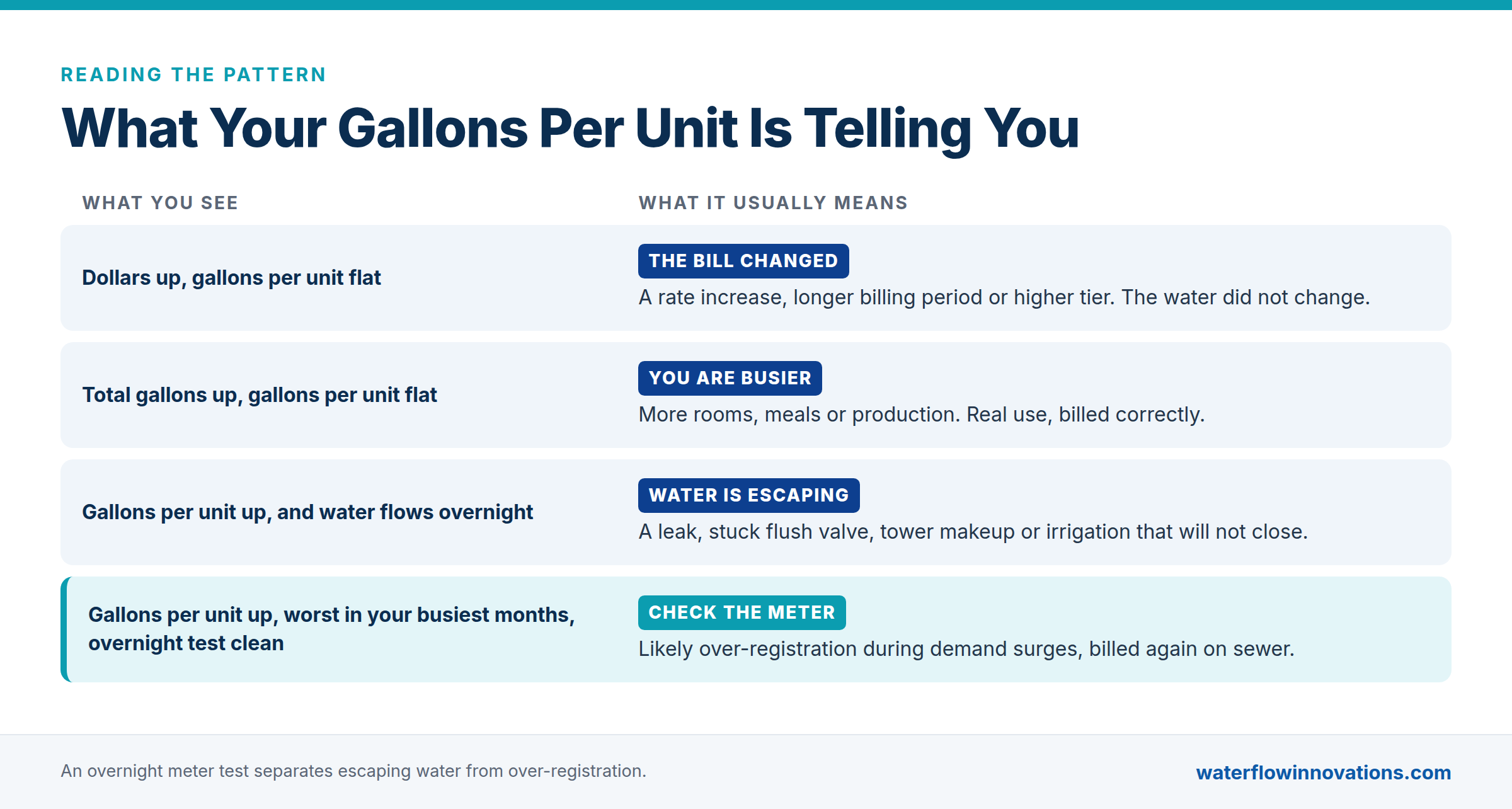
A water bill’s total is built from things that have nothing to do with how much water you used: the rate per unit, fixed charges, the number of days in the billing period, and which pricing tier you landed in. A 32-day period after a 28-day period looks like a 14% jump with no change in use, and a mid-year rate increase does the same.
Even total gallons can mislead, because a busier month uses more water for honest reasons. What you want to know is whether you’re using more water for the same amount of work. That’s what gallons per unit tells you.
Step 1: Pick Your Unit
- Hotels: gallons per occupied room-night
- Apartments and senior living: gallons per occupied unit-day
- Restaurants: gallons per meal or cover served
- Car washes: gallons per car washed
- Laundromats: gallons per machine cycle
- Manufacturing and food processing: gallons per unit or pound produced
- Schools: gallons per student-day
- Offices: gallons per occupied workday
You probably already track the activity number for other reasons. The water number comes straight off the bill.
Step 2: Calculate It
Convert the billed volume to gallons first. CCF and HCF are both 100 cubic feet, or 748 gallons; some utilities bill per 1,000 gallons. Then divide by the activity in the same billing period.
Example: a 180-room hotel at 72% occupancy over a 30-day period has 3,888 occupied room-nights. Its bill shows 1,350 CCF, which is 1,009,800 gallons, or about 260 gallons per occupied room-night. If the same month last year was 228, water per room-night is up about 14% for the same work. That gap is the question worth answering.
Try It: Gallons Per Unit Tracker
Gallons Per Unit Tracker
Enter one billing period. Add last year's number to see the change. Your numbers stay in your browser unless you download a report.
CCF and HCF are 100 cubic feet (748 gallons). For a fair comparison, use the same unit of activity every month.
Step 3: Read the Pattern
Why Over-Registration Shows Up in Your Busiest Months
Over-registration happens during demand surges, when valves snap open, pumps start, or many fixtures run at once. Water speeds up through the meter and pressure inside it drops. Dissolved gas comes out of solution and vapor forms, and the meter, which measures volume, counts that volume as water. More activity means more surges, so the over-count grows fastest in your busiest months, which is why gallons per unit drifts up at peak.
On most commercial accounts the sewer charge is calculated from the same meter reading, so every over-counted gallon is billed twice. See Sewer Double-Impact Billing.
What Pushes a Commercial Meter High
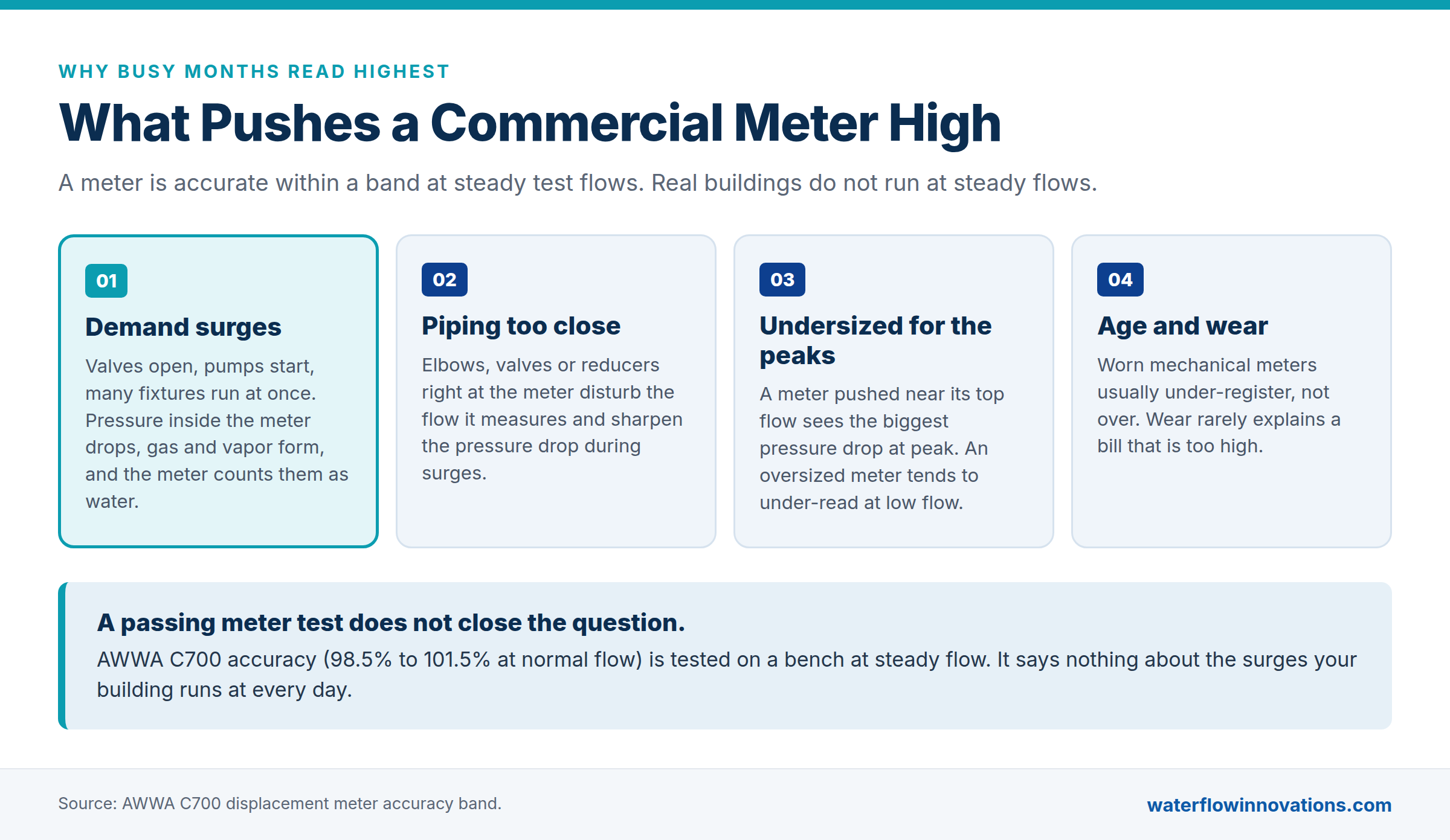
Worn mechanical meters usually under-register, and an oversized meter tends to under-read at low flow, so neither explains a bill that’s too high. A passing test doesn’t settle it either. See My Meter Passed Its Test.
What to Do With the Number
- Track it monthly: billing days, billed gallons, activity, gallons per unit, and the same month last year.
- When it climbs, run the overnight test before calling anyone.
- If the overnight test is clean, model your building in the free Water & Sewer Savings Calculator, or send us twelve months of bills for a free review.
If the cause is over-registration, the Flow Conditioning Device (FCD) installs immediately after the meter and creates a small, controlled back-pressure that extends back through it, holding pressure up during demand surges so far less gas and vapor form and are counted. Pressure loss is under 0.8 psi, nothing downstream changes, and it doesn’t reduce the water you use; it corrects what the meter records. Documented installations typically show up to a 30% reduction in water and sewer costs (46% highest documented), starting on the next full billing cycle. Once it’s installed, gallons per unit is the simplest way to see the correction on your own bills.
Common Questions
What is gallons per unit?
Why not just compare the dollar total?
How do I convert CCF to gallons?
My gallons per unit went up. Is it a leak?
Why would over-registration be worse in busy months?
Does tracking gallons per unit lower my bill?
Find Out What Your Gallons Per Unit Is Hiding
Send twelve months of bills plus your activity numbers (occupancy, covers, or production) and your meter make, model, and size. We’ll show you whether your meter is over-registering and what it’s costing you.