
Bigger Meter or Smaller Meter? How Meter Size Changes Your Water Bill
Direct answer: A bigger water meter lowers over-registration, because the same water moves more slowly through it, but it usually raises your fixed monthly charge (a 3-inch or 4-inch meter's charge is often two to three times that of a 2-inch meter) and adds one-time upsizing costs. For most buildings, the lowest total water and sewer bill comes from keeping a meter that's correctly sized for peak demand and adding a Flow Conditioning Device (FCD) immediately after it, which corrects the over-registration without the higher fixed charge.
Same Water, Different Meter, Different Bill
Picture your building’s busiest moment: 150 gallons per minute flowing in. The building uses exactly the same water no matter which meter it flows through. What changes is how fast the water has to move to get through the meter, and that changes how much the meter records.
| The same 150 gallons per minute through a… | How fast the water moves | Pressure drop inside the meter | What it means for your bill |
|---|---|---|---|
| 2-inch meter | About 10 mph 14.3 feet per second | High: about 5 times the 3-inch meter | The most gas and vapor form, so the most over-registration. Lowest fixed charge. |
| 3-inch meter | About 4.5 mph 6.5 feet per second | Moderate: about one-fifth of the 2-inch | Less over-registration, but a fixed charge often about twice the 2-inch meter’s. |
| 4-inch meter | About 2.5 mph 3.8 feet per second | Low: about one-fourteenth of the 2-inch | Little over-registration, but a fixed charge often about three times the 2-inch meter’s, and it can miss small flows. |
Why speed matters so much: when water speeds up, pressure inside the meter drops, and the drop grows much faster than the speed. Twice as fast means about four times the pressure drop. More pressure drop means more dissolved gas comes out of the water and more vapor forms, and the meter counts all of it as water.
That’s why a bigger meter reduces over-registration, and why it isn’t free: you pay for it in a higher fixed charge every month. The FCD gives you the lower reading without the bigger meter.
The Trade-Off
Every building has three choices. Here is how they compare.
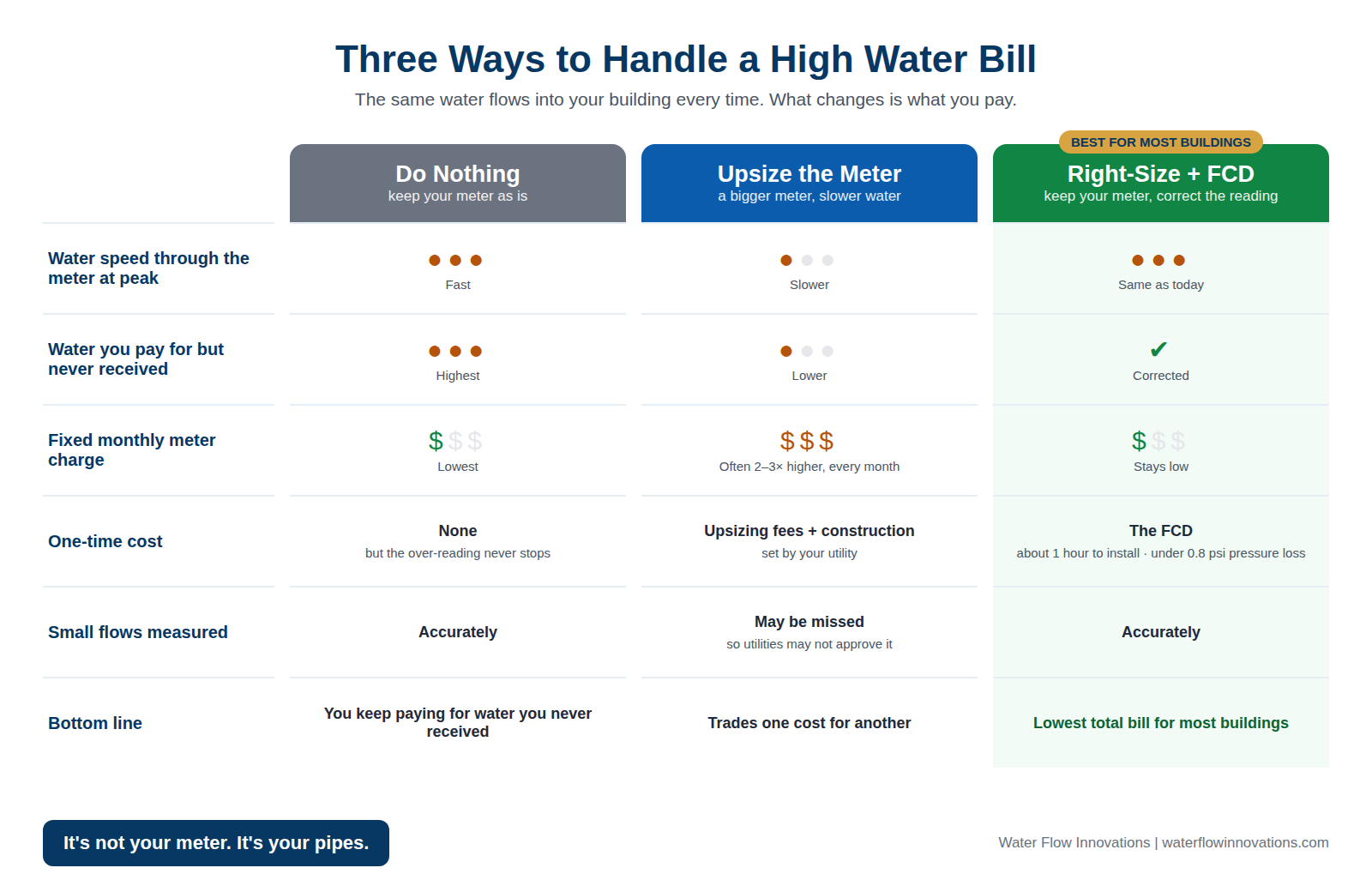
1. Do nothing
Keep your meter as is.
- Lowest fixed monthly charge
- Measures small flows accurately
- But the meter keeps over-registering at peak, so you keep paying for water you never received
2. Upsize the meter
A bigger meter, so the water moves slower.
- Less over-registration
- A higher fixed charge every month. Compared with a 2-inch meter, a 3-inch meter’s fixed charge is often about twice as much, and a 4-inch meter’s about three times as much.
- One-time upsizing fees and construction, set by your utility
- May miss small flows, so utilities may not approve it
3. Right-size the meter + add the FCD
Best for most buildings.
- Keep a meter sized for your peak demand, and its lower fixed charge
- The FCD, installed immediately after the meter, holds pressure up through it during surges, so far less gas and vapor are counted as water
- About 1 hour to install, under 0.8 psi pressure loss, and a 6-month money-back guarantee, no questions asked
Compare Meter Sizes for Your Building
Enter a few numbers from your bill. The tool compares your current meter with the sizes around it: how each fits your peak flow, the velocity and over-registration at each size, fixed charges, and total monthly cost with and without the FCD. If you’ve already used our Savings Calculator, your building details fill in automatically.