Home »
Why Your Water Bill Is So High, and Why It’s Correctable
Up to 30%
46%
Under 0.8 psi
6-Month
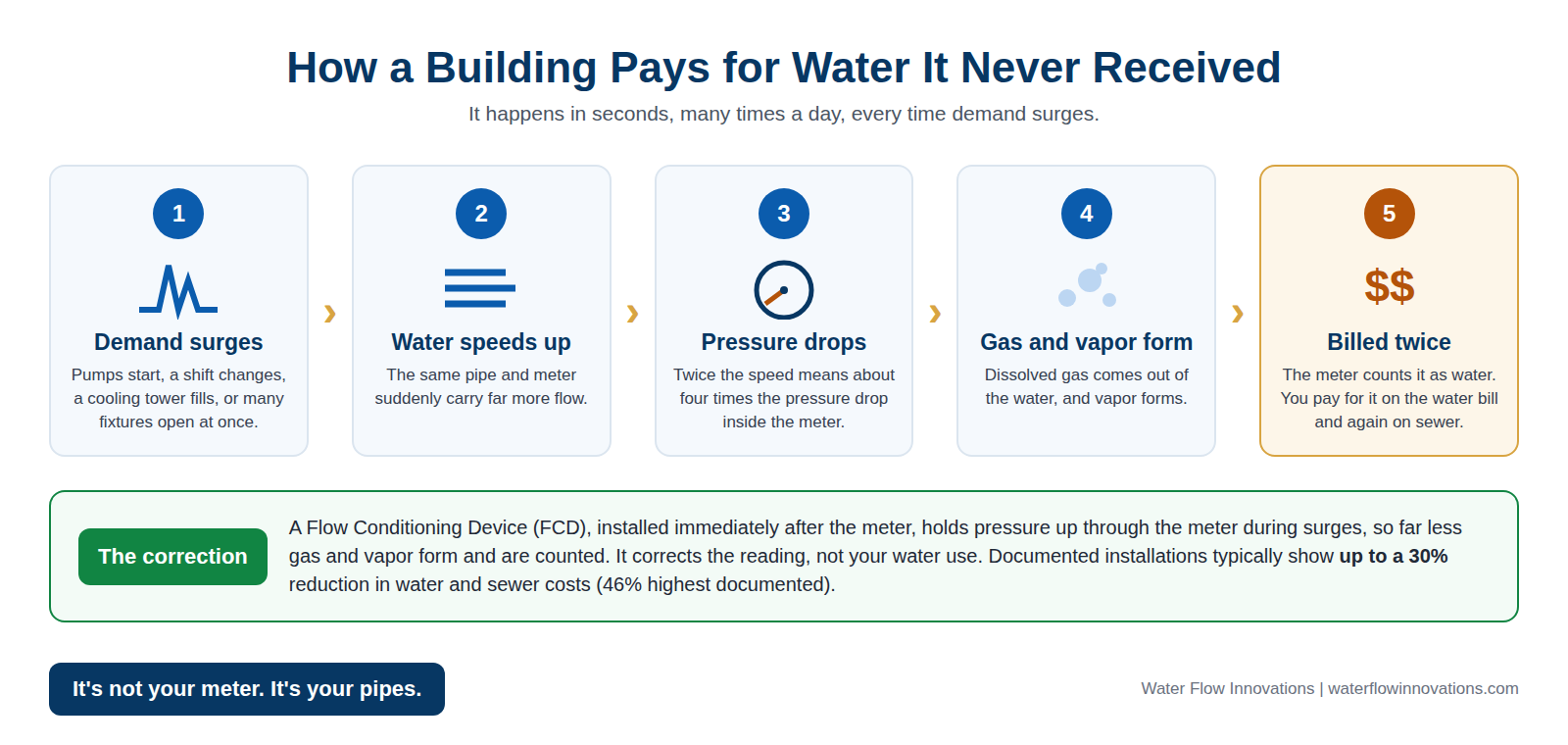
Direct answer: Many commercial water bills are high because the meter records more than the building receives. During high-demand surges, water speeds up through the meter, pressure inside it drops, dissolved gas comes out of solution, and vapor forms. The meter counts that volume as water, and the utility bills it twice, once for water and again for sewer. It's correctable: a Flow Conditioning Device (FCD) installed immediately after the meter holds pressure up during surges, and documented installations show up to a 30% reduction in water and sewer costs.
It’s Probably Not What You Think
Most building owners check the usual suspects first. They’re worth ruling out. But when the bill stays high after you have, the cause is often in the pipes around the meter.
“We must have a leak.”
Leaks are worth checking, and a leak shows up as steady flow around the clock, even at night. If your building is quiet overnight and the bill is still high, the extra volume is coming from somewhere else. Run the overnight meter test.
“We’re just using more water.”
If the bill climbs faster than your occupancy, production, or operating hours, usage alone doesn’t explain it. Over-registration grows with how hard and how often water surges through the meter, not only with how much you use.
“The rates went up.”
Rate increases raise the price per gallon. They don’t explain a meter recording more gallons than your activity suggests, and they make every over-read gallon more expensive.
“Then the meter must be broken.”
Usually it isn’t. Meters are tested with steady water on a bench, where they’re accurate. In service, they count whatever passes through, including gas and vapor during demand surges. A meter can pass its test and still over-register.
What’s Really Happening at Your Meter
A water meter counts volume. It can’t tell water from what’s mixed into it. When demand surges, from booster pumps starting, a shift change, a cooling tower filling, or many fixtures opening at once, water speeds up through the meter. Pressure inside the meter drops, and pressure drop rises with the square of velocity, so doubling the speed roughly quadruples the drop.
As pressure falls, dissolved gas comes out of solution and vapor forms. Meters count that volume as water. Your utility bills it as water, and usually bills it again as sewer.
Nobody is doing anything wrong. The meter works as designed, and the utility bills what the meter records. The cause is the conditions in your pipes.
Sounds Too Good to Be True? Here’s the Evidence.
Skepticism is reasonable. So here’s what the correction is, what’s been measured, and what happens if it doesn’t work for you.
The reading
It corrects what the meter records, not your usage
The FCD doesn’t change how much water your building uses. Installed immediately after the meter, it creates a small, controlled back-pressure that extends back through the meter, holding pressure up during surges so far less gas and vapor form.
35% → 2%
Independent laboratory test
In an independent laboratory test that sent gas and water through a meter, simulating conditions after a water main break, meter error fell from about 35% to about 2% with the device installed.
6 months
Money-back guarantee
No questions asked (installation is non-refundable). Savings show up on the next full billing cycle, so you can compare bills well within the guarantee period.
Verified results from real buildings
| Facility | Meter | Bill reduction | Measured over | How it was measured |
|---|---|---|---|---|
| Commercial facility | 2″ | 46.5% | 92 days | IPMVP measurement & verification |
| Commercial facility | 2″ | 33.6% | 121 days | IPMVP measurement & verification |
| Hospital | Two meters | 20.3% | 125 days | Utility bill comparison |
| Commercial facility | 4″ line | 19.7% | 17 billing periods | IPMVP measurement & verification (sustained average) |
| Commercial facility | 3″ | 16.5% | 122 days | Same-season comparison, IPMVP |
| Apartment community, 305 units | Two meters | 16% | Monthly bills | Utility bill comparison |
| Apartment community | — | 14.1% | 12 months | Utility bill comparison |
| Commercial facility | 1.5″ | 13.0% | Winter, season-matched | Same-season comparison, IPMVP |
| Hospital | — | 12% | Multi-year bills | Engineer-signed evaluation |
Results are from documented installations of the same device, measured from utility bills or under the IPMVP measurement and verification protocol, with seasonal and occupancy adjustments where noted. Facility names are withheld for client privacy. The middle result is about 16%; individual results depend on each building’s flow pattern, meter, and pressure.
Want to see the physics yourself? Our “See It for Yourself” blog series walks through everyday experiments that show gas coming out of water when pressure drops.
Check Your Building in Three Steps
Free, no contact information needed to see your results.
1
Over-Reading Scorecard
Establish the documented baseline before the correction — water and sewer both, itemized if your utility separates them.
2
Water & Sewer Savings Calculator
Your 24-hour flow profile, estimated bill reduction, payback, and 5-year savings.
3
NOI & Property Value Calculator
What those savings add to net operating income and property value.
Should We Just Get a Bigger Meter?
It’s a fair question. The same volume moves more slowly through a larger meter, so over-registration drops. But it comes with trade-offs.
Keep the smaller meter
- Lower fixed monthly meter charges
- Higher velocity at peak, so more over-registration
Upsize to a larger meter
- Lower velocity, so less over-registration
- Much higher fixed monthly charges, every month
- One-time upsizing, capacity, and construction costs
- Can under-register small flows, so utilities may resist it
Right-size the meter, then add the FCD
- Keep the meter that’s correctly sized for your demand and its lower fixed charges
- Correct the over-registration that high velocity causes
Common Questions
Is my water meter broken?
Why haven't I heard of meter over-registration before?
How much can a building really save?
Does the FCD reduce water pressure or water use?
Will my water utility object?
What if it doesn't work for our building?
Find Out What Your Building Is Really Using