
Quick answer
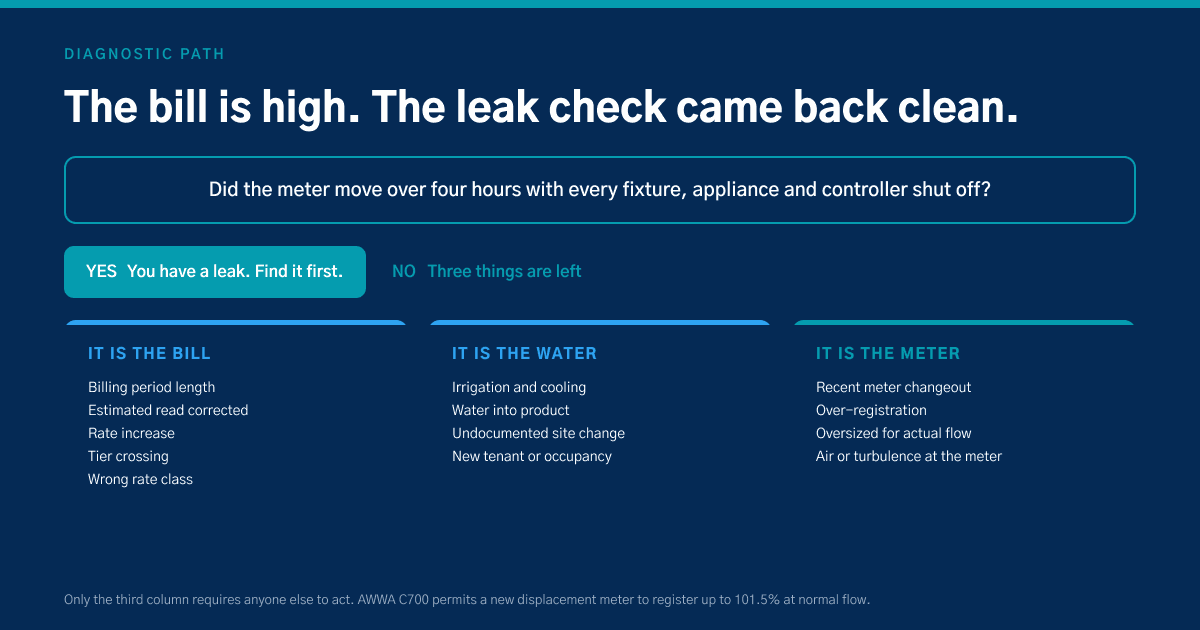
If you have already checked the toilets, the faucets, the water heater and the irrigation and the bill is still high, you have eliminated the causes that every article covers. What is left falls into three groups. Water is leaving your property somewhere you have not looked, the bill is not measuring what you think it is measuring, or the meter reading is wrong.
That last group is real, it is measurable, and it is regulated. Under AWWA C700 a new displacement meter is only required to register within 98.5 to 101.5 percent at normal flow, and Wisconsin requires a utility to recalculate bills once a displacement meter registers above 102 percent. Here are the eight causes worth checking after the leak hunt comes up empty.
Was your leak check actually conclusive?
Most leak checks fail for the same two reasons. They do not run long enough, and they do not isolate everything.
Before you move past leaks, run this properly once.
CheckThe four-hour isolation test
- Shut off every water-using device. Ice makers. Humidifiers. Water softeners, which can sit in a regeneration cycle for over an hour. Irrigation controllers, including the rain-delay ones that still run. Evaporative coolers. Any process equipment on a timer.
- Record the full meter reading including the low-flow indicator, which is usually a small triangle, star or gear.
- Leave it four hours, ideally overnight.
- Read it again.
Four hours, not fifteen minutes. A leak small enough to be invisible is also small enough to be invisible over a short test.
If the meter moved, you have a leak and the rest of this page does not apply yet. Find it first.
If the meter did not move, keep reading. The eight causes below are what remains.
The two leaks a four-hour test finds but a walkthrough never will
If the meter moved, before you start pulling apart fixtures, narrow it to one of two places.
Close the main shut-off valve at the building and re-test. If the meter still moves with the building isolated, the loss is between the meter and the building. That is an underground service line leak, and there is usually nothing to see. The water follows the trench or the bedding and surfaces somewhere else, or nowhere at all. On a commercial service that run can be long, and the volume can be substantial before anyone notices.
If the meter stops when you isolate the building, the loss is inside. Where there is no visible water and no damp, look at slab leaks. Signs are a warm patch on a floor, a water heater or boiler running more than it should, a faint sound of running water with everything off, or an unexplained drop in pressure. Slab leaks under a poured floor can run for a long time without ever producing a visible sign.
Neither of these shows up in a walkthrough. Both show up in a four-hour meter test.
For context on scale: EPA WaterSense puts average household leak losses at 180 gallons a week, or 9,400 gallons a year, and toilets account for close to 30 percent of indoor water use even when working correctly.
What causes a high water bill when there is no leak? Eight answers
1. The billing period changed length
A bill covering 34 days will be higher than one covering 28, and nothing about your water use changed.
CheckCost per day across six bills
Find the service period dates on the last six bills. Calculate cost per day. If cost per day is flat and only the total moved, you are done. It is the fastest check on this page and it takes two minutes.
2. The read was estimated and then corrected
When a meter cannot be read, most utilities estimate. Those estimates are usually conservative. When an actual read finally happens, the accumulated difference lands in one bill.
CheckLook for the estimate flag
Look for an “E”, “EST” or “estimated” marker on recent bills, often in small print beside the reading. A run of estimates followed by an actual read produces exactly the pattern of a bill that appears out of nowhere.
3. The rate went up, and by more than you would guess
Bluefield Research tracks rates across utilities in 50 US cities representing roughly 20 percent of the population. In 2025 combined household water and sewer bills rose 5.1 percent in a single year, the largest annual increase in five years. Water alone rose 6.0 percent. Across five years the cumulative rise reached 24.2 percent. Between January 2000 and December 2025, prices for water and sewer service rose 207 percent while overall inflation rose 93 percent.
CheckApply both tariffs to the same volume
Get the current tariff and last year’s. Apply both to the same volume. If the gap explains the increase, the answer is rates.
4. You crossed a tier, or your rate class changed
Tiered pricing means the marginal unit costs more than the average unit. Crossing a threshold produces an increase that looks disproportionate because it is.
Rate class matters too. Utilities charge residential, commercial, industrial and institutional accounts differently. A building that changed use, changed owner, or was converted can sit in the wrong class for years.
CheckConfirm rate code and tier position
The rate code is on your bill. The tariff is on the utility’s website. Confirm both.
If the increase turns out to be rate-driven rather than volume-driven, the practical ways to bring the bill down are different from the ones people usually reach for.
5. Water is leaving the property without entering a drain
Irrigation. Evaporative cooling. Water incorporated into a product. Truck fill. Wash-down that discharges to storm rather than sanitary.
All of it registers on the meter. If your utility bills sewer volumetrically, all of it is also on your sewer charge, which is the more expensive half of the problem for most facilities.
CheckMap every point of use
List every point of use on the site and mark whether the water reaches the sanitary sewer. Anything that does not is potentially excludable through a deduct meter, an irrigation exemption, or a cooling tower evaporation credit.
6. Something on site changed and nobody recorded it
Occupancy. A new tenant. A process change. Equipment replaced with a less efficient unit. A cooling tower cycling harder through a hot month. A softener regenerating on a shorter interval than before.
CheckPlot 24 months and find the step
Consumption almost always steps rather than drifts. Find the month it stepped, then find what changed that month. If it drifts steadily upward, you are more likely looking at gradual mechanical wear somewhere, including possibly the meter.
7. The meter was recently replaced
A new meter frequently reads higher than the one it replaced, and the reason is not that the new one is wrong.
Mechanical meters wear, and worn meters generally under-register. A meter that has been in service 15 years may have been quietly undercharging you. Replace it and consumption appears to jump, when what actually happened is that billing caught up with reality.
If the meter appears to move when nothing is running, that is a separate diagnostic: the signs a meter is over-reading.
CheckGet the changeout dates and the removal test
Ask the utility for the install date of your current meter and the removal date of the previous one. If the increase starts at a changeout, this is the likely explanation. Ask whether the old meter was tested on removal, and ask for the test result.
8. The meter is registering more than passed through it
This is the cause no other page on this search result covers, and it is the one worth understanding properly.
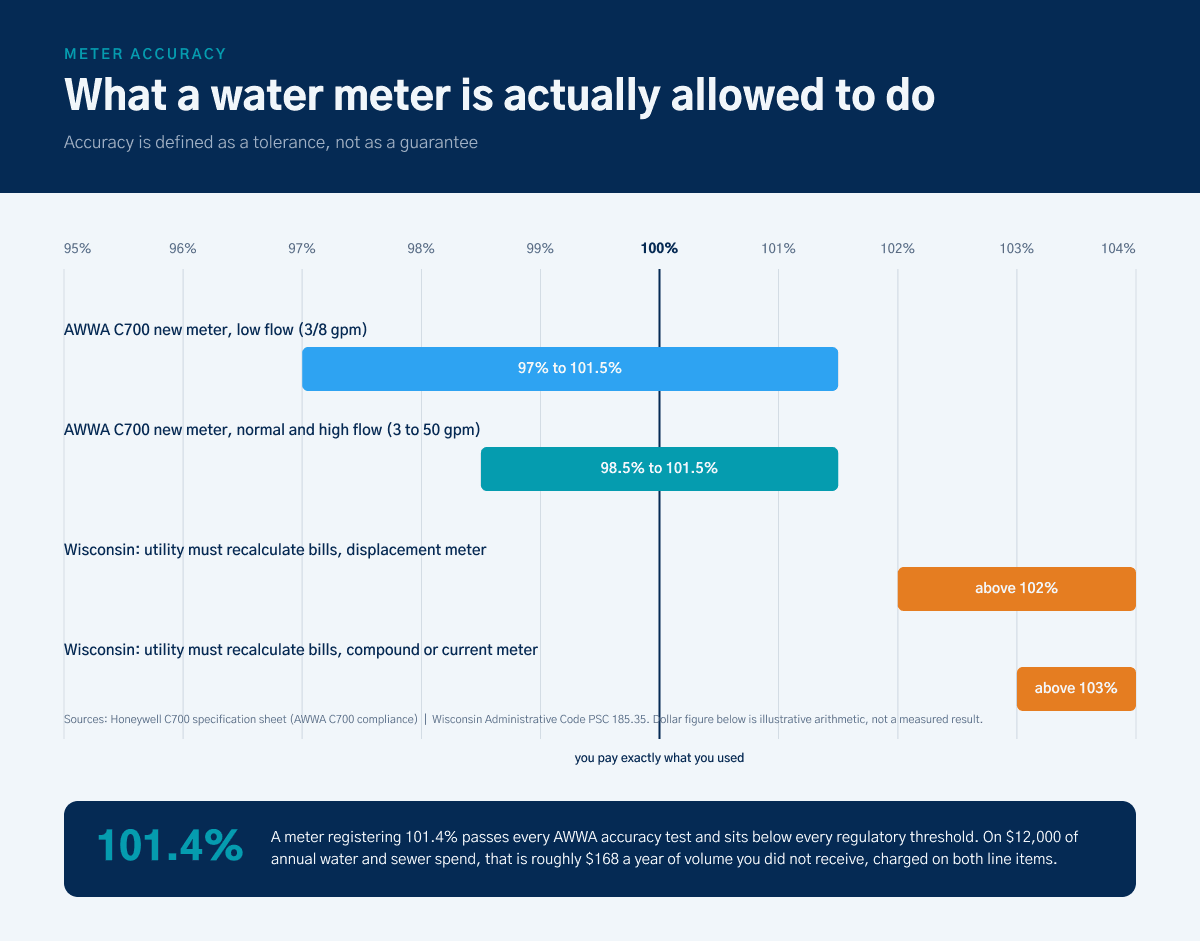
A water meter is accurate within a tolerance, not absolutely. Under AWWA C700, a new cold-water displacement meter is expected to register between 98.5 and 101.5 percent at normal and high flows, which for a residential meter means roughly 3 to 50 gallons per minute, and between 97 and 101.5 percent at the AWWA specified low flow of three eighths of a gallon per minute.
Note what that means. A meter tested at a flow rate your building never actually runs at has been verified against conditions that do not exist on your site.
Regulators define the point at which over-registration becomes actionable. In Wisconsin, a displacement meter registering above 102 percent, or a compound or current meter registering above 103 percent, obliges the utility to recalculate bills for the period of inaccuracy using the average percent error above 100. Where the recalculated overcharge exceeds $5 for a current customer, the full difference must be refunded. The rule also states that no backbill is permitted where a customer questioned the meter’s accuracy and the utility failed to check it within a reasonable time.
Flow conditions can affect what a meter records. In a 2010 complaint decision, the California Public Utilities Commission recorded a meter manufacturer’s confirmation that “the performance of a positive displacement water meter can be affected by the presence of air,” with possible effects including “over-registration of usage by the meter.”
Now the part that matters more than the quote. In that same case the customer’s complaint was largely denied. He received a $500 adjustment against a balance of $2,143.10, the utility’s testing found no air on its side of the meter, and the Commission ordered an independent engineering study to establish where the problem actually originated. Air can cause over-registration. Proving it at a specific installation requires site evidence.
Air, bubbles and turbulence caused by high velocity water flowing through a line cause a positive displacement meter to over-register, up to 46 percent in rare cases. All water meters over-register to some extent. But what really causes water meters to over-read is an “open-valve” situation, meaning water is being drawn at high velocity to satisfy demand. Turbulence, air and bubbles are generated in the water stream, they pass through the meter, and the meter counts them as water. The meter is not able to distinguish between the two.
Bottom line, your water bill goes up for water you are not using. This is the reason so many facilities have installed a Flow Conditioning Device, to prevent the meter from over-reading and to reduce overall water cost. In luxury high-rise and apartment buildings, to increase NOI.
How do you get a water meter tested, and what should you ask for?
Most utilities will test a meter on customer request. The fee is usually modest and often refunded if the meter fails. The City of New Haven, Indiana publishes a $30 fee. Fees vary by utility, so check your own tariff.
Requesting the test is the easy part. Getting a useful result requires asking better questions.
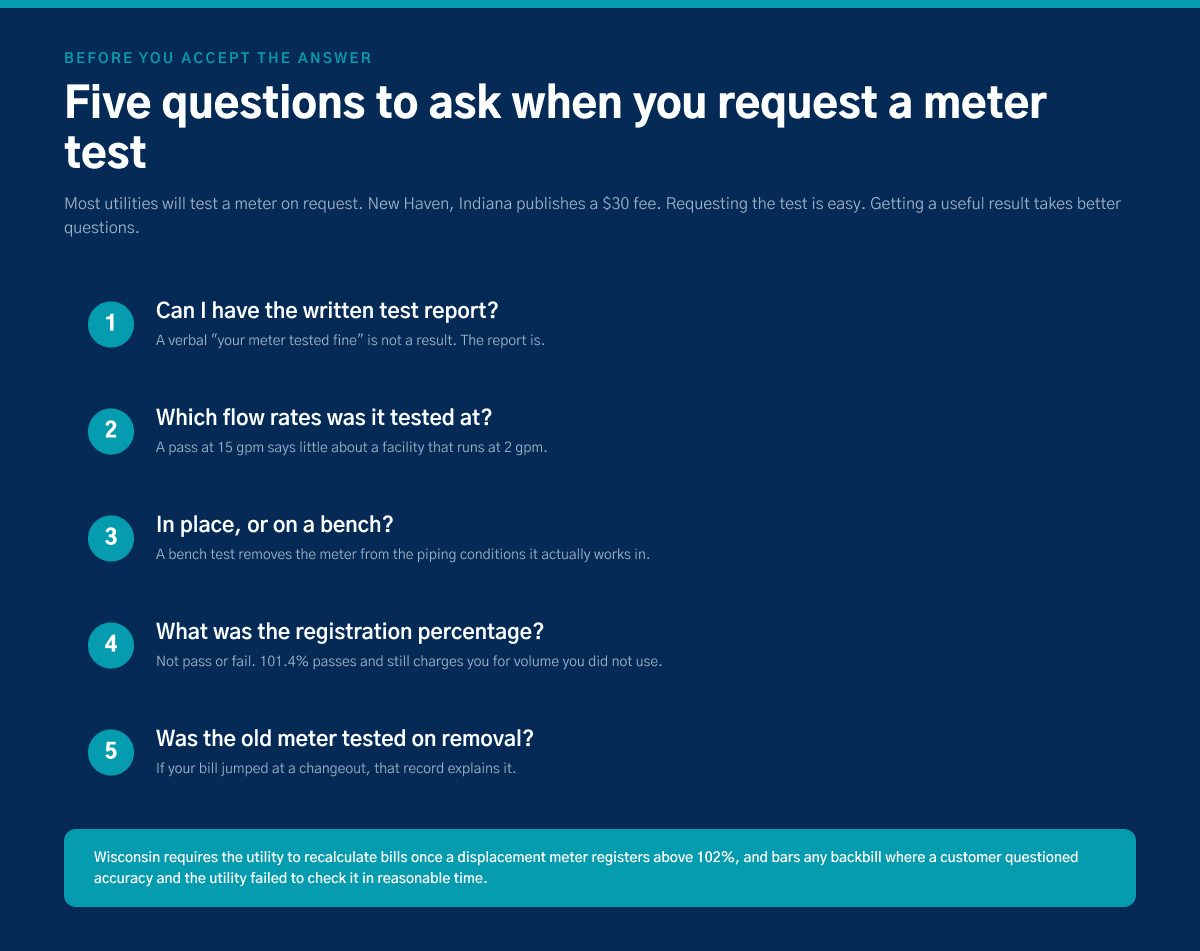
Ask for the test report, not the verdict. “Your meter tested fine” is not a result. The report is.
Ask which flow rates were tested. AWWA test protocols specify low, intermediate and high flow points. If your facility’s actual operating profile sits outside those points, a pass tells you less than it appears to.
Ask whether the meter was tested in place or on a bench. A bench test removes the meter from the piping conditions it normally operates in, which is exactly where flow-related effects would show up.
Ask what the meter’s registration percentage was, not just whether it passed. A meter at 101.4 percent passes. It is also charging you 1.4 percent more than you used, and if your utility bills sewer on the same reading, it is charging you 1.4 percent more twice.
Ask for the removal test if your meter was recently changed out. Utilities frequently test meters on removal. That record exists.
What should a commercial or industrial facility check that a homeowner cannot?
Meter sizing. Meters get specified for peak or fire-flow demand that the building never approaches in daily operation. A meter running most of the time at the very bottom of its range is operating where accuracy tolerance is widest, which is why compound meters exist at all. If your normal draw sits far below the meter’s rated range, sizing is worth reviewing.
Meter type. Displacement, compound, turbine and ultrasonic meters behave differently, particularly at low flow and during transients. Knowing which one you have changes what questions are worth asking.
Flow conditions at the meter. Open-discharge events such as tank filling, clean-in-place cycles, sprinkler testing and large draws create conditions at the meter that no residential service produces. Air entering the line after a shutdown or a main repair is a real phenomenon in commercial service. Whether it affects your registration is measurable.
Straight pipe run. Most meters have a manufacturer-specified minimum length of straight pipe upstream and downstream. Elbows, valves or reducers too close to the meter create turbulence at the measuring element. Check the installation against the manufacturer’s requirement.
The sewer multiplier. For most commercial accounts the sewer charge is the larger of the two line items and it comes off the same meter reading. Any registration error is therefore billed twice. That is the whole reason meter accuracy is worth a facility manager’s time when a 1.5 percent question would otherwise be ignorable.
What to do first, by property type
The order changes with size, because the cost of investigating has to be proportionate to what is at stake.
Single building, under 10 units. Four-hour meter test, then the billing checks. Cost per day across six bills will resolve most of these without anyone visiting.
10 to 100 units. Add rate class verification and tier position, because at this size a misclassification compounds every month. Confirm whether sewer is billed on metered volume or on unit count. If it is unit count, water-side work will not move the bill and the lever is the tariff.
Over 100 units, or any industrial site. Start with the meter, not the fixtures. Meter sizing, meter type and flow profile determine whether the number the whole bill is built on is correct. Everything downstream of a wrong reading is wasted effort. Pull interval data if the utility has AMI, and look at what the meter records overnight when the building should be near zero.
Multi-site portfolios. Compare cost per unit of production, per square foot or per occupied unit across sites on the same tariff. The outlier site tells you where to look, and it is a faster diagnostic than auditing all of them.
Why is my sewer bill so high? Nine causes and how to check each one
What order should you work through this in?
- Run a four-hour meter test with everything isolated. Rules leaks in or out.
- Compare cost per day across six bills. Rules out billing period.
- Check for estimated reads. Rules out correction artefacts.
- Compare this year’s tariff to last year’s at equal volume. Rules out rate change.
- Confirm rate class and tier position against the tariff.
- Plot 24 months of consumption and find the step.
- Check whether the meter was changed out, and when.
- Request a meter test, and ask the five questions above.
Work it in that order. Each step is cheap, and each one either finds the answer or narrows what is left.
Frequently asked questions
The most common answers are a longer billing period, a corrected estimated read, a rate increase, or a tier crossing. If none of those apply, the remaining possibilities are water leaving the property without reaching a drain, an undocumented change in on-site use, a recent meter changeout, or the meter registering more volume than actually passed through it.
Isolate every water-using device, record the meter including the low-flow indicator, wait at least four hours, and read again. Any movement confirms flow. To locate it, shut the main valve at the building and re-test. If the meter still moves, the loss is between the meter and the building, which usually means an underground service line.
Either water is being used somewhere you have not accounted for, or the meter is over-registering. Meters are accurate to a tolerance, not absolutely. AWWA C700 allows a new displacement meter to register up to 101.5 percent at normal flow. Wear, installation conditions, sizing, and air in the line can all affect registration. A utility meter test will establish the actual figure.
Yes, within limits that are defined and regulated. A meter registering above its allowed tolerance obliges the utility to correct the bill in many jurisdictions. Wisconsin sets that threshold at 102 percent for displacement meters and 103 percent for compound and current meters, and requires refunds where the recalculated overcharge exceeds $5.
It can. A meter manufacturer confirmed to the California Public Utilities Commission that the performance of a positive displacement meter can be affected by the presence of air, including over-registration. Establishing that it is happening at a specific meter requires site evidence, and in the case where that statement was recorded, the customer’s complaint was largely denied for lack of it.
Typically a modest flat fee, often refunded if the meter fails. New Haven, Indiana charges $30. Check your utility’s tariff or call customer service, and ask for the written test report rather than a verbal result.
Get the reading checked properly
Water Flow Innovations reviews water and sewer billing for commercial, industrial and multifamily properties. Send 12 months of bills plus your meter make, model and size, and we will tell you what the data shows. That includes telling you when the billing is correct and the meter is accurate, which is sometimes the answer.
Request a bill and meter review Water Bill Savings CalculatorSources: Honeywell C700 specification sheet (AWWA C700 compliance) · Wisconsin Administrative Code PSC 185.35 · CPUC Decision, complaint C.10-05-012 · EPA WaterSense · Bluefield Research US water and wastewater rate index 2025 · City of New Haven, Indiana meter test fee schedule.
Water Flow Innovation LLC, 2651 Route 412, Coopersburg, PA 18036. Call 1-844-934-8258.
0 Comments